



Nigerians should ignore the fictitious mock election figures published by an organisation that claimed to be working with the Independent National Electoral Commission (INEC).
On Saturday, INEC, in preparation for the 2027 election, conducted a mock election in two polling units in each ward nationwide. With 8,809 wards and 176,846 polling units nationwide, the exercise covered just 17,618 polling units, representing approximately 10 per cent of the total.
The mock poll also tested the efficacy of INEC ‘s Bimodal Voter Accreditation System (BVAS). The ballot papers used during the exercise did not feature the names or logos of political parties. Instead, options such as “AQUA”, “BLUE”, “COAL”, “CYAN” and “GOLD” were used. INEC declared no winner or loser.
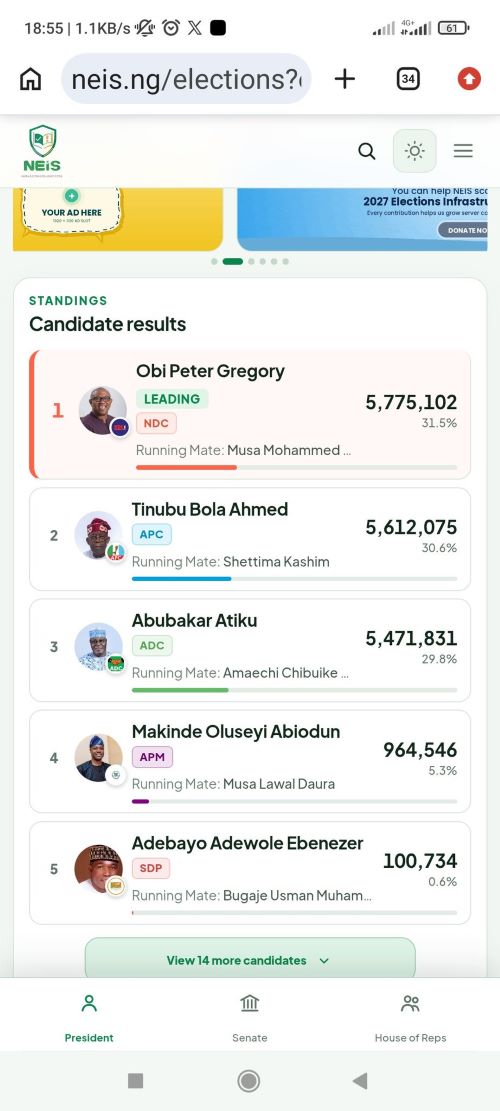
In a surprising turn, the Nigeria Election Intelligence System (NEIS), a pro-National Democratic Congress (NDC) and pro-Peter Obi organisation, published figures purportedly from INEC claiming that Peter Obi led the mock poll with more than five million votes.
The figures are totally the imagination of NEIS, fraudulent and meant to mislead the public.
First, INEC has never announced election results through a third party. Under Nigeria’s electoral law, the commission is responsible for announcing official election results. So, on what basis and under whose authority is NEIS presenting these figures as election results?
How did NEIS arrive at figures for the APC, NDC, ADC and other political parties when none of them featured on the ballot papers?
After the exercise, INEC did not collate or announce any results at the polling unit, ward, local government, state, or national levels. If the commission did not collate results, where did NEIS get the figures it claims to have recorded?
How did NEIS arrive at more than 17 million votes from an exercise that covered only about 10 per cent of the country’s polling units?
Finally, NEIS itself describes the process on its website as a “simulation”. Yet, it appears to have presented the figures generated from the exercise as though they were actual election results.
If the exercise was merely a simulation, the figures should not be mistaken for a genuine representation of voters’ preferences.
Rather than a reliable attempt to gauge the country’s political mood, NEIS’s claim appears to be an online political game designed to attract attention, engagement and traffic.
Citizens should therefore ignore the figures published by NEIS and avoid interpreting them as an indication of the likely outcome of the 2027 general elections.
The Obidient movement may choose to celebrate NEIS and its phantom figures, but such celebrations should not be confused with an actual electoral victory or evidence of nationwide support.
Nigerians should take note of our previous warnings and alerts about the devious plots of opposition elements to manipulate public opinion through fake news, AI-generated images, discredit the electoral process, and delegitimise INEC in order to force a predetermined electoral outcome.
Dele Alake
Spokesperson, APC Presidential Campaign Council
November 29, 2026