
Following the Central Bank of Nigeria’s directive to harmonize exchange rates and the subsequent spike in the dollar-to-naira rate—reaching over ₦1,600/$1 in official markets— Nigeria’s commercial banking, ride-hailing, and telecommunications sectors demonstrated media resilience in Q1 2025.
This is the key insight from a comprehensive sentiment audit by P+ Measurement Services, Nigeria’s foremost media intelligence consultancy, which analysed over 1.3 million online publications and 2,100 print media articles locally and globally during the period.
Leveraging advanced media intelligence frameworks, the Q1 2025 analysis encompassed data from 28 commercial banks, 4 major telecommunications providers, and 4 leading ride-hailing platforms.
The study deployed rigorous monitoring, measurement, and auditing techniques, drawing from structured metadata points such as editorial tone, CEO visibility, public discourse, and brand-specific media traction.
By quantifying sentiment across these variables, the analysis offers a strategic lens into how media narratives—beyond operational milestones—are actively shaping brand trust, credibility, and relevance across Nigeria’s core economic sectors.
Commercial Banks: Visibility, Trust and Turbulence
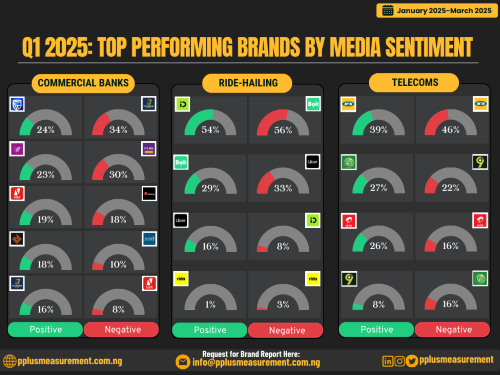
Q1 media sentiment around Nigeria’s banks showed a polarity in perception. Stanbic IBTC Bank emerged as the frontrunner in positive coverage, responsible for 24% of favorable sentiment across the industry. Wema Bank (23%), UBA (19%), Access Bank (18%), and First Bank (16%) followed closely.
Their visibility was supported by initiatives such as Wema Bank’s 80th anniversary campaign and UBA’s ₦41 million customer reward promo.
However, First Bank, while present in positive narratives, also carried the burden of 34% of all negative sentiment. FCMB (30%), Sterling Bank (18%), and Ecobank (10%) followed, driven by litigation, regulatory reprimands, and negative market performance.
These data points indicate that while strategic PR efforts amplified brand equity for some, crisis events significantly dampened sentiment for others.
Ride-Hailing: Innovation Meets Scrutiny
Among ride-hailing operators, inDrive dominated favorable mentions at 54%, aided by product enhancements like the “Light Cashless” bank transfer feature. Bolt (29%) and Uber (16%) also maintained a strong share of voice.
Yet, sentiment was bifurcated. Bolt attracted 56% of all negative coverage, largely due to safety concerns and regulatory backlash. Uber followed with 33%.
Media narratives were significantly influenced by driver protests, public safety incidents, and the call for federal-level e-hailing regulations. These contributed to rising brand scrutiny despite aggressive service innovation.
Telecoms: Leadership in Spotlight, Policy Driving Talkability
In telecommunications, MTN Nigeria led positive sentiment at 39%, with Airtel (27%) and Globacom (26%) closely trailing. MTN’s “Go M.A.D” youth empowerment initiative stood out, as did Globacom’s roll-out of SIM-less eSIM technology.
Yet, MTN also bore the brunt of negative sentiment 46%, fueled by union threats and consumer backlash over tariff adjustments. A turbulent leadership transition at Globacom and an ongoing ownership saga at 9mobile contributed to reputational headwinds.
Notably, telecoms media narratives in Q1 were driven as much by policy shifts and service upgrades as they were by instability and consumer rights activism.
The Media Intelligence Lens: Contextualising Sentiment Drivers
From an analytical standpoint, the divergence between positive and negative sentiment reflects not just brand activity, but the underlying media mood — a composite of how editors, commentators, and the public receive and interpret brand behavior in context.
In banking, initiatives tied to financial inclusion, brand legacy, and public goodwill increased positive talkability. Conversely, regulatory breaches, fraud allegations, and legal entanglements skewed perception negatively, reinforcing the classic PR principle: “Silence in crisis equals narrative surrender.”
For ride-hailing, product enhancements were insufficient buffers against public safety crises, a trend increasingly important in a media environment where social proof, particularly from user-generated forums and review sites, plays a strong role in shaping brand trust.
Telecommunications brands faced media volatility as regulatory pricing interventions and leadership instability challenged perception management. Here, media responsiveness and spokesperson effectiveness proved critical in determining how well brands navigated the sentiment curve.
Conclusion: Media Presence ≠ Media Health
As Q2 unfolds, the Nigerian media terrain will likely remain sensitive to leadership decisions, regulatory policy, customer experience, and public safety across sectors.
This Q1 analysis reinforces the idea that media presence, while important, must be accompanied by brand media health management, the strategic balancing of visibility, credibility, and sentiment.
For stakeholders, from investors and regulators to brand custodians and PR strategists, these insights form a crucial foundation for navigating reputational capital in an era where perception can often outweigh performance.
About P+ Measurement Services
A leading AMEC member and Nigeria’s foremost independent media intelligence consultancy, P+ Measurement Services provides near real-time media monitoring and retrospective PR performance audits to public and private sector organisations.
Their expertise spans media monitoring, sentiment analysis, PR audits, and reputation tracking across Nigeria’s key economic sectors.