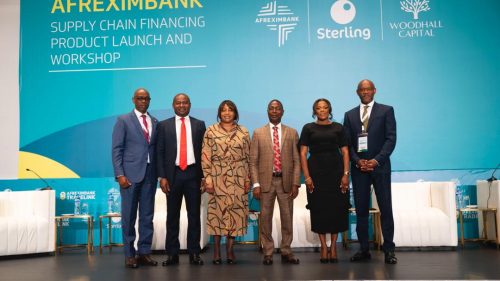

Mr. Henry Shofowora, Chief Operating Officer (COO) Woodhall Capital Limited; Mr. Eric Intong Monchu, Regional Chief Operating Officer, Anglophone West Africa, Afreximbank; Mrs Gwen Mwaba, Director & Global Head, Trade Finance & Acting Director and Global Head, Client Relations, Afreximbank; Mr. Abayomi Arogundade, Director of the Other Financial Institutions, Supervision Department, Central Bank of Nigeria( CBN) , Representing Dr. Olayemi Cardoso, CBN Governor; Mrs. Mojisola Hunponu-Wusu, Founder Woodhall Capital Limited and Mr. Adegboyega Festus – Chief Executive Officer (CEO) Woodhall Capital Limited.
Afreximbank and Woodhall Capital recently hosted a successful one-day workshop on Supply Chain Finance and Factoring in Nigeria.
The event, which convened Corporates, Financial Institutions and Sovereigns, served as a platform to explore the opportunities and challenges within the Payables Finance Industry in Africa’s biggest economy.
The workshop was well attended by industry stakeholders, among them the key guests – Mrs. Folasade Ambrose-Medebem, Honorable Commissioner for Trade and Investment in Lagos and Mr. Abayomi Arogundade representing Dr. Olayemi Cardoso, The Governor of the Central Bank of Nigeria. The workshop was followed by a joint launch of the innovative Payables Finance product, branded as ‘Afreximbank Tradelink’ in partnership with Sterling Bank.
The introduction of Payables Finance is the next stage on Afreximbank’s roadmap to promote Supply Chain Financing in Africa. The Bank currently provides US Dollar and Euro financing across Africa and plans similar partnerships in other African countries while incorporating local currencies.
The workshop provided a platform for corporates and banks to gain insights into the benefits and applications of supply chain finance and factoring. Through informative sessions and interactive discussions, participants had the opportunity to explore practical strategies for leveraging these financial solutions to optimize working capital management and drive business growth.
The Governor of the Central Bank of Nigeria, Mr. Olayemi Cardoso, represented by Mr. Abayomi Arogundade, Deputy Director of the Other Financial Institutions, Supervision Department highlighted the significance of the workshop, he emphasised the ongoing collaboration, particularly in establishing regulatory frameworks for factoring. Both institutions are committed to exploring regulatory measures to support the development of supply chain finance.
Mrs. Mojisola Hunponu-Wusu, founder of Woodhall Capital, asserted to the Central Bank of Nigeria, the unwavering support of financial institutions towards the receivables financial industry, underscoring its growing visibility.
“We are thrilled by the overwhelming response to the workshop,” said Adegboyega Festus, Chief Executive Officer at Woodhall Capital.
“The presence of esteemed guests from Lagos State and The Central Bank of Nigeria, such as Mrs. Folasade Ambrose-Medebem, further highlights the importance of collaboration in advancing the payables finance industry in Nigeria. We believe that by equipping businesses and financial institutions with the knowledge and tools they need to navigate the complexities of supply chain finance and factoring, we can contribute to the sustainable development and growth of the African economy. “
Participants engaged in insightful discussions, sharing expertise and strategies to navigate the evolving landscape of Supply Chain Finance.
From identifying innovative financing solutions to addressing regulatory considerations, the workshop provided valuable insights for attendees to enhance their operations and seize new opportunities in the marketplace.
Woodhall Capital is a leading financial advisory firm that has raised over $5 billion from various funding sources across the globe. The funds have been raised to support local financial institutions, multinationals and conglomerates operating in various economic sectors in Nigeria and across Africa.
Afreximbank has been a pioneer in providing lines of credit to support and promote factoring across the continent through its Factoring Working Group.