Equities Market Extends Losses to Second Consecutive Session…NSE ASI Down 87bps

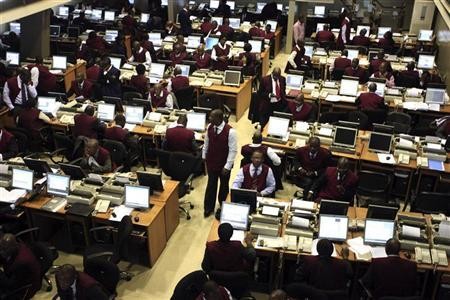
In line with the equities market correction currently being experienced across the developed markets, the Nigerian All Share index (ASI) extended losses into the second consecutive trading session, down 0.9% to close at 43,877.30 points while YTD return further moderated to 14.7%.

Accordingly, investors lost N138.2bn as market capitalization reduced to N15.7tn. Today’s negative performance is largely on account of broad based sell-offs across sectors, although banking stocks – ZENITH (-4.4%) FBNH (-5.2%), UBA (-2.4%) and GUARANTY (-0.7%) were the main drags on performance.

However, activity level strengthened as volume and value traded surged 68.0% and 77.5% to 717.2m units and N4.9bn respectively.

All Sectors Close in the Red
Sector performance was bearish as all indices closed in the red. The Banking index was the biggest loser, shedding 2.1% following price depreciation in market bellwethers – ZENITH (-4.4%), UBA (-2.4%) and GUARANTY (-0.7%).

The Industrial Goods index followed, falling 1.0% owing to losses in WAPCO (-1.1%) and CCNN (-0.8%) while the Insurance index declined 0.5% on the back of sell offs in MANSARD (-3.4%) and CUSTODIAN (-2.1%). Similarly, the Oil & Gas index slid 0.4% as MOBIL (-2.8%) and FORTE (-0.2%) closed lower while the Consumer Goods index shed 0.3% due to profit taking in UNILEVER(-4.4%) and FLOURMILLS (-4.7%).

Investor Sentiment Softens 
Investor sentiment as measured by market breadth (advance/decline ratio) softened to 0.4x from 0.6x recorded the previous session as 18 stocks advanced against 48 decliners. The top performing stocks today were PRESTIGE (+7.7%), CAVERTON (+6.9%) and AFRINSURE (+5.0%) while HMARKINS (-9.1%), SKYE (-8.9%) and TRANSCORP (-6.8%) were the worst performers.

Following sustained sell offs across global equity markets, we anticipate a further decline in the local bourse in trading sessions ahead. As a result, we envisage possible bargain opportunities for investors ahead of the full year earnings season.


spot_img
spot_img
spot_img
spot_img
spot_img

Hot this week

Stanbic IBTC Reinforces Capital Markets Leadership Through Dangote Refinery IPO

Stanbic IBTC Holdings Plc has reinforced its position as...

CBN Bags NES Distinguished Organisation Award for Economic Reforms

The Central Bank of Nigeria (CBN) has received the...

Leadway Assurance Backs ISSP Initiative to Deepen Insurance Penetration, Consumer Trust

Leadway Assurance, Nigeria’s leading insurance services provider and a...

RMB Nigeria Advises on BOI’s N274.18bn Domestic Bond Issuance

L-R: Head, Debts Capital Markets, RMB Nigeria, Laju Atake;...

LG Electronics Highlights Seven Home Appliances at IFA 2026

As routines and lifestyles evolve across Europe, consumers are...

Topics

…Ecobank Raises Remuneration of EDs by 9% after Sack of Workers

Meanwhile, in its annual report, Ecobank revealed that while...

Emirates Flight Catering Opens World’s Largest Vertical Farm in Dubai

Emirates Flight Catering is opening the world’s largest farm...

Sanlam Life Rewards Sales Champions, Holds Customers’ Forum

  Tunde Mimiko Managing Director/CEO Sanlam Life Insurance Nigeria Limited As part of...

NLNG, CORA Celebrate 11 Poets on 2026 Longlist

NLNG in partnership with The Committee for Relevant Art...

Societe Generale Unveils Growth Strategy in Africa Plan

During a press trip to Dakar, Senegal, the Societe...

Nova Merchant Bank ED, Funke Okoya, Named Chairperson, Women’s Empowerment Commission

Mrs. Funke Okoya, an Executive Director, NOVA Merchant Bank...

Case Study: The Collapse of Lehman Brothers

Overview On September 15, 2008, Lehman Brothers filed for bankruptcy. With $639 billion in assets and $619 billion in debt, Lehman's bankruptcy filing was the largest in history, as its assets far surpassed those of previous bankrupt giants such as WorldCom and Enron. Lehman was the fourth-largest U.S. investment bank at the time of its collapse, with 25,000 employees worldwide. Lehman's demise also made it the largest victim, of the U.S. subprime mortgage-induced financial crisis that swept through global financial markets in 2008. Click here to make a lazy tweet
spot_img

Related Articles

Popular Categories

spot_imgspot_img