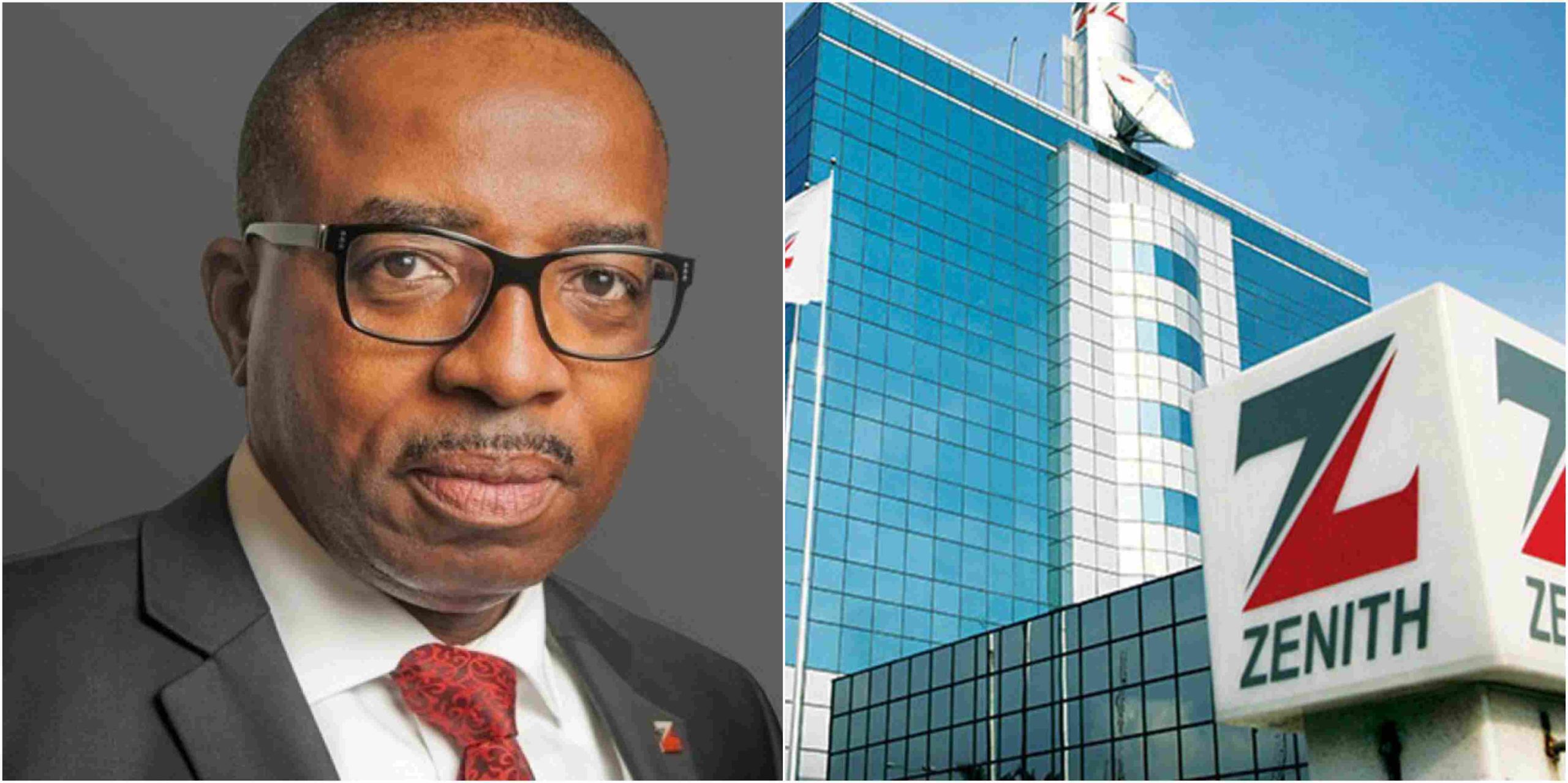

Ebenezer Onyeagwu
MD/CEO
Zenith Bank Plc
The 2020 half-year (H1) financial report of Zenith Bank Plc reveals a mixed bag of decline and strong growth in certain market fundamentals.
On the EPS of NGN3.30 (+16.6% vs. H1-19), the Board has proposed an interim dividend of NGN0.30/s (H1-19: 0.30/s), which equates to a yield of 1.7% based on the closing price of NGN17.20 as of the 3rd of September 2020.
Analysis by Cordros Research shows that interest income grew by 1.1% y/y to NGN216.95 billion, supported primarily by the income from loans and advances to customers (+11.6% y/y to NGN128.37 billion) as risk asset creation has been strong in the year so far (+13.8% YTD to NGN2.62 trillion).
The other contributory line recorded a decline – investment securities (-18.1% y/y). The decline in income from investment securities was expected, as yields across assets have pared significantly from the prior year.
Also, interest expense declined by 17.4% y/y to NGN59.55 billion, reflecting lower interest cost on borrowings over the corresponding period of the prior year (-50.7% to NGN17.00 billion) and despite the increased cost on deposits from customers (+13.3% to NGN42.54 billion).
Consequent to the decline in interest expense, net interest income settled higher by 10.5% y/y at NGN157.41 billion. After accounting for credit impairment charges (+74.2% y/y to NGN23.92 billion), net interest income (ex-LLE) settled 3.7% higher year-on-year.
The exponential growth in LLE is in line with our expectations, given the application of the ECL model and the expected impact of the pandemic on the bank’s risk asset quality both at present and going forward.
Continuing the trend during the year, non-interest income (NII) was strong, settling 6.2% higher y/y at NGN116.49 billion. The strong growth recorded was supported by expansions in FX revaluation gains (+239.6% y/y to NGN22.02 billion), and gains on investment securities (+30.4% y/y to NGN58.83 billion). This expansion in NII, alongside the growth in net interest income, led to an expansion in operating income of 4.8% y/y to NGN249.97 billion.
Operating expenses growth was moderate, as the bank continued to focus on cost management in the face of moderate gross earnings growth. Opex grew by 7.1% y/y to NGN135.85 billion, with the most pressure exerted by other operating expenses (+16.6% y/y to NGN21.22 billion) such as I.T, and maintenance costs.
Consequent to the Opex growth relative to operating income growth, the bank’s cost-to-income ratio (ex-LLE) settled higher at 54.3% relative to 52.7% and 50.9% in the prior quarter and the corresponding period of the prior year.
Also, profitability was stronger, with profit-before-tax settling 2.2% higher year-on-year. However, profit-after-tax settled 16.8% higher year-on-year, on account of a 54.8% decline in income tax expense.
In our view, the bank’s macro-prudential ratios remain strong, as all ratios settled within statutory limits. The bank’s non-performing loans ratio improved to 4.7% from 5.0% in the prior quarter, although this may be adduced to the significant YTD expansion in loans to customers, as well as regulatory forebearance for distressed restructures.
Similarly, the bank’s capital adequacy (20.0%) and liquidity (43.8%) ratios remained strong after expanding quarter on quarter and signifies that the bank has ample headroom for growth over the medium-term.
“Also, we note that the bank’s current loans-to-deposits ratio (66.1%) is now above the minimum LDR of 65.0%.”