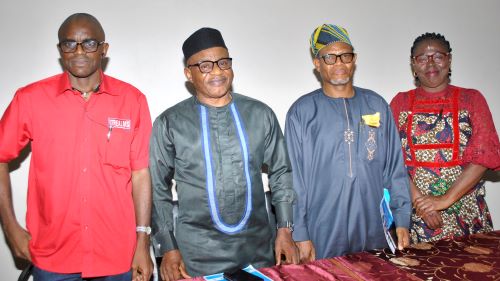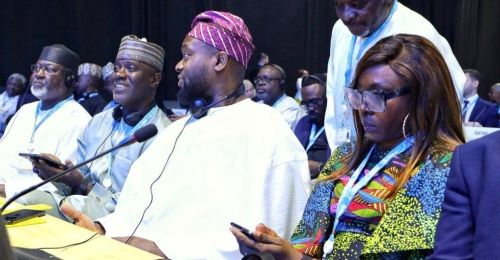

L-R: Executive Commissioner, Technical Services, Nigerian Communications Commission (NC)), Engr. Ubale Maska; Executive Vice Chairman, Nigerian Communications Commission NCC, Dr. Aminu Maida; Minister of Communications, Innovation and Digital Economy/Head of Nigerian Delegation, Dr. Bosun Tijani, and Managing Director, Nigerian Communications Satellite Limited, Mrs. Jane Egerton-Idehen, during the recently-concluded World Radiocommunications Conference (WRC-2023), where Nigeria joined the rest of the world to sign unto the Final Acts WRC-23, which constitutes a record of the decisions taken at the conference.
At the conclusion of the World Radiocommunications Conference (WRC) 2023, Nigeria joined the rest of the World to sign unto the Final Act WRC-23, which constitutes a record of the decisions taken at the conference.
The Final Act comprises both the new and revised provisions of the Radio Regulations, an international treaty governing the use of the radio-frequency spectrum and satellite orbits.
The Minister of Communications, Innovation and Digital Economy, Dr. Bosun Tijani, represented Nigeria and was joined by the Executive Vice Chairman, Nigerian Communications Commission (NCC), Dr. Aminu Maida and the Managing Director, Nigerian Communications Satellite Limited (NigComSat Limited), Mrs. Jane Egerton-Idehen.
The WRC-2023 is a global, inter-governmental treaty conference which is held every three to four years by the International Telecommunication Union (ITU), the United Nations-affiliated international organization for telecommunications.
At the end of each conference, countries signed unto an updated Final Act, the outcome of agreements on agendas put forward by country administrations.
According to a statement by the ITU, “the agreement to the updated Radio Regulations identifies new spectrum resources to support technological innovation, deepen global connectivity, increase access to and equitable use of space-based radio resources, and enhance safety at sea, in the air, and on land.”
Among the decisions reached, the Conference also identified spectrum for International Mobile Telecommunications (IMT), which will be crucial for expanding broadband connectivity and developing IMT mobile services, also known as 4G, 5G and, in the future, 6G.
The conference also identified new frequencies for non-geostationary fixed-satellite service Earth Stations in Motion (ESIMs) that would provide high-speed broadband onboard aircraft, vessels, trains, and vehicles. These satellite services are also critical following disasters where local communication infrastructure is damaged or destroyed.
Provisions were also included to protect ship and aircraft mobile service stations located in international airspace and waters from other stations within national territories.
Nigeria’s delegation at the conference comprised seasoned engineers and experts in telecommunications and satellite regulations and governance from the Ministry, NCC, National Broadcasting Commission (NBC), NigComSat Limited, National Space Research and Development Agency (NASRDA), Nigeria Airspace Management Agency (NAMA), telecom operators and other practitioners from the telecommunications industry in Nigeria.
Meanwhile, Tijani, who led the Nigerian delegation at the WRC-23, thanked the delegation for their sacrifices which, he noted, were made for the collective benefit of the future of Nigeria.
He also enjoined the Nigerian delegation to commence preparation for future conferences to ensure the preservation of the country’s interest by developing capacity through investments in extensive research and inter-agency collaboration.
Also, during an engagement with the Nigerian delegation at the conference, Maida commended the delegation for collaborating towards Nigeria’s best interest. He emphasised the conference’s significant importance for Nigeria.
According to him, “the agreements reached at this year’s conference will provide valuable spectrum resources that will benefit the Commission’s stakeholders, especially ordinary Nigerians by enhancing service quality and bridging the digital gap in rural areas.
“Additionally, the establishment of international standards for radiocommunications and the decisions made at the conference will impact the development and implementation of new technologies.
“These outcomes align with Nigeria’s overall objectives and the Honorable Minister’s Strategic Plan for the Ministry particularly on expanding broadband connectivity, in harmony with the global transition to 5G and future 6G technologies, as well as improving quality of experience and providing equitable access to all Nigerians.”