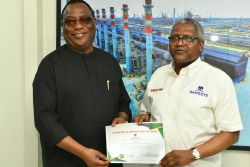

The Executive Secretary NCDMB, Engr. Felix Omatsola Ogbe presenting the certificate of the Nigerian Content Downstream Operator of the Year Award won by the Dangote Petroleum Refinery and Petrochemical Company at the inaugural Champions of Nigerian Content Awards to President of the Dangote Group, Alhaji Aliko Dangote on Tuesday.
The Nigerian Content Development and Monitoring Board (NCDMB) and the Dangote Petroleum Refinery and Petrochemical Company on Tuesday inaugurated a Joint Technical Committee (JTC) aimed at advancing local content implementation during the operational phase of the 650,000 barrels per day refinery plant.
The inauguration ceremony which took place on Tuesday at the Dangote Free Trade Zone, Ibeju-Lekki, Lagos State marks a pivotal moment in fostering strategic collaboration between both institutions and is a significant move to reinforce local content development in the oil and gas sector.
The ceremony presided over by the Executive Secretary of the Board, Engr. Felix Omatsola Ogbe, and the Group Vice President, Oil and Gas, Dangote Group, Chief Edwin Devakumar featured the formal sign-off of the Committee’s Terms of Reference (ToR), a guided tour of the refinery, other critical facilities, and the official commencement of the JTC’s responsibilities.
The visit also featured the presentation of the certificate of the Nigerian Content Downstream Operator of the Year Award won by the Dangote Petroleum Refinery and Petrochemical Company at the inaugural Champions of Nigerian Content Awards held recently in May.
The Executive Secretary NCDMB made the presentation to the President of the Dangote Group, Alhaji Aliko Dangote, who expressed delight at the recognition, noting that he would display the certificate proudly at his office.
Engr. Ogbe congratulated the Dangote Group on the successful development and commissioning of the largest single train refinery in the world, as well as petrochemical and fertiliser plants, describing the projects as a “historic milestone” not only for Nigeria but for the entire continent.
He emphasised that the Dangote Refinery stands as a testament to the success of the Nigerian Oil and Gas Industry Content Development (NOGICD) Act of 2010 and the transformative potential of Nigerian-led industrial projects.
“At an optimal daily production capacity of 650,000 barrels, this refinery will significantly enhance Nigeria’s energy security and contribute to the supply of refined petroleum products across West Africa,” the Executive Secretary stated. “Nigerians, have to own the plant, we have to make sure that the plant works well. We have to secure it, we have to maintain it,” he said.
NCDMB, he said, would continue to collaborate with Dangote Petroleum Refinery, while highlighting the need to ensure more value retention in the sector, as mandated by the Nigerian Oil and Gas Industry Content Development Act (NOGICD) 2010.
He demanded compliance with Sections 32 and 33 of the NOGICD Act, with particular reference to local manpower utilisation and requirements for NCDMB’s approval prior to the engagement of expatriates.
“The NOGICD Act stipulates that no expatriate can be employed in any organization in the oil and gas industry without the prior approval of the NCDMB. We will work with you. We have to protect jobs for Nigerians,” he said, while commending the company for training and employing Nigerian engineers.
“This collaboration must ensure qualified Nigerians are given opportunities across all operational roles. It is critical to job creation, skills development, and national capacity building in line with the Renewed Hope Agenda of President Bola Ahmed Tinubu,” he added.
The NCDMB boss also urged Dangote Petroleum Refinery and Petrochemicals to support its initiative aimed at developing oil and gas industrial parks across the country to foster local content and manufacturing in the oil and gas sector.
He explained that the Nigerian Oil and Gas Parks Scheme (NOGaPS) seeks to create an enabling environment for Small and Medium Enterprises in the sector. NOGaPS was conceived by the Board to develop facilities close to oil fields where manufacturing of oil and gas components, as well as research and development, can be carried out.
“We would like Dangote to support one of our major activities, which is the oil and gas industrial parks scheme. The parks are aimed at creating an enabling environment for SMEs in the industry to do fabrication, among others, and create more jobs for Nigerians,” Ogbe said.
In his welcome address, Chief Edwin Devakumar highlighted that the Dangote refinery project and NCDMB have been working together, promoting local content development during the construction stages of the project. “We can’t say we have achieved everything, but there is opportunity to do more,” he said.
“We are grateful to the NCDMB for all their support and advice. As entrepreneurs, we are trying to optimise costs. It is a Nigerian company; it is also an entrepreneur-driven company. As a Nigerian company, the focus will be on Nigerian content. As an entrepreneur-driven company, it will be cost-focused.
He underscored the long-standing commitment of the Dangote Group to national development and capacity building, remarking that the Group’s vision is to grow Nigeria’s industrial landscape.
The high point of the visit was the inauguration of the Committee’s members.
The Committee is tasked with ensuring the implementation of local content in refinery operations. Its core objectives include promoting the use of Nigerian skilled manpower, services, and locally sourced materials in compliance with Section 3 of the NOGICD Act. They will also support Dangote Refinery in aligning its operational procedures with the Act’s requirements.
In his acceptance remarks, Director of Corporate Services at NCDMB and chair of the Committee, Mr. Abdulmalik Halilu, expressed gratitude to the leadership of both organisations. He reiterated the Committee’s dedication to upholding the highest standards of local content enforcement and fostering measurable outcomes that will benefit the Nigerian economy.