Sunday, May 31, 2026
30.1 C
Lagos

NAICOM, NFIU to Strengthen Partnership on Financial Regulation

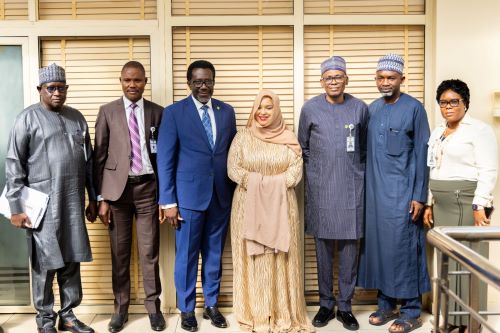
From Left: Mr. Ahmed Adamu Director, Innovation & Regulation NAICOM; Dr. Usman Jankara Jimada Deputy Commissioner, Olusegun Ayo Omosehin, Commissioner for Insurance/CEO, Hafsat Abubakar Bakari, Chief Executive Officer, NFIU; Mr. Ekerete Ola Gam-Ikon Deputy Commissioner, Dr. Nuhammed Jiya Chief Operating Officer Emerging Technologies & Innovation NFIU, Mrs. Oluwatoyin Charles Director Supervision, NAICOM.

The Commissioner for Insurance/CEO of the National Insurance Commission (NAICOM), Mr. Olusegun Ayo Omosehin, along with his management team, welcomed the Management team of the Nigerian Financial Intelligence Unit (NFIU) led by its Chief Executive Officer, Hafsat Abubakar Bakari, during their courtesy visit to the Commission on Thursday, July 11, 2024.

The Commissioner for Insurance in his opening remark, expressed gratitude to the NFIU for the ongoing collaboration, highlighting the significant benefits that NAICOM has reaped from this partnership. He commended the NFIU for their co-ordination and the progress made by institutions in meeting the Financial Action Task Force (FATF) requirements and ensuring compliance with Anti-Money Laundering and Counter Financial Terrorism (AML/CFT) standards.

Additionally, he praised the joint inspections, training sessions, awareness creation initiatives, and the improved compliance levels demonstrated by insurance companies. Also, the CFI Olusegun Ayo Omosehin emphasised the need for continued periodic training and examination of regulated entities to maintain and enhance the integrity of the financial sector.

The Chief Executive Officer, NFIU, Hafsat Abubakar Bakari reiterated the pivotal role of the NFIU as the central national agency in Nigeria, responsible for receiving, analysing, and disseminating financial intelligence to competent authorities. She underscored the purpose of this engagement which is to gather feedback on enhancing collaboration with various financial agencies, with the goal of removing Nigeria from the grey list and establishing a sustainable and effective AML/CFT framework.

The meeting concluded with a shared commitment to strengthen the partnership between NAICOM and NFIU, ensuring robust financial regulations and safeguarding the integrity of Nigeria’s financial system.


spot_img
spot_img
spot_img
spot_img

Hot this week

Mutual Benefits Delivers Strong 2025 Financial Performance, Record Profit Growth, Balance Sheet Expansion

Mutual Benefits Assurance Plc has announced its audited financial...

Heirs Insurance Group Opens Entry for 5th Essay Championship with ₦11.5m Prizes for Students, Teachers, Schools

Heirs Insurance Group, Nigeria’s fastest-growing insurance group, has opened...

NGX Seeks Cross-Listing Opportunities with Nairobi Securities Exchange

Alhaji (Dr) Umaru Kwairanga, Group Chairman, Nigerian Exchange Group...

NAICOM Issues First Insurtech Licence, Reinforcing Commitment to Innovation, Market Integrity

L-R: Mr. Suleiman Olalekan Ajani, MD/CEO, CBI Insurtech and...

NDIC Reiterates Commitment to Strong Deposit Insurance Funding to Enhance Financial System Stability

L – R: Executive Director, Corporate Services, Nigeria Deposit...

Topics

Examining Peter Obi’s Debate Boycott Threat

By Haniel Ukpaukure Debates involving candidates in an election are...

Africa Re Restates Commitment to Nigeria, Invest $90m

Africa Reinsurance Corporation (Africa Re) has restated its corporate...

$7m Prize to Fund African Renewable Energy Projects

Access Power, a developer, owner and operator of power...

‘OPEC Still Has Important Role in Global Oil Market’

  By Sebastian Wagner Scan Western news about OPEC from the...

The Impact of Low Oil Prices on sub-Saharan Africa

Growth picked up in sub-Saharan Africa in 2014, after moderating in 2013, but remained weaker than during the pre-crisis years. It softened around the turn of the year owing to headwinds from the plunge in the price of oil. Sub-Saharan Africa’s oil exporters, which account for nearly half of the region’s aggregate output, have been hit hard by the sharp decline in the price of oil. From June 2014 to January 2015, oil prices fell by nearly 50%, and have remained low despite the recent uptick.

Stanbic IBTC Bank Showcases upgraded EOL 2.0 Transaction Solution

Stanbic IBTC Bank Limited, a subsidiary of Stanbic IBTC...

Union Bank Announces Graduation of 2024 New Management Trainees

Union Bank of Nigeria, one of Nigeria’s foremost financial...
spot_img

Related Articles

Popular Categories

spot_imgspot_img