Monday, December 15, 2025
26.4 C
Lagos

Japan to Support 50m Tonnes Rice Production in Africa

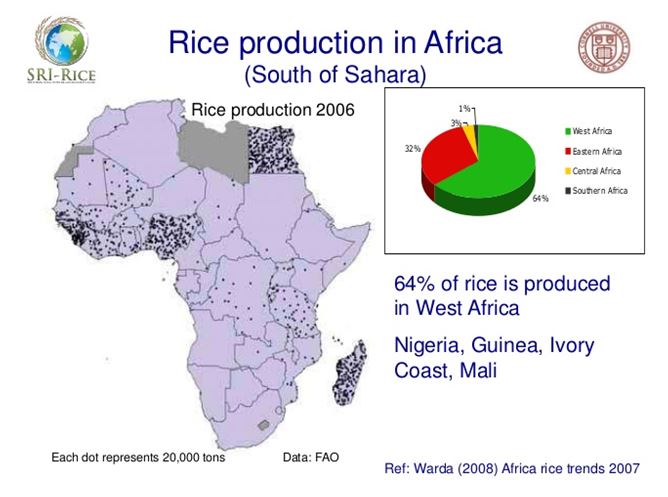
The Sasakawa Association will work with the Japan International Corporation Agency (JICA) to help double rice production to 50 million tonnes in Africa by 2030.  Japanese Prime Minister Shinzo Abe made the announcement at the Sasakawa Africa Association (SAA) symposium held on Wednesday during TICAD7.
“Japanese technology can play a key role in innovation which is key to agriculture,” Prime Minister Shinzo Abe told delegates.
“We’ve always believed in the agriculture potential of Africa,” said Yohei Sasakawa, Chairman of the Nippon foundation. “We are paying more attention to income-generating activities. We want to help shift the mindset of small-holder farmers from producing-to-eat to producing-to-sell. We are hopeful that Africa’s youth can take agriculture to a new era, and that they can see a career path in agriculture,” he added.
In a keynote address, African Development Bank Group President, Akinwumi Adesina, called for urgent and concerted efforts to “end hunger”.
“In spite of all the gains made in agriculture, we are not winning the global war against hunger. We must all arise collectively and end global hunger. To do that, we must end hunger in Africa. Hunger diminishes our humanity,” Adesina urged.
According to the FAO’s 2019 State of Food and Security, the number of hungry people globally stands at a disconcerting 821 million. Africa alone accounts for 31% of the global number of hungry people – 251 million people.

spot_img
spot_img
spot_img

Hot this week

Diesel Supply Disruptions: Quality of Service Challenges in Abuja

The Nigerian Communications Commission (NCC) is aware of the...

FG to Empower Businesses with N1.4tn in 2026 via Tax Reform

Mr. Taiwo Oyedele, Chairman of the Presidential Committee on...

NCC Promises Seamless Quality of Service Despite Challenges in Abuja

The Nigerian Communications Commission (NCC) acknowledges the Quality of...

Stanbic IBTC FUZE Festival Returns with The Ultimate Show on Saturday, Dec 20

Stanbic IBTC, a member of Standard Bank Group, has...

FG, SEC, NGX Group Forge Unified Direction on Capital Gains Tax Reform

The Federal Government has inaugurated the National Tax Policy...

Topics

Sovereign Trust Insurance Celebrates Children’s Day with School Kids

As part of the activities marking the 2018 Children's...

MTN Condemns Xenophobia, No Mention of South Africa

“MTN Nigeria strongly condemns hate, prejudice and xenophobia and...

NCDMB Hosts Nigerian Army Personnel, Showcases Milestones in Local Content Implementation

The Nigerian Content Development and Monitoring Board (NCDMB) on...

1.5bn Smart Phones to Ship Worldwide in 2016

Canalys' recently published country level forecasts predict that over...

Linkage Assurance Gross Written Premium up 16% to N12.98bn in 2022

Amidst tough operating environment in the 2022 financial year,...

Heirs General Insurance Offers N100,000 Fuel Vouchers for Motor Insurance Subsidy Promo 

Heirs General Insurance – the Non-Life arm of the Heirs Insurance Group - the fastest-growing...

Business Journal Named in Top 20 Nigeria Business Blogs Ranking

The Business Journal online (www.businessjournalng.com) platform has been named...

NSE Unveils Composition of New Market Indices July 1

The Nigerian Stock Exchange (NSE) will unveil the composition of new market indices on Wednesday, July 1, 2015. This follows the results of the bi-annual review for The NSE 30 and the five sectoral indices of The Exchange - The NSE Banking, The NSE Consumer Goods, The NSE Oil & Gas, The NSE Industrial and The NSE Insurance. The Nigerian bourse began publishing The NSE 30 Index in February 2009 with index values available from January 1, 2007. On July 1, 2008, the NSE developed four sectoral indices with a base value of 1,000 points, designed to provide investable benchmarks to capture the performance of specific sectors. The sectoral indices comprise of the top 10 most capitalised and liquid companies in the Banking, Insurance and Food/Beverage & Tobacco (now Consumer Goods) sectors and the top five most capitalised and liquid companies in the Oil & Gas (Petroleum Marketing) sector.
spot_img

Related Articles

Popular Categories

spot_imgspot_img