Monday, April 6, 2026
29.7 C
Lagos

COP 28: Kyari Makes Case for a Just Energy Transition for Africa

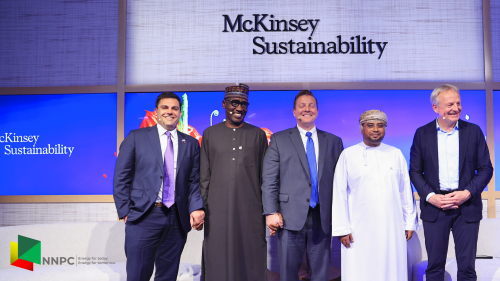
L-R: President/CEO, EQT Corporation, Toby Rice; GCEO NNPC Limited, Mr. Mele Kyari; Senior Partner, Oil & Gas Practice, McKinsey & Company, Micah Smith; CEO, Energy Development Oman, Mazen Al-Lamki and CEO, CEPSA, Maarten Wetselaar at the Regional CEO Panel Session organised by McKinsey & Company, on the sidelines of the on-going United Nations Conference on Climate Change (UNCCC), also known as COP 28 Conference in Dubai, UAE on Monday.

As conversations on finding sustainable solutions for a decarbonized energy future continue to hold globally, the Group Chief Executive Officer (GCEO), NNPC Limited., Mr. Mele Kyari has said the African Continent needs “a just, differentiated transition” to enable it to harness its resources for today for the benefit of its future generations.

The GCEO made this known while speaking at a Regional CEO Panel organised by McKinsey & Company on the sidelines of the on-going United Nations Conference on Climate Change (UNCCC), also known as the COP28 Conference, in Dubai, UAE on Monday.

The GCEO, who joined other global energy leaders from the United States, Holland, and Oman to highlight energy perspectives and insights on the evolving energy market, said the world must understand Africa’s peculiarities in addressing the effects of climate change on energy businesses.

“I have always advocated for a differentiated and just energy transition. In Africa, we have different circumstances compared to other places in the world.

In Africa today, 75% of our population doesn’t have access to electricity, leaving us with biomass as a key energy source. The world needs to recognise that the most practicable thing today is to substitute what we have in the short term to close the energy gap for our rising population,” he stated.

With Nigeria forecasted to be among the global top 10 economies by 2035 and 3rd in terms of the global population by the same year, the GCEO said it is critical that the energy poverty question be discussed as nations unite to achieve net zero by 2050.

According to the GCEO, with abundant natural gas reserves of 206 trillion cubic feet (tcf) that have the potential to rise to 600tcf, Nigeria is currently utilising gas to drive its journey towards energy transition.

He said that NNPC Limited is creating a regional gas pipeline network to supply natural gas across the African continent and boost its Liquefied Natural Gas (LNG) supply to the foreign market.

Explaining that NNPC Limited is currently eliminating gas flares in almost all its gas projects, Kyari said the idea is to deploy such gas towards developing power plants nationwide, which will boost nationwide electricity supply, create employment opportunities, and trigger the nation’s industrial and economic development.

He said that to demonstrate NNPC Limited’s commitment to a net-zero future by 2025, the Company recently signed up as a participant in the United Nations Global Compact in New York, becoming the first state-owned oil company to join the global initiative.



spot_img
spot_img
spot_img

Hot this week

APC National Chairman, Nentawe Yilwatda, Donates N15m to Jos Attack Victims, Vows End to Killings in Plateau State

The National Chairman of the All Progressives Congress (APC),...

PR Industry Leaders Hail Adejumoh’s Book, Advocate Strategic Shift in Practice

L-R: Chief Yomi Badejo-Okusanya (YBO), Chairman, Board of the...

Beta Glass Reports Revenue of N149.1bn in Audited Results for 2025

Beta Glass Plc, the leading glass container manufacturer in...

Stanbic IBTC Sets Sustainable Growth Agenda for Key Sectors at Inaugural Nigeria Business Summit

Stanbic IBTC, a leading financial services provider in Nigeria,...

Ecobank Nigeria Assures Customers of Uninterrupted Banking Services During Easter Public Holidays

Ecobank Nigeria, a member of Africa’s leading pan-African banking...

Topics

SMILE Communication Appoints Mann El Amine as New GMD

Smile Communication, a pan African Telecommunications group with firm...

JUMIA Seeks Better Infrastructure for e-Commerce in Africa

Francis Dufay, the Managing Director of JUMIA Côte d’Ivoire has called for better infrastructure to foster rapid and sustainable growth of the e-commerce sector in Africa. He said Côte d’Ivoire "has the basics of the different types of infrastructure" needed for e-commerce and "the challenge remains to improve each of these elements." E-commerce is based on four key infrastructures: Internet, logistics, payment and the legal framework. Although JUMIA managed to transcend the limitations inherent to each type of infrastructure, allowing it to route some 2,000 parcels daily, several points would benefit from qualitative evolutions; including: Logistics with a need for; better roads, 3PL offering the highest quality of service at competitive prices and a more comprehensive addressing system. Payment; where the widespread adoption of cashless payment methods such as mobile money for which JUMIA enjoys the expert support of MTN, should be encouraged. The regulatory and organisational framework could benefit from more education for stakeholders for a better understanding of contractual implications. And internet, whose penetration estimated at 8 million people in Côte d'Ivoire, remains curtailed.

GCR Affirms Leadway Assurance’s AA+NG Financial Strength

Leadway Assurance Company Limited's solid financial position as an...

UBA Pays Total Dividend of N95.8bn, Translating to N2.80 Per Share in 2023

L-R: Group Chairman, Mr. Tony O. Elumelu and Group...

The N714bn Bailout: Matters Arising

It was good news the other morning when news filtered out that the federal government has graciously given cash-strapped states a bailout of approximately N714 billion to settle outstanding salaries and other forms of wages to workers in their states. To the workers, it was probably the best news of the year 2015, given that some that had fallen into arrears for upwards of seven to nine months. To ordinary Nigerians not directly affected by the salary crisis in the affected states, the bailout represents a moment of relief from the plight of the workers. For the state governments, the bailout is only a temporary measure to relieve them of the scandalous inability to meet their obligations to workers in the states.

FSI Marks 6 Years of Driving Innovation, Talent Development, Startup Growth Across Africa

Financial Services Innovators (FSI) has marked its sixth anniversary,...

Worldwide Smartphone Sales Grew 3.9% in 1st Qtr 2016

Global sales of smartphones to end users totaled 349...

Stanbic IBTC Insurance Hosts 2nd Annuitant Forum on Life in Retirement

Retirement is often viewed as a new beginning, an...
spot_img

Related Articles

Popular Categories

spot_imgspot_img