


Home Blog Page 258

Sanofi Unveils 5 Winners of AfriTech 2020

0

Sanofi, a bio-pharmaceutical company, has announced five winners in the finals of AfricaTech Healthcare Challenges 2020. The finals held online on Thursday, June 11 and saw Mobihealth International, a Nigerian startup and telehealth platform, emerge as winner in its category of challenge.

The challenge on ‘How to help healthcare systems leapfrog from manual to smart logistics solutions at point of care’ was aced by Mobihealth International which is Africa’s first fully integrated telehealth electronic medical records and video app. Its mission is to use telemedicine to provide people in developing countries with access to quality healthcare services in the most cost and time effective way, anytime, anywhere.

A total of 11 startups pitched their projects before an online jury and audience at the live virtual event. Early in the year, Sanofi called on startups and techpreneurs across Africa to submit applications to its four healthcare challenges. 268 applications were received from 34 African countries, based on five criteria: project maturity, early results, relevance of the solution, market potential and business model, as well as the skills and expertise of the team.

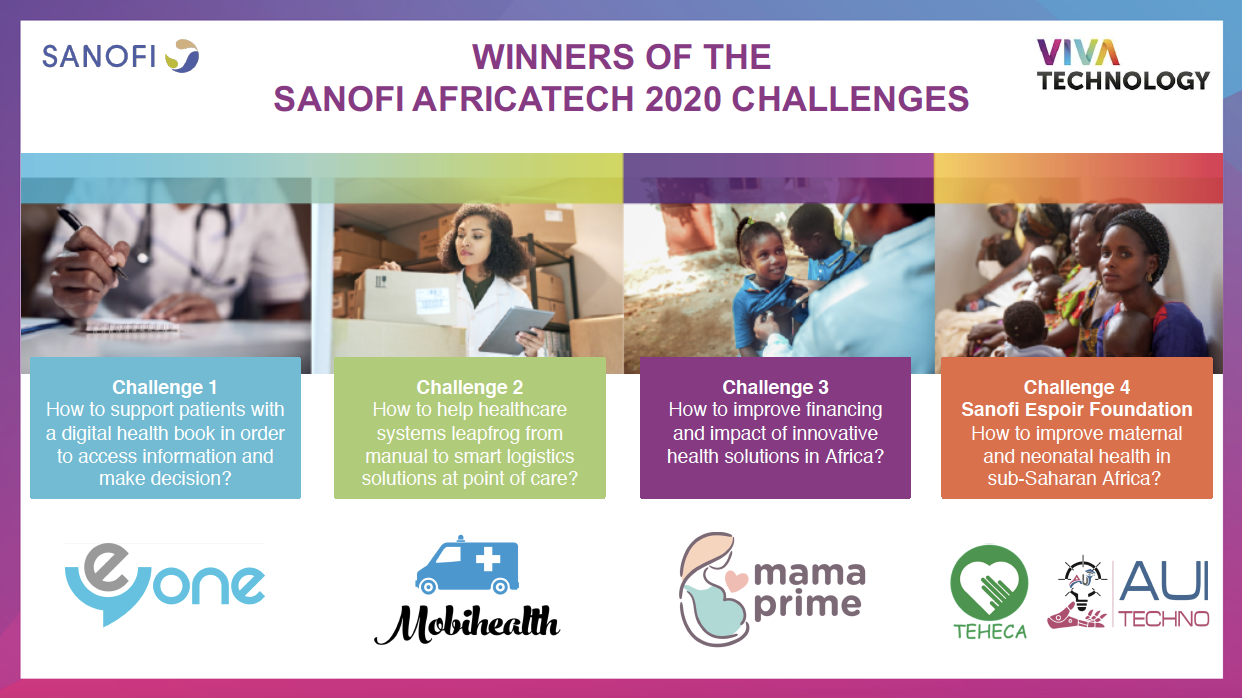
At the end of the finals, the jury, composed of experts internal and external to Sanofi, announced the 5 winning startups:

The first challenge was ‘How to support patients with a digital health book in order to access information and make decision’ was won by EYONE, a Senegalese startup whichoffersasharedmedicalfilewherepatientshaveaccesstotheirmedicalrecords in real time everywhere and are connected to 35 online health professionals that have partnered with the startup.

Kenya’s MamaPrime won the third Challenge titled‘ How to improve financing and impact of innovative health solutions in Africa’. MamaPrime is a health fintech company that enables mothers and their families to prepay for their prenatal and postnatal care and child wellness services in installments throughout their pregnancy.

Two winners emerged from the ‘ Sanofi Espoir Foundation: How to improve maternal and neonatal health in sub-Saharan Africa’ challenge. They were Teheca, a Ugandan startup which connects new and expectant mothers to qualified nurses for at home post- natal checkups and supports by using low cost and low-tech solutions; and the University Agency Innovation (from Cameroon) which is a hub of scientific, technological and enterprise-based innovations.

AfricaTech is a commitment by Sanofi to encourage and accelerate innovation in Africa, improve access to healthcare and transform the health ecosystem throughout the continent.


CSR: GNI Partners Ogun State Security Trust Fund

0

Mrs. Cecilia O. Osipitan

Managing Director/CEO

Great Nigeria Insurance Plc 

One of the foremost underwriting firms in the country, Great Nigeria Insurance Plc partnered with Ogun State Security Trust Fund as part of its strategic Corporate Social Responsibility (CSR) initiatives.

The company supported the Ogun State Security Trust Fund (OSTF) through donations in discharging its duty of securing the lives and properties of indigenes and residents of the state.

The Managing Director/CEO of the company, Mrs. Cecilia O. Osipitan while commenting, mentioned that as a socially responsible corporate entity, the company’s donation was the fulfillment of the organization’s resolve to support causes that will help create a safer and better society.

She stated that the partnership with the government is focused on ensuring that the desired security stance is maintained within the state and its environs. She also said that the donation was informed by the need to boost the Security Fund’s operation, as security is very essential to economic development; considering the fact that no investor will commit funds into an unstable economy characterized by lawlessness, disorderliness and chaos.

She reaffirmed continuous support to the Ogun State Security Trust Fund (OSTF) in actualizing its main objective which is to maintain the security and welfare of citizens in building a safe community.

Mrs. Cecilia O. Osipitan commended the Government of Ogun State under state Governor, Prince (Dr.) Dapo Abiodun for encouraging an enabling environment for businesses in the State, particularly pointing out the remarkable improvement in security across the state.

According to Mrs. Osipitan, the Ogun State Security Trust Fund has witnessed great re-engineering by Governor Abiodun which will greatly impact the operations of the security initiative. She thus encouraged other private sector stakeholders to increase their contribution in funding the state’s security initiative.

While stating the improved security situation in Ogun State, Mrs. Cecilia O. Osipitan lauded the leadership style of Governor Abiodun, likening the state to a business enterprise being efficiently managed by its Chief Executive Officer, in this case, Executive Governor, Prince (Dr.) Dapo Abiodun.

The Ogun State Security Trust Fund was established in 2011 by the Ogun State Government as a public-private partnership for the improvement of security in Ogun State and refined in 2019 by Governor, Prince (Dr.) Dapo Abiodun.

Since October 2019, Great Nigeria Insurance Plc has supported the Ogun State Security Trust Fund in line with fulfilling its obligation to support its host community.


CRC Credit Bureau Unveils Data Submission API

0

CRC Credit Bureau has launched its Data Submission Application Programming Interface (API) that enables institutions access and submit data on their credit customers online real time.

This innovation in Nigeria, the first in the industry, is an automated medium that enables institutions, provide CRC with information on credits  immediately they are booked on the system and update existing credit records as soon as repayments have been made by their customers. The API also enables them to access relevant information about their customers through live connections.

Traditionally, lenders submit credit data once or twice a month which leaves some customers who have paid, in between this cycle, either waiting for an update to be done, while others are not able to build a credit history especially if they have taken and repaid the loan before the information is provided to the credit bureau.

An example of these are short-tenured facilities e.g. 24 hours, 7-day facilities etc. The traditional reporting often causes a delay for borrowers who want to access new loans immediately after they pay off outstanding facilities or for those who want to build credible profiles to access loans/postpaid products thereby improving their standard of living.

On the lenders side, they spend additional man hours updating information manually thereby increasing their operational cost and negatively impacting efficiency.

By adopting this technological advancement in data reporting, institutions can eradicate these challenges, as their customers begin to build credible profiles and histories immediately facilities are taken. Instant updates are conducted on loans and postpaid products as repayments happen and are fully made. Therefore, by taking advantage of this API, lenders assist all their customers to continuously build accurate and reliable credit profiles that enable them to enjoy additional opportunities.

This solution completes the operational reporting cycle for lenders to CRC Credit Bureau, as now they can automate both the generation of credit information for decision making and the submission of data on their credit customers. Lenders can reduce their loan processing costs and increase efficiency emanating from the challenges associated with the manual reporting of credit files, ultimately scaling up their business and increasing profitability.

Even though the Federal Government of Nigeria, has eased the lockdown significantly in order to kick-start economic activities, the use of online mediums or Electronic-Channels for digital lending will continue to be the most favorable method of initiating credit requests and CRC’s API is a welcome innovation in the credit bureau sub-sector which will benefit lenders and borrowers alike.

According to the Managing Director/CEO of CRC Credit Bureau Limited, Dr.‘Tunde Popoola‘ “We are always listening to our customers, individuals and institutions alike, and during the restriction of movement one overarching challenge was the need to have an automated means of accessing and submitting data 24/7. As a data company, we should ensure that beyond just providing credit data, our customers are able to access and submit data as efficiently as possible. We know that timely data reporting is essential to the quality of data which ultimately increases access to finance and postpaid products for consumers and businesses. Consequently, our Data Submission API makes this process more efficient and effective for all parties involved’’

Lenders can have access to CRC’s API solutions in 4easy steps: Request for the API Integration Kit, Implement API, Test and Go Live. Further information can be obtained by sending CRC Credit Bureau an email to [email protected] or [email protected].

CRC Credit Bureau provides a nationwide repository on credit profiles of corporate entities as well as consumers, thus improving the ability of credit providers and borrowers to make informed lending and borrowing decisions. The bureau’s database covers the credit industry which includes commercial banks, non-bank institutions, retailers, utility service providers and fintechs.

High Cost: Major Reason for Protein Deficiency in Nigeria

0

Nutritionists and public health experts have identified high cost as the major reason for protein deficiency in Nigeria.

Speaking during a webinar on Nigeria’s Food Culture and the Challenge of Protein Deficiency, Dr. Omadeli Boyo, Medical Director of Pinecrest Specialist Hospital lamented that carbohydrates such as rice and garri constitutes the most commonly consumed food in the country mainly because many families cannot afford such protein foods such as egg and beans regularly.

Boyo, who is also a public health expert, described protein as the building block of the human body system. He traced a link between low consumption of protein foods and malnutrition. He identified four major types of malnutrition as iron deficiency anaemia, protein-energy deficiency, vitamin A and iodine deficiency disorder.

As a solution, Boyo called for dietary diversification in Nigeria in form of healthy diet by families as follows:

  • Eating balanced diet that contains a variety of nutritious foods
  • Prepare such foods using the best cooking methods
  • Eating in the right proportion
  • Limit total fats consumption, especially saturated fats
  • Increased consumption of fruits and vegetables, legumes, whole grains and nuts
  • Limit intake of sugar

Boyo tasked the government on the challenge of malnutrition by sensitizing communities and attitudes, running awareness campaigns regarding the benefits of meals rich in proteins and ensuring buy-in by stakeholders such as women, farmers, traditional institutions, labour unions and the media.

He also called on the government to educate communities on the danger and causes of malnutrition, explain the link between malnutrition and disease/growth disorders and also enact acceptable policies to address the situation.

Mr. Ezekiel Ibrahim, President, Poultry Association of Nigeria (PAN) described chicken as the cheapest source of animal protein in the country. He decried the high cost of poultry production in Nigeria, lamenting that the country effectively abandoned agriculture because of oil, even when the agric sector employs about 60 percent of Nigerians who reside in rural areas.

On his part, Mr. Lanre Fasakin, the Managing Director of CMRG, a leading research firm, said a survey conducted by his firm concluded that Nigerians appreciate the essence of protein and its nutritious impact.

Fasakin said: “High cost is the major hindrance to protein consumption in Nigeria. The issue of double AA (availability and affordability) is key.”

He recommended that people should go for protein foods that are readily available and affordable, rather asking families to eat what they cannot afford to buy.

The Protein Deficiency Awareness Webinar was designed to create awareness on the importance of consuming foods rich in protein to effectively tackle the growing problem of malnutrition in the country.

Stanbic IBTC Holdings Tasks Employees on Digitization, Upskilling

0

Stanbic IBTC Holdings PLC, a member of Standard Bank Group, has urged employees to embrace digitization and build career resilience through diversity and upskilling in order to be outstanding in the workplace.

Olufunke Amobi, Country Head, Human Capital, Stanbic IBTC Holdings PLC, gave this advice  during a Virtual Learning Series themed “Building Career Resilience.”

Mrs Amobi revealed that forces of change such as globalization and rapid technological advancements such as Artificial Intelligence, Robotics, cognitive technologies and crowdsourcing, amongst others, are the rationale for the evolution of careers and their shift from traditional to contemporary.

She noted that the traditional career path was defined in terms of linear progression up the firm’s hierarchy while seeking to obtain greater extrinsic rewards. The contemporary career trajectory, on the other hand, focuses on experiences and competencies that exist across firms, driven by values that are more flexible and dynamic.

The Stanbic IBTC Holdings PLC Country Head of Human Capital encouraged participants to build contemporary careers as well as a strong network to enable them attain success in their professions. She also advocated the need for workers to invest in technology and exploit various websites for free online courses to develop their digital literacy skills.

Mrs Amobi further stated that the COVID-19 pandemic has changed the workplace culture, emphasizing that workers that would survive these times are those that can easily adapt in the rapidly changing world. She counselled employees to acquire various skillsets to enable them to respond to changes in the workplace, noting that “we are in a Volatile Uncertain Complex Ambiguous (VUCA) world.”

According to her, the internet age bordered on contemporary career, which is self-directed and non-linear. “Building diversity and depth of skill are key in multiplying knowledge and skillset and making them future proof. That is the reality of the 4th industrial revolution that sees a rise of the internet age” she said.

She cited how most jobs during the lockdown were done remotely and online, adding that the dexterity in such times will be considered during recruitment processes. She however encouraged workers to build their careers based on their passion as that is a sure way to build their network faster while on the job.

She also urged workers to respond to the new normal by being proactive and not reactive. “There is the need to be creative, innovative and knowledgeable about digitization and the wave of change” she said.

Pantami Tasks Danbatta, NCC on Digital Economy

0

Following the reappointment of Prof. Umar Garba Danbatta as the Executive Vice Chairman (EVC)/CEO of the Nigerian Communications Commission (NCC) for another five-year term, the Hon. Minister of Communications and Digital Economy, Dr. Isa Ali Ibrahim Pantami, has charged the EVC and the entire Management of the Commission to redouble their efforts towards actualising the digital economy agenda of the Federal Government.

The Minister spoke when the Executive Management of the Commission led by Prof. Danbatta paid him a courtesy visit on Monday.

According to the Minister, the proactive decision to recommend Danbatta’s reappointment to the President for approval was “to ensure stability in the telecommunications industry and consolidate on the gains and successes already recorded in the industry in the last five years of Danbatta’s leadership as the EVC of NCC.”

Pantami, however, emphasised the need for Danbatta-led NCC Management to work more harmoniously with the Ministry and Agencies towards ensuring effective implementation of the National Digital Economy Policy and Strategy (NDEPS) as well as thorough implementation of the new National Broadband Plan (NBP), 2020-2025.

“The success of the Commission is our collective responsibility. While we, as a Ministry, do our best to formulate general industry policy and supervise the activities of the Commission, I will urge the NCC family to be united, remove all lines of demarcation, ensure justice, fairness in all decisions and above all, ensure harmonious relationships. This task lies on the table of the EVC,” he pointed out.

Speaking further, Dr. Pantami reminded the EVC that the focus of President Muhammadu Buhari is currently to boost digital economy, which, he said, has become even more important following the experience of COVID-19 pandemic that has left many individuals and organisations relying more on digital platforms for work and collaboration.

“So, we expect the NCC, as the telecoms Regulator, to take the issue of digital economy very seriously and give it all the attention it deserves within Commission,” he said.

Speaking earlier, the EVC appreciated the Minister’s role in his reappointment and reiterated his commitment to taking the Commission to greater heights.

“I consider my reappointment as the EVC of NCC for another five years as an honour and a show of the confidence the Hon. Minister and the President have in our efforts at NCC in the last five years. We would like to assure the Hon. Minister of our commitment, as a Commission, to work with the Ministry and other Agencies under the Ministry’s supervision towards advancing the frontiers of digital economy in Nigeria,” the EVC said.

Those who accompanied the EVC during the visit include the Executive Commissioner, Technical Services, Engr. Ubale Maska; the Executive Commissioner, Stakeholders Management, Barr. Adeleke Adewolu;  Secretary, Universal Service Provision Fund (USPF), Shu’aibu Ayuba; and Director, Legal and Regulatory Services, Mrs. Yetunde Akinloye.

Others are the Director, Compliance Monitoring and Enforcement, Mr. Efosa Idehen; Director, Public Affairs, Dr. Henry Nkemadu: Director Licensing and Authorisation, Mohammed Babajika and Director, Human Capital and Administration, Barr. Usman Malah,  among other management staff.


Emirates Resumes Flights to 29 Cities via Dubai

0
emirate

Following the UAE Federal Government’s announcement to lift restrictions on transit passenger services from 15th June, Emirates will offer passenger services to 16 more cities on its Boeing 777-300ER aircraft. With travel restrictions remaining in place in most countries, customers are reminded to check entry and exit requirements before their journeys.

Flights to the following cities will be available for booking in your GDS: Bahrain, Manchester, Zurich, Vienna, Amsterdam, Copenhagen, Dublin, New York JFK, Seoul, Kuala Lumpur, Singapore, Jakarta, Taipei, Hong Kong, Perth and Brisbane.

In addition, from 8 June Emirates will offer flights from Karachi, Lahore and Islamabad for travellers from Pakistan who wish to connect onwards to other Emirates destinations.

With this latest announcement, Emirates will be offering flights for passengers on the back of its scheduled cargo operations from Dubai to 29 cities, including existing flights to London Heathrow, Frankfurt, Paris, Milan, Madrid, Chicago, Toronto, Sydney, Melbourne and Manila (from 11 June).

Customers can book to fly between destinations in the Asia Pacific and Europe or the Americas, with a convenient connection in Dubai, as long as they meet travel and immigration entry requirements of their destination country.

Working closely with the UAE authorities, Emirates continues to take a measured and phased approach to flight resumption and rebuilding connections between Dubai and the world.

Health and safety first: Emirates has implemented a comprehensive set of measures at every step of the customer journey to ensure the safety of its customers and employees on the ground and in the air, including the distribution of complimentary hygiene kits containing masks, gloves, hand sanitiser and antibacterial wipes to all customers.

Travel restrictions: Customers are reminded that travel restrictions remain in place, and travellers will only be accepted on flights if they comply with the eligibility and entry criteria requirements of their destination countries. 

Residents returning to the UAE can check the latest requirements at: Flying you back to Dubai.


Sanofi to Host 2-Day Virtual Summit for Healthcare Practitioners

0

Sanofi, a global biopharmaceutical company, is set to host a live virtual scientific and educational summit where healthcare practitioners from Nigeria and Ghana will update their knowledge about evolving issues in patient care in the face of the COVID-19 pandemic. Dedicated scientific sessions will provide new insight on treatment of COVID- 19 patients who live with other disease conditions.

The two-day summit will include a plenary session on the first day, June 10, 2020 at 14:00 WAT and clinical breakout sessionsonthesecondday, June11, 2020 at 14:00 WAT and 15:30.Attendance is open only to healthcare professionals through registration.

The capacity building session will accommodate up to 10,000 doctors, pharmacists, nurses and other health practitioners in Nigeria andGhana.

Speaking during the buildup to the summit, Folake Odediran, General Manager, General Medicines, Nigeria & Ghana and Country Lead, Nigeria stated that “Sanofi has been at the forefront of initiatives that could have both immediate and lasting impact in the fight against COVID-19. As a global healthcare leader, Sanofi will continually support healthcare practitioners with up-to-date knowledge to effectively manage patients with improved outcomes. This is in line with our purpose of Empowering Life.”

The plenary session will focus discussions on the journey so far in the fight against COVID-19 pandemic in Nigeria and Ghana and examine challenges and future prospects in both countries. It will also provide  update on the global collaborative efforts at finding a treatment for the disease, as exemplified bySanofi.

The clinical breakout meeting, which will comprise of eleven separate scientific sessions each of one-hour duration, will hold in two parts. Each session will focus on a specific healthcare or disease management topic and healthcare practitioners will be able to attend a session of their choice. Each session will be followed by a Q&A session moderated by healthcare experts.

During the first part which will start at14:00WAT, healthcare experts will lead discussions on six topics related to COVID-19 infections. This includes clinical management of neonates and young children, hypertension, diabetes, pneumonia, immunisation as well as clinical and community pharmacy practice. The second part will start at 15:30 WAT and will examine peculiarities and challenges of managing diabetes in hospitalized patients.

Stanbic IBTC Supports Akwa Ibom State in Combating Covid-19

0

As the need arises for the establishment of additional testing centres across the country, Stanbic IBTC Bank PLC, a subsidiary of Stanbic IBTC Holdings PLC, has partnered Inoyo Toro Foundation, a Non-Governmental Organisation, to support the fight against the Coronavirus (Covid-19) pandemic.

The leading full services financial institution has donated the sum of N20 million towards the set up of certified testing centre in the State.

Speaking on the rationale behind the donation, Yinka Sanni, Chief Executive, Stanbic IBTC Holdings PLC said: “Now more than ever before, the country needs every available resource to fight this pandemic. In recent times, the country has experienced an increase in the number of confirmed Covid-19 cases. This is one of the reasons we decided to donate to the state towards fighting this pandemic. We have no doubt that the the establishment of the centre will help in diagnosis of the virus, which would then form the basis for treatment.”

Responding on behalf of the AkwaI bom State government, Dr. Domic Ukpong, Health Commissioner, AkwaI bom State said:“Akwa Ibom State Government is grateful to Stanbic IBTC Bank, a subsidiary of Stanbic IBTC Holding PLC, who in partnership with Inoyo Toro Foundation, a Non-Governmental Organization focused on human capital development, has committed to extending support in laboratory equipment to the state for the establishment of a testing center. This will ensure early testing of suspected cases and accurate diagnosis of Covid-19.”

Stanbic IBTC Holdings PLCalso donated the sum of N250 million to the Central Bank of Nigeria led organised private sector driven initiative to combat the Covid-19 pandemic. The organisation is also supporting other initiatives towards fighting the Covid-9 scourge.

Employment in Nigeria Decreased Marginally – PMI Report

0


Despite predictions of a huge rise in unemployment due to the negative impact of the coronavirus pandemic (COVID-19) on businesses in the country, the Nigeria Purchasing Managers’ Index (PMI) report has revealed that employment in Nigeria decreased marginally as about 98% of companies kept their workforce numbers.

The report also showed that new orders, output, employment level, suppliers’ delivery, and stock purchases rose to 40.7 index points in May 2020, a 3.6 increase from 37.1 index points recorded in April 2020.

The Nigeria PMI survey report, a property of Stanbic IBTC Holdings PLC, is a collection of economic indicators obtained from monthly surveys of Nigeria private sector companies. The sectors covered by the survey include agriculture, mining, manufacturing, construction, wholesale, retail and services. The indices vary between 0 and 100, with a reading above 50 indicating an improvement in business conditions compared to the previous month.

According to the PMI report, the Nigerian private sector remained in a deep downturn during May, with rates of decline in output and new orders only slightly softer than the unprecedented falls recorded in April 2020.

Furthermore, the rate of purchase cost inflation hit a record high for the second month running, with the scarcity of materials, currency weakness and higher costs relating to logistics leading to higher purchase prices.

The report further stated that due to the lockdown and restrictions on operations, firms experienced delays to orders received which resulted in an increase in backlogs of work for the second month running. While suppliers’ delivery times shortened slightly, reduced activity requirements led to a second successive decline in input buying while inventory holdings fell.

The Nigeria PMI report is a weighted average of the following five indices: New Orders (30%), Output (25%), Employment (20%), Suppliers’ Delivery Times (15%) and Stocks of Purchases (10%).

It showed an increase in companies’ selling prices at a marked pace in May as a result of the higher purchase costs and the rate of output price inflation accelerated to a new record level.

Although business confidence dropped to a 29 month low in May, the rate of contraction is easing slightly as a result of relaxing the lockdown restrictions.

Linkage Assurance Assures Shareholders of Meeting New Capital Requirement

0


Daniel Braie

Managing Director/CEO

Linkage Assurance Plc

Linkage Assurance Plc has assured shareholders that despite the challenges posed by the impact of Covid-19, the Company is on course to meeting the recapitalization requirements.

The Company disclosed that it is concurrently exploring all available options including Rights Issue, private placement, and internal capital sourcing to raise the required funds.

Insurance companies in the country have been in the process of raising capital as required by the National Insurance Commission (NAICOM) before the Covid-19 pandemic, which did not only affect the economy but disrupted the exercise as expected investors from both local and outside the shores of the country were affected.

The industry recapitalisation exercise, which commenced on 20th  May 2019 and to end 31 December 2020, requires that life companies increase their paid-up share capital from N2 billion to N8 billion; General Business from N3 billion to N10 billion; Composite Business from N5 billion to N18 billion; and Reinsurance companies from N10 billion to N20 billion.

The Managing Director/CEO of Linkage Assurance Plc, Daniel Braie had assured the brokerage fraternity earlier in the year that his company will meet the new capital base of N10 billion.

Linkage Assurance Plc at the close of business in 2019 posted a Gross Written Premium (GWP) of N6.52 billion as against N5.39 billion during the same period in 2018, indicating a 21 percent increase.

From the business generated in 2019, the company also recorded a Profit Before Tax (PBT) growth of 909 percent, moving from N135 million in 2018 to N1.36 billion during the review period.

Profit After Tax (PAT) also grew to N1.3 Billion, a 553 percent increase from a loss position of N290 million during the same period in 2018.

Underwriting profit rose by 153 percent to close at N409 million during the review period, as against loss position of N773 million the previous year, while investment also grew by 10 percent,  moving from N2.46 billion in 2018 to N2.71 billion in 2019.

AfriTech 2020: Sanofi Selects 11 Start-ups for Online Finale on June 11

0


Following the cancellation of the 2020 edition of Viva Technology, Sanofi will maintain its four AfricaTech Challenges by organising an online pitch day on June 11, 2020.

The objective is to continue Sanofi’s commitment to encourage innovation in Africa, improve access to healthcare and transform the health ecosystem throughout the continent.

For this 3rd edition, Sanofi has received 268 applications (compared to 222 last year) from 34 countries. 11 finalists were selected, based on five criteria: project maturity, early results, relevance of the solution, market potential and business model, as well as the skills and expertise of the team.

These are the four challenges and the 11 selected startups:

Challenge#1: How to support patients with a digital health book in order to access information and make decision?

  • Bypa-ss (Egypt) is digitizing healthcare information exchange through its platform HealthTag that allows patients to get their diagnosis, latest check-ups, medical scans as well as test results.
  • Keeplyna (Tunisia) is an eHealth platform for tele-medicine. It offers a free digital medical book to all African citizens and includes all health information of all family members.
  • EYONE (Senegal) offers a shared medical file. Patients have their medical records in real time everywhere and are connected to 35 online health professionals that have partnered with the startup.

Challenge #2: How to help healthcare systems leapfrog from manual to smart logistics solutions at point of care?

  • Doctor 4 Africa (India) is an integrated online platform offering a digital health solution in African countries. It connects patients to health care professionals in under-served communities where there is a shortage of specialists, so they can receive affordable quality care.
  • Mobil health International (Nigeria) is Africa’s first fully integrated tele-health electronic medical records and video app. Its mission is to use tele-medicine to provide people in developing countries with access to quality healthcare services in the most cost and time effective way, anytime, anywhere.

Challenge #3: How to improve financing and impact of innovative health solutions in Africa?

  • SOSO CARE (Nigeria) is a low-cost digital tool enabling 100 million Nigerians to access health insurance and care in 1,170 clinics.
  • Mama Prime(Kenya) is a health fintech company that enables mothers and their families to prepay for their prenatal & postnatal care and child wellness services in installments throughout their pregnancy.
  • Jokko Santé(Senegal) is a digital payment platform that secures the use of money intended for health, with a new payment method. It can also be used to manage drug traceability and online prescriptions.

Challenge #4 – Sanofi Espoir Foundation: How to improve maternal and neonatal health in sub-Saharan Africa? 

  • Teheca(Ouganda) connects new and expectant mothers to qualified nurses for at home post-natal checkups and supports by using low cost and low-tech solutions. The accessibility increase to post-natal cares aims a timely identification and a referral of life-threatening complications during post-natal period.
  • The University Agency Innovation (Cameroun) is a hub of scientific, technological and enterprise-based innovations. Its spin-off AUI Techno designs and produces an interactive infant incubator connectable to doctors’smartphones, in order to reduce the neonatal mortality rate.
  • Natal Cares (Nigeria) is an integrated solution providing healthcare, medical monitoring and emergency services to at-risk pregnant women and nursing mothers belonging to disconnected rural communities.

At the 2020 AfricaTech live virtual pitch, these startups will compete in their respective challenge categories before an online audience and a jury made up of global professionals, investors and thought leaders in technology and healthcare.

Folake Odediran,Sanofi’s General Manager, General Medicines, Nigeria & Ghana and Country Lead, Nigeria, commenting on the up-coming live pitch, said: « The AfricaTech initiative is in line with our purpose of empowering lives. We are so far impressed with the progress of the 2020 Challenge and are happy for all the finalists who have made it this far. We are even more excited that three of the emerged from our Nigeria-Ghana affiliate and we hope that the best techpreneurs win ».

After Viva Technology 2020 was cancelled due to the COVID-19 pandemic, the selected startups will now be invited to pitch their solutions at 2:00pm CET (Paris time) on June 11, 2020, during a special

Sanofi Africatech day by video conference.

The live virtual event will  be hosted by Sanofi Africa zone and will comprise of four pitch sessions, each of 30 – 45 minutes duration. Attendance is open to external audiences through prior registration. You can register by visitinghttp://surl.sanofi.com/2y7

The four winning startups will be announced at the end of this event, and Sanofi will then evaluate longer-term partnership opportunities with them.


High Cost: Major Reason for Poor Protein Consumption in Nigeria – Report

0


High cost has been identified as a major disincentive for the consumption of most protein food sources in Nigeria. This was revealed in a national survey report, the Nigeria Protein Deficiency Report, unveiled at the recent launch of the Nigeria Protein Awareness Campaign. The campaign is tagged ‘Protein Challenge Nigeria’.

The survey, which was designed to empirically determine the current status and dimensions of protein deficiency in Nigeria, sheds light on food consumption patterns among Nigerians.

According to the report, “51 per cent of respondents do not have adequate protein-rich foods due largely to high cost.” The report also showed that the fundamental factors determining the necessity of meal items consumed across the country are availability (79%) and affordability (68%).

Highlights of the report indicate, as most Nigerians would probably expect, that carbohydrates are the most consumed food amongst Nigerians.

Rice topped the list with 91%, closely followed by ‘swallows’ (such as eba, amala, fufu, pounded yam, etc.) as 83%. 58% of sampled institutional providers (dieticians and nutritionists) insisted that the protein intake of Nigerians is generally quite insufficient.

According to Dr. Omadeli Boyo, a medical doctor and public health expert, “the report lends credence to many of the long-held perceptions about food consumption in Nigeria. It is detailed, yet concise, clear and places in context food consumption patterns across the country.”

He noted that it is no surprise that, with carbohydrates as the most commonly consumed foods, incidence of malnutrition is today a prevalent public health concern.

Shedding more light on the protein deficiency campaign, Dr. Boyo explained that an important thing about the proposed campaign is that it aligns with the Sustainable Development Goals (SDG) 2, which seeks to ‘end hunger, achieve food security and improved nutrition and promote sustainable agriculture.’

Also commenting on the report, Ebenezer Amuwaolu Oluloto, a nutrition expert, said: “Excellent job, I skimmed through the slide deck, it looks good, insightful and informative.”He noted that it is interesting to see up to 65% consuming animal source foods like meat. He posited however that vegetables at 53% ought to be close to rice, ‘swallow’ and beans, because they usually go together, along with stew.

Another Nutritionist, Judith Igwe, said: “The report highlights the dimensions of protein deficiency in Nigeria.It also establishes that availability, affordability, taste, nutritional value and preference are factors that drive the choice of protein consumption among the target audience.”

The survey was commissioned as a part of Protein Challenge, a protein-pull media campaign supported by the United States Soybean Export Council (USSEC) and other partners, which seeks to create awareness about the prevalence, status and impact of protein deficiency in Nigeria.

The campaign website www.proteinchallengeng.com is set up as a knowledge platform to promote protein in general and soybeans in particular. The website is the ‘go-to’ place for everyone interested in understanding the importance of protein to health and wellbeing.

The Nigeria Protein Deficiency Report can be downloaded free from the website.


‘SMEs Must Reinvent to Remain Competitive’ – Heritage Bank CEO, Sekibo

0


Mr. Ifie Sekibo

Managing Director/CEO

Heritage Bank Limited

Mr. Ifie Sekibo, Managing Director/Chief Executive, Heritage Bank Limited, has advised Small and Medium Enterprises (SMEs) to reinvent themselves in order to remain competitive and overcome the challenges of the COVID-19 pandemic.

Speaking on “Converting ideas into reality with focus on SME’s”, Sekibo also stressed the need for SMEs to continually embrace partnership and function as an integral part of a value chain.

He said: “For SMEs to strive, they must continually re-invent themselves, one big plus for SMEs is that they are quite small, and they can easily change. Co-operation is key at this very time. I advocate always, competition is good but complementing each other is better, it comes with value chain principle.

“When you plan yourself in a value chain, you gain more because the big dinosaurs need the small SMEs to survive. The economy of Nigeria needs the SME to survive. I recommend that partnerships are developed in the space of SMEs, one-man business find it difficult to survive in an economy that is changing on daily basis or even hourly. If you want to remain viable, your dreams being viable, partnerships are good way to go.”

Sekibo also counselled SMEs on the need to adapt to the realities of a new world occasioned by the COVID-19 pandemic, especially the increased adoption of electronic channels (E-Channels) for productivity and product marketing.

He said: “The truth is that even after this pandemic, we can never return to the normal way because this is the new normal and in our desperation to find solution, mistakes abound, failures will set in and most of us will hide from our failures other than face it.

“We will blame everybody for it and some of us will throw in the towel. My advice to SMEs at this critical time is that since this is a failure not caused by you or anybody, you should accept the failure. Let us begin to make amends. We are having a conference today and it is on E-Channel, can we begin to sell our products by E-Channel, can we begin to sell our ideas on E-Channel, can we begin to work at home and still be as productive and disciplined as we should. Those are the new normal. So, if we know the new normal, then we should courageously face it and go on.”


Again, NCC Absolves Minister of Involvement in NiDCOM Office Space Process

0


The Nigerian Communications Commission (NCC) has, again, clarified that the Hon. Minister of Communications and Digital Economy, Dr. Isa Ali Ibrahim Pantami, was never involved in the process of offer of office allocation to the Nigerians in Diaspora Commission (NiDCOM) at the NCC’s Communications and Digital Economy Complex located at Mbora District, Abuja, as the public is being made to believe.

The Commission reiterated this position in a press statement signed by its Director of Public Affairs, Dr. Henry Nkemadu, in which it made further clarifications to the members of public and other stakeholders on the situation.

“For the avoidance of doubt, the Honourable Minister of Communications and Digital Economy, Dr. Isa Ali Ibrahim Pantami, was never involved in the offer to the office space, or in the withdrawal of the offer for same office space.  The Minister should not, therefore, be brought into the issue,” he said.

According to Dr. Nkemadu, the decision to withdraw the offer of office space from NiDCOM was purely of the NCC, the custodian of the office complex.

“It should, however, be made abundantly clear that the withdrawal of the offer of the office space, which was unconditionally given, in the first instance, to NiDCOM, was informed by exigencies and change in priorities within the NCC, which led to the taking back of the office space earlier allocated with intention of finding a suitable replacement for NiDCOM,” he said.

The Commission therefore reiterates its confidence in the leadership, person and office of the Honourable Minister of Communications and Digital Economy, Dr. Isa Ali Ibrahim Pantami.