Monday, December 1, 2025
26.5 C
Lagos
Home Blog Page 211

‘Gas is Critical for Sub-Saharan Africa’s Energy Future’

0
Energy experts discuss the importance of gas for Africa’s current and future energy needs; GE’s innovative gas power generation portfolio is providing faster, more reliable, more cost-effective and more environmentally friendly power for baseload, emergency or clean energy transition needs; Gas will be critical for creating industry, manufacturing and attracting investment capital.

With recent major gas discoveries in Tanzania, Mozambique, Senegal, Mauritania and South Africa, Africa is poised to use gas technologies that are faster, more reliable, more cost-effective and more environmentally-friendly than coal or oil. To deliberate on the changing trends and future direction of gas in the energy industry, GE recently hosted the Gas Power Summit for Sub-Saharan Africa in Cape Town, South Africa.

The forum brought together senior leaders from governments, financiers as well as key stakeholders and thought leaders from utilities and the private sector across the region to explore industry opportunities and challenges on the future of gas power in sub-Saharan Africa.
During his keynote discussion, Scott Strazik, CEO of GE Gas Power, emphasized the need for countries in sub-Saharan African to work together with the private sector to meet the growing energy demands. “Bridging the energy gap in Sub-Saharan Africa will require continuous, sequential power improvements and the full involvement of governments, fuel suppliers, private capital and technology providers.  Gas is a natural choice to help fill the gaps – providing dispatchable, flexible, affordable, and fast power for people and industries – and with more than 120 years of experience in the region, GE is proud to continue to help lead these efforts.” Strazik said.
The participants at the forum discussed key trends shaping the energy sector including the use of technology to drive better efficiencies for utilities and the use of natural gas to meet the increasing energy demand. “Energy demand globally is driven primarily by socio-economic development and Sub-Saharan Africa will need to be creative in how we manage the energy deficit,” said Hendrik Malan, CEO for Frost & Sullivan Africa. “Adoption of natural gas is an excellent opportunity for the region to reduce carbon emissions and balance the energy mix,” he said.
The modern power grid needs resources that can ramp up and down, swiftly, efficiently and repeatedly. Operational flexibility is critical for gas turbines that compliment renewable energy as it balances electric system loads and helps maintain grid reliability.

“GE continues to help countries throughout sub-Saharan Africa meet their growing energy demands. Case in point, our  Aero-derivative gas turbines provide fast, reliable power for energy emergencies and power crisis while our total plant management solutions demonstrates our strength as a single service provider that understands the full plant-as-a-system impact for installation, maintenance, repair and upgrade activities,” said Elisee Sezan, CEO for GE’s Gas Power business in Sub-Saharan Africa. “GE’s TM2500 mobile aeroderivative gas turbine, for example, can be installed quickly – in as little as a few weeks – to help alleviate frequent outages, making them especially well-suited for countries throughout Africa.” In Angola, GE Gas Power provided emergency power within 30 days just before Christmas, providing emergency power for approximately 100,000 Angolan homes.
GE has been collaborating with energy stakeholders to deploy innovative technologies tailored to respond to the needs in the region since the 1950s with reliable baseload and flexible emergency power. In 2018, the company celebrated its 100th power plant in Sub-Saharan Africa and today, up to 17GW of gas power generation on the grid runs on GE gas turbines. GE Gas Power’s portfolio consists of advanced technologies and solutions that help build and manage power plant assets and operations more efficiently.


#SMWLAGOS: Unity Bank Advocates Increased Investment in Creative Industry 

0

From left: Head, Digital, Events & Sponsorships, Unity Bank, Bashir Salami, Founder/CEO of Sparkle, Uzoma Dozie, Head, Retail & SME Banking, Opeyemi Ojesina, CEO of Kuda, Babs Ogundeyi and Partner, PwC, Chijioke Uwaegbute after a panel session on “Financing the Music” at the just concluded Social Media Week, Lagos.

Nigeria’s commercial lender, Unity Bank Plc has advocated more investment in the creative industry to drive its contribution to the Nigerian economy.

The Head, Personal & SME, Unity Bank Plc, Mr. Opeyemi Ojesina made the call in Lagos on Wednesday while speaking at a panel to explore financing options for the music industry at the just concluded Social Media Week.

Nigeria’s music industry witnessed an explosion over the past decade, growing by 9 per cent in 2016 to hit $39 million, and is set to grow by 13.4 per cent by 2021, with an estimated worth of about $73 million, according to statistics.

Highlighting impediments to flow of credits and investment, Ojesina stated that the music industry with the involvement of stakeholders in financial services sector needs a deliberate action plan to boost investment that will grow opportunities for entrepreneurs in the sector.

“To attract the required funding in the music industry, all the stakeholders involved must be deliberate about it. But most importantly, the people in the industry must begin to understand the business of their craft and build the necessary structure that would enable financial institutions to make an informed investment decision’’, Ojesina said.

Also speaking, the Head of Digital, Events & Sponsorships, Unity Bank Plc, Bashir Salami reiterated that the Bank has been exploring several financing strategies to support musicians and grow the industry.

He added that, “before the Central Bank of Nigeria, CBN, came out with the Creative Funding Initiative, CFI, the Bank has supported a number of artistes to promote initiatives and projects that resonates with corporate objective of the Bank,” citing the endorsement deal with Adekunle Gold in 2018 as the most significant project to enhance the Bank’s contribution to the growth of the Nigerian music industry.

The session was hosted by Beat FM in partnership with Unity Bank Plc. Titled: “Financing the Music” it had in attendance over hundreds of musicians and creative industry entrepreneurs.


About Unity Bank Plc 

 We are one of Nigeria’s leading retail banks with over 200 business offices spread across the 36 states and Federal Capital Territory of Nigeria. 

The Bank offers wide-ranging financial services to individuals, businesses and the public sector of the nation’s economy. As a further commitment to the growth of the nation’s economy, Unity Bank focuses on SMEs and Agribusinesses. We are driven by the vision to be the retail bank of choice for all Nigerians and this is at the core of all that we do. 


‘Linkage Assurance Will Meet N10bn Capital Base by 2nd Qtr’

0


 L-R: Okanlawon Adelagun, Executive Director, Technical, Linkage Assurance Plc; Rotimi Edu, Deputy President, Nigerian Council of Registered Insurance Brokers (NCRIB); Bola Onigbogi, President, NCRIB ; Daniel Braie, Managing Director/CEO, Linkage Assurance; Joyce Ojemudia, General Manager, Marketing, Linkage Assurance and Fatai Adegbenro, Executive Secretary/CEO, NCRIB, during the February Members’ Evening of the NCRIB hosted by Linkage Assurance Plc in Lagos.

The Managing Director/CEO of Linkage Assurance Plc, Mr. Daniel Braie has assured the brokerage fraternity that his company will meet the new capital base of N10 billion.

Braie said that Linkage is not looking outside for funding to meet the recapitalisation requirement, but that it has the internal capacity to raise the needed funds.

Mr. Daniel Braie, who disclosed this during the February Members Evening of the Nigerian Council of Registered Insurance Brokers (NCRIB) held in Lagos, said that Linkage Assurance will conclude its recapitalisation process on or before the end of second quarter 2020.

He told them that they are dealing with an underwriter that is financially strong and have the capacity to meet its obligations as and when due, disclosing that Linkage as at the end of 2019 has a shareholders fund of N28 billion.

According to him, being the first underwriter to host the brokers this year 2020, having also achieved that feat in 2019 underscores the regard and valued partnership the Company has with the brokers. We believe that the brokers are our genuine partners and that is why we continue to be the first to host this programme.

Linkage is also the first underwriting company to extend this partnership to other Area Committees of NCRIB outside Lagos. NCRIB Area Committees hosted in 2019 are in Abuja, Port-Harcourt, Kano, and we are continuing, he said.

Braie assured the brokers that Linkage will not take the partnership for granted, and so has put in place a seamless system to ensure that commissions and claims are processed speedily.

From the way we have structured our operations, you don’t need to see the MD for your claims to be paid, and from anywhere we are in this world we can authorise payment, he assured the brokers.

The NCRIB Members, who unanimously commended Linkage Assurance for their professionalism and response time, gave their endorsement, charging the company to continue its exemplary leadership role in the industry.

Linkage Assurance Plc at the close of business in 2019 posted a Gross Written Premium (GWP) of N6.52 billion as against N5.39 billion during the same period in 2018, indicating a 21 percent increase.

From the business generated in 2019, the company also recorded a Profit Before Tax (PBT) growth of 909 percent, moving from N135 million in 2018 to N1.36 billion during the review period.

Profit After Tax (PAT) also grew to N1.3 Billion, a 553 percent increase from a loss position of N290 million during the same period in 2018.

Underwriting profit rose by 153 percent to close at N409 million during the review period, as against loss position of N773 million the previous year, while investment also grew by 10 percent,  moving from N2.46 billion in 2018 to N2.71 billion in 2019.

Standard Chartered Bank Commits $75bn Towards SDGs

0

Standard Chartered Bank has announced new business targets for supporting its clients as they transition to a low carbon economy as part of its Sustainability Aspirations.

By the end of 2024, the Bank commits to:

  • Providing $40 billion of project financing services for infrastructure that promotes sustainable development
  • Providing $35 billion of project financing services, M&A advisory and debt structuring services for renewables and clean tech projects (solar and wind)

Underpinning the aspirations, Standard Chartered also intends to reduce its emissions across its global properties by 2030. With an office footprint spanning 60 countries, including many large emerging markets, the Bank will achieve net zero emissions by only sourcing energy from renewable sources and continuing to pursue energy efficiency measures across its 12 million square feet of property.
Tracey McDermott, Group Head, Corporate Affairs, Brand & Marketing, commented: “Over the past 18 months, we have made a series of commitments which are all geared towards supporting the Paris Agreement on climate change and the transition to a cleaner, greener, fairer economy. We know that the investment required cannot be provided by governments and NGOs alone, so it is critical that investors embrace the Sustainable Development Goals at pace and scale.
“Our unique footprint means we are well placed to help get finance to where it matters most. That is why, as well as ceasing support for clients who generate more than 10% of earnings from thermal coal by 2030, we also have a renewed target for financing and facilitating $35 billion of clean technology and renewables, and $40 billion of sustainable infrastructure.”
Sunil Kaushal, Regional CEO for Standard Chartered, Africa and the Middle East, said: “It is estimated that emerging markets need an annual $2.5 trillion investment to meet the SDG targets by 2030. A bulk of this investment will need to be focused on Africa and the Middle East, which is home to some of the key sustainable development opportunities.  The financing gap in Arab countries has been estimated to be over $100 billion annually, whilst in Africa this figure stands between $500 billion and $1.2 trillion. For the goals to be met by 2030, investors and banks need to coordinate and connect capital to promote sustainable development.”
“With our unique footprint into emerging and developing markets, we can use our banking knowledge, people, and products to catalyse capital to where it matters most for SDG financing.  The Africa and Middle East region is home to some of the world’s fastest-growing economies, though we also face some of the world’s most pressing environmental and social issues. Our ability to solve for the issues here will have tremendous impact on our 2030 ambition to meet global SDGs.”


Swiss Re Misses $1.3bn Expected Profit in 2019

0

Reinsurer, Swiss Re reported weekend a smaller-than-expected profit in 2019 due to claims for a series of man-made and natural disasters, as well as expenses for its U.S. casualty business, sending its shares lower.

Net profit in the year rose 73 percent to $727 million, up from $421 million in 2018, but analysts had expected a net profit of $1.32 billion, according to Refinitiv.

Shares were down 4.9 percent in midmorning trade.

“We are taking proactive measures to put us at the forefront of adverse trends,” Chief Executive Christian Mumenthaler said.

The Zurich-based company pointed to losses from typhoons in Japan, a hurricane in the Atlantic, wildfires and floods in Australia and problems with the Boeing 737 MAX fleet.

The corporate insurance arm also lost $647 million in the year, wider than a $405 million loss in 2018.

The company said it had set aside more reserves to cover increasingly large jury awards in the United States that affect its casualty business.

Swiss Re’s combined ratio in its property and casualty division, a key measure of profitability, worsened to 107.8 versus 104 a year earlier. Readings below 100 indicate profitability. The company had expected the division’s ratio to be about 98 this year.


‘Coronavirus May Impact Insurance Business’

0

Ping An Insurance Group Co of China Limited, China’s largest insurer by market value, said over the weekend that the coronavirus crisis may have an impact on its business.

Ping An’s comments on the virus were included in its annual results, where the company reported a 39% increase in annual net profit on the strength of its retail business, but missed expectations.

The coronavirus outbreak in China has caused widespread disruption to businesses and factory production, raising worries about the country’s economic outlook as growth is expected to slow sharply in the first quarter.

The virus “may affect the quality or the yields of the credit assets and investment assets of the group in a degree,” Ping An said in its annual report, adding that the extent of the impact would depend on how long the epidemic lasts among other factors.

Ping An, seen by regulators as the only Asian insurer of global stature, made a net profit of 149.4 billion yuan ($21.3 billion) in the year ended December 2019, versus a 107.4 billion yuan profit in 2018.

That compared with the 157.6 billion yuan Refinitiv-compiled Smart Estimate based on a survey with analysts.

Profits were driven by strong retail customer growth.

Operating profit from Ping An’s retail business rose 25.7% to 122.80 billion yuan in 2019, from 97.73 billion yuan in 2018, meanwhile numbers of retail customers were up 11.2% from the beginning of 2019 for the year.


Carbon Unveils $100,000 Fund for Startups in Nigeria, Others

0


Carbon has set up a $100,000 Pan-African fund to address the lack of funding and support holding back budding tech entrepreneurs on the continent.

Carbon’s Disrupt fund, the first of its kind by an African fintech startup, will invest up to $10,000 per startup (for 5 percent equity) and give access to Carbon’s API, allowing investees to leverage Carbon’s growing customer base and innovative technology platform, to get to market faster.

Acknowledging that its success is dependent on the growth of the tech ecosystem, Carbon expects the initiative to spark more collaboration and further investment that should drive growth across the ecosystem. It’s not all altruistic, unfortunately!

Carbon is now accepting applications from companies with operations in Uganda, Kenya, Nigeria, Ghana, Cote d’Ivoire and Egypt.

Startups looking to apply for the fund must have a functioning product, post revenue and looking to operate in multiple countries. The fund has a wide investment mandate but target sectors include insurance, health, education which have not seen as much investment as the fintech space.

More than 50 percent of startup funding on the continent in 2019 went to fintech firms1, despite the abundance of opportunities that exist in other sectors.

Carbon’s Disrupt fund has been developed to tackle this head on, making it easier for entrepreneurs across all sectors to access the funds and support they need to establish their solutions and achieve their business objectives.

The fund will also provide mentorship, access to Carbon’s customers and payment platform, as well as office space in Carbon’s Lagos offices.

According to Chijioke Dozie, CEO and co-founder of Carbon, “Common investor wisdom is to stay in your market and dominate. This assumes that you are expanding on your own but we believe that by collaborating and partnering deliberately, Carbon and other tech companies can scale faster and build more enduring platforms.  There are many excellent companies across the continent looking for the kind of scale Nigeria offers and we are excited to partner with them to provide the support and financial investment they need. We are equally excited to expand beyond Nigeria and Kenya by working with a new generation of innovators across the continent and sharing our experience to tackle common obstacles to growth”

Ngozi Dozie, co-founder of Carbon, added: “The investing environment for early stage startups has improved in recent years. However, a key issue for most startups that has not been addressed is the cost of customer acquisition. A lot of money is spent on acquiring customers, mainly via social media, when a more collaborative approach among tech companies could be more efficient. Our fund will enable this collaboration, allowing others to market to our customer base and vice versa – a win-win for everyone. As the saying goes, ‘if you want to go fast, go alone.  If you want to go far, go together.”


NDIC Liquidates 425 Financial Institutions

0

As at December 31, 2019, the Nigeria Deposit Insurance Corporation (NDIC) has liquidated a total of 425 financial institutions in Nigeria.

Mr. John Abiodun, an Assistant Director in NDIC listed the financial institutions as 51 Deposit Money Banks (DMBs), 325 Micro-Finance Banks (MFBs) and 51 Primary Mortgage Banks (PMBs).

He listed challenges facing NDIC in this regard to include legal action by owners of distressed banks, recovery of debts owed the failed banks, creditor apathy and delays in revocation of the licence of distressed banks.

Interswitch Partners American Express to Broaden Acceptance of Amex Cards in Nigeria

0


(L-R) Akeem Lawal, DCEO, Payment Processing, Interswitch; Vivi Galani, VP & GM, Business Development GNS EMEA; Mitchell Elegbe, GMD and Founder, Interswitch Group; Jonathan Curtis, Director, Business Development East & West Africa at the launch of Interswitch and AMEX partnership in Lagos recently.

Interswitch Limited, a leading technology-driven company focused on the digitisation of payments in Nigeria and other countries in Africa, and American Express (AmEx), are pleased to announce a new partnership to expand the usage and acceptance of American Express Cards across Nigeria.

The partnership with Interswitch will enable American Express Card members to transact using a wide range of merchants, who process payments through the Interswitch platform, for a range of travel, retail, hospitality and dining expenses, as well as ATM withdrawals.

The partnership will also allow Interswitch to integrate its network of merchants in Nigeria into the global American Express network.

As part of the agreement, Interswitch will assume responsibility for managing American Express merchants in Nigeria, while bringing new merchants onto its platform. Previously, American Express Card members could only use their cards at select locations across the country. This new partnership broadens that acceptance to Interswitch merchants, ATMs and websites nationwide.

Akeem Lawal, Divisional Chief Executive Officer for Payment Processing at Interswitch said: “AmEx and Interswitch are aligned in our desire to provide fast and secure payment solutions and transactions across Nigeria. With this new partnership, we are improving AmEx Card member access to a convenient and secure network, which also benefits our merchants who will gain new opportunities presented by an expanded user base. By remaining card scheme neutral, Interswitch will continue to explore innovative partnerships that will benefit consumers and retailers alike.”

Lawal also reiterated the commitment of Interswitch to reliably cater to its valued merchants, to reinforce the Company’s mantra of ‘Transaction solutions you can depend on’. He recommended new merchants join the Interswitch platform, highlighting that the addition of American Express cards can help to expand their businesses.

Vivi Galani, Vice President & General Manager, Global Network Partnerships EMEA for American Express stated that the new partnership reinforced American Express’s role as a leading global network. She said: “We are excited to be partnering with Interswitch, a well-respected pan-African financial technology company, to continue to grow our presence in Nigeria. As we partner with leading banks and financial institutions around the world, we are bringing the powerful backing of the American Express network to Card members and merchants by expanding acceptance of our Cards.”


‘Recapitalisation will Strengthen Banks in Nigeria’

0


The International Monetary Fund (IMF) says recapitalisation will strengthen the resilience and capacity of banks in Nigeria, especially in view of systemic vulnerabilities in the banking sector.

After its recent mission to Nigeria, the IMF team issued the following statement:

“Banking system vulnerabilities should continue to be addressed. The mission welcomed recent efforts to reduce legacy non-performing loans. The introduction of risk-based minimum capital requirements would also help strengthen bank resilience. Notwithstanding the significant increase in lending, concerns about shortened maturity, asset quality and conflicting monetary policy signals call for revisiting the minimum lending to deposit ratio directive.

Further tightening of monetary policy—albeit through more conventional methods—is needed to contain domestic and external pressures arising from large amounts of maturing CBN bills. The mission reiterated its advice on ending direct central bank interventions, securitizing overdrafts to introduce longer-term government instruments to mop up excess liquidity and moving towards a uniform and more flexible exchange rate. Removing restrictions on access to foreign exchange for the 42 categories of imported goods would be needed to encourage long-term investment.

On border closure, the IMF said: “Nigeria’s border closure will continue to have significant economic consequences on the country’s neighbors. It is important that all involved parties quickly resolve the issues keeping the borders closed—including to stop the smuggling of banned products.”

IMF: ‘Nigeria Growth Forecast is 2% in 2020, Outlook Challenging’

0
Flag of Nigeria. Full frame, loopable and realistic. High Definition 1920x1080 Format.


The International Monetary Fund (IMF) says its growth forecast for 2020 for Nigeria was revised down to two (2) percent to ‘reflect the impact of lower international oil prices.’

It also says that ‘Inflation is expected to pick up, while deteriorating terms of trade and capital outflows will weaken the country’s external position.’

A team from the IMF led by Amine Mati, Senior Resident Representative and Mission Chief for Nigeria, visited Lagos and Abuja from January 29-February 12, 2020.

At the end of the visit, Mati issued the following statement:

“The pace of economic recovery remains slow, as declining real incomes and weak investment continue to weigh on economic activity. Inflation—driven by higher food prices—has risen, marking the end of the disinflationary trend seen in 2019. External vulnerabilities are increasing, reflecting a higher current account deficit and declining reserves that remain highly vulnerable to capital flow reversals. The exchange rate has remained stable, helped by steady sales of foreign exchange in various windows.

“High fiscal deficits are complicating monetary policy. Weak non-oil revenue mobilization led to further deterioration of the fiscal deficit, which was mostly financed by Central Bank of Nigeria (CBN) overdrafts. The interest payments to revenue ratio remains high at about 60 percent.”

Stanbic IBTC Partners Afreximbank on N300bn Domestic Bond

0


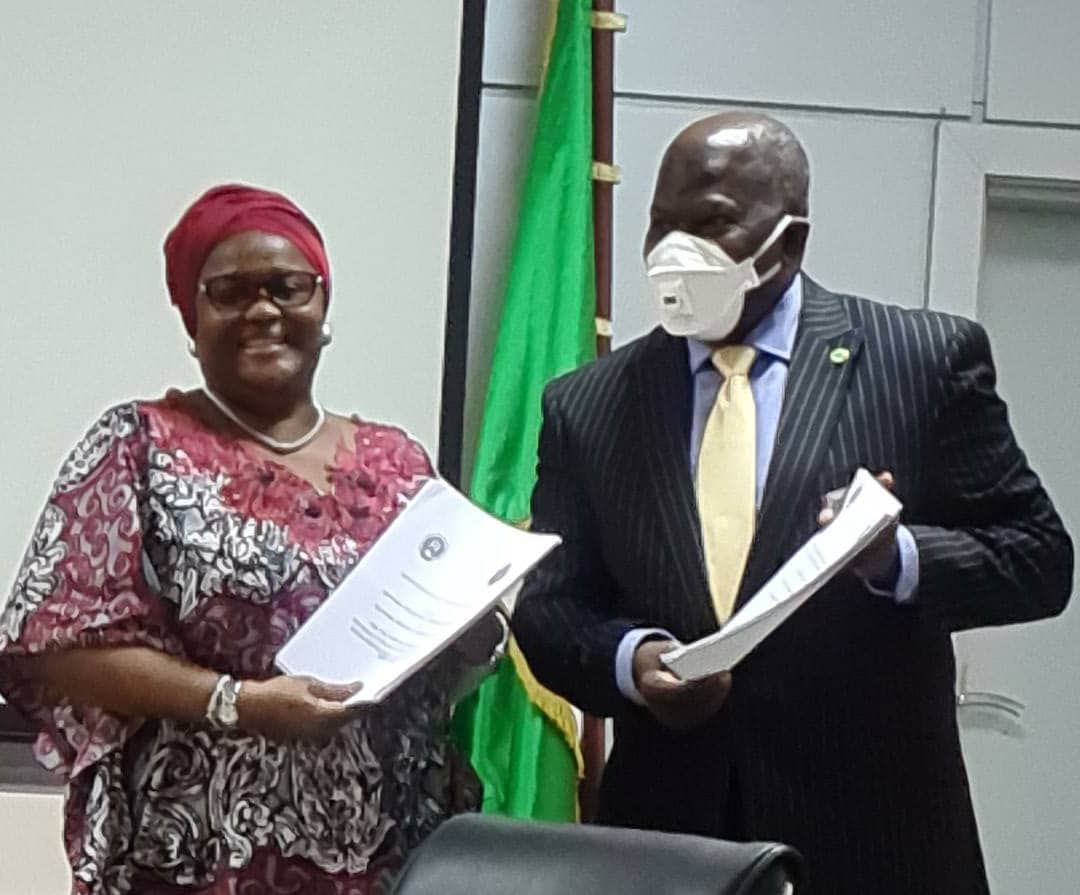
Stanbic IBTC Capital Limited, a subsidiary of the Stanbic IBTC Holdings PLC, has established a ₦300 billion Domestic Bond Programme for the African Export-Import Bank (Afreximbank). The signing ceremony which held in Lagos marked the official kick-off of the initiative.

Afreximbank, a multi-product partner of Stanbic IBTC and the Standard Bank Group, is one of Africa’s largest Developmental Finance Institutions and a seasoned issuer in the international capital markets.

The establishment of the debt issuance programme in the Nigerian capital market by Afreximbank makes it the third supranational ever to join an elite group of Nigeria’s development partners, enabling the domestic capital market. It is vital to establish the Bond Programme in local currency, considering the strong liquidity and current low yields in the domestic market.

This initiative by Afreximbank aligns with global best practice in treasury management and innovation to stay abreast of evolving market conditions. It will aid in stimulating the expansion and development of Nigeria, through the intervention in various sectors of the Nigerian economy.

The transaction was consummated in the presence of members of the Stanbic IBTC team, members of the Afreximbank Executive management team, representatives from the Nigerian Stock Exchange and FMDQ OTC Plc, amongst others.

Stanbic IBTC Capital Limited remains fully committed to developing the Nigerian capital markets and has been at the forefront of driving financial innovation and advising clients on staying ahead of changing times.

AIG to Invest $1.3bn by 2023 on Technology, Services

0


American International Group (AIG) says it will invest $1.3 billion over the next three years in its massive AIG 200 initiative to revamp and improve technology infrastructure and services.

AIG President and COO, Peter Zaffino said work on the identified “10 core operational programs” would kick-start this year.

Zaffino said: “We have been carefully planning operational road maps for each program, with a focus on resource and investment prioritisation, as well as disciplined execution.”

AIG CEO, Brian Duperreault explained the AIG 200 concept as “a marathon and not a sprint” and “will require significant investment” over time to reduce the company’s cost structure.

Law Union, WAPIC Losses Drag Insurance Index Down by 0.8%

0


A report by Afrinvest Research says sustained losses yesterday by Law Union & Rock Insurance Plc

(-9.6%) and WAPIC Insurance Plc (-9.1%) dragged the Insurance Index lower by 0.8% at the Nigerian Stock Exchange (NSE).

Consequently, both Law Union and WAPIC led the bearish run at the market.

Afrinvest says it expects the bearish sentiment at the stock market to persist in the near term.

AIICO Holds Board Meeting on February 20, 2020

0


 Babatunde Fajemirokun

Managing Director/CEO

AIICO Insurance Plc

AIICO Insurance Plc will hold its Board Meeting on February 20, 2020 to review and approve the company’s financials for the year ended December 31, 2019 and also consider the payment of dividend to shareholders.

The notice was contained in a statement to the Nigerian Stock Exchange (NSE) issued by Mr. Donald Kanu, Company Secretary, AIICO Insurance Plc.