Sunday, December 28, 2025
26.6 C
Lagos
Home Blog Page 132

Africa’s Upstream Industry: Holding Steady in a Turbulent Oil, Gas Market

0


By NJ Ayuk

Executive Chairman

African Energy Chamber

Africa’s oil and gas industry is going to breathe new life into many African economies and will create new opportunities for many Africans in 2023.

During the recent African Energy Week, many players and host nations outlined some of the most ambitious plans to produce more natural gas, diversify our economies and create more jobs, especially for women and our young people. This is a better plan than development aid.
In September 2022, the EU approved an additional 15 million Euros to support counter-insurgency efforts in Mozambique. That fresh funding – intended to protect the natural gas-rich area of Cabo Delgado – brings the bloc’s total support up to 104 million Euros this year.
This sudden involvement in the area’s five-year security saga highlights Europe’s newfound interest in a stable, energy-producing Africa.
Oil prices spiked to $85 a barrel by November and currently show no signs of slowing. The Russia-Ukraine conflict has sent shockwaves through the entire oil and gas industry, with Western nations, particularly in the EU, searching for alternate fuel sources.

While the U.S. immediately banned Russian oil imports in March, similar measures by the U.K. and EU were put off until December.
As we pointed out in our released report, “The State of African Energy: 2023 Outlook,” During African Energy Week, African oil and gas production remains steady — and fairly immune to the Ukraine-Russia conflict.

Oil – Marginal Increase
Take Nigeria for instance, whose oil production hit a 30-year low this August but is now projected to see an overall increase through 2023. By tackling its most dramatic setbacks, the West African nation has managed to maintain equilibrium.
One such setback came to light at the Forcados crude oil terminal in July when operators discovered leaks around the loading buoy, halting exports from the terminal. The operators, Nigerian National Petroleum Company (NNPC) Limited and Shell Petroleum Development Company (SPDC) of Nigeria, promptly promised to repair the leaks and resume exports by late October — and they met the self-appointed deadline.
Last summer also saw a huge escalation in pipeline theft that culminated in Nigeria losing its spot as Africa’s biggest oil producer. Ironically, this may have served as a much-needed wake-up call to tackle the decades-old problem of theft.

After a July and August that saw Nigeria’s output fall below 1 million bpd, the government awarded security contracts to protect the pipelines. The tactic yielded fruit within a month when contractors uncovered an illicit pipeline that had been siphoning stolen oil for nine years. By November, Nigeria’s output had climbed back to 1 million bpd.
Libya experienced an even more dramatic pendulum, with production falling from 1.2 million barrels per day (bpd) to 100,000 bpd this spring. In a now-familiar pattern, the conflict between two competing governments led to production outages and blockades. By August, however, production had returned to a steady 1.2 million bpd.
These setbacks in Nigeria and Libya have something in common: The solutions came from within. In a world reeling from the ripple effects of the Ukraine conflict, any producer that can tackle its largest issues in-house, without relying on geopolitical trends, deserves some notice.
Europe seems to share this attitude. Total and Eni are “close” to finalising oil production deals with Libya, where BP is also due to begin new onshore drilling. These reassuring signs all address the other major challenge shared by Libya, Angola, and Nigeria: Lack of new projects and foreign investment. Exxon also recently discovered a new well in Angola, another nation in need of fresh prospects. I had a chance to keynote the Angola oil and gas gathering and held discussions with key industry players. There is fresh hope and excitement on the horizon.
Even without factoring in these recent deals, our 2023 report predicts marginal growth for Africa’s oil production at just over 7 million bpd. Intriguingly, a stable Libya and fresh projects could see that output grow to 7.25 million bpd by 2030.

In the Russia-roiled short term, Africa’s sheer consistency offers relief to energy-hungry nations – and in the long term, potential energy security.

Gas – Growing Steady
As with oil, Africa’s natural gas output remains quite resilient to the Ukraine-Russia conflict. Some nations have already stepped up their exports to Europe, and several major projects are on track for production by 2030. While our report predicts a marginal decline in production for the short term, the continent’s overall future looks bright.
Take Algeria, whose Berkine field went from discovery to production in record-breaking time. NOC Sonatrach discovered the 12 trillion cubic feet (tcf) in reserves in March and, in partnership with Italian major Eni, began production by November.

The deal was enabled by Algeria’s international oil company (IOC)-friendly hydrocarbon law and bodes well for Eni’s and Sonatrach’s agreement to increase Italian imports by 20%.
Similarly accommodating of IOCs, Mauritania and Senegal are also growing strong. Their Tortue/Ahmeyim field contains approximately 15 tcf of gas, with operators hoping to begin production in 2024. Mauritania is also in talks with BP to develop their equally rich BirAllah (gas field. While young in the industry, the two nations have proven quite competent at cooperating with both each other and international majors.
Even more intriguing, war-torn Mozambique began exporting natural gas to Europe this November – an unexpected first. This milestone likely owes something to the EU’s recent investment in Mozambique’s security. The question remains, of course, whether Mozambique will remain stable enough to continue these gains and truly become a part of Europe’s energy security solution.

Short- and Long-Term Goals
On the surface, the state of Africa’s energy is a simple one – the continent’s production should remain steady in the short-term and has already offered Europe some energy relief. Underneath the surface, of course, individual nations face different circumstances and play their own parts in the larger picture. Libya, with its history of alternating peaceful production and violent dry spells, is a very different nation from a stable newcomer like Senegal.

As the West eyes Africa for long-term energy security and the green transition, it behooves them to examine individual nations for their strengths, weaknesses, and unique opportunities for partnership. We encourage all parties to investigate – and invest in – Africa’s rising stars for long-term energy solutions.

Stanbic IBTC Asset Mgt Launches N20bn Infrastructure Fund Series III Issuance

0

Stanbic IBTC Asset Management, a subsidiary of Stanbic IBTC Holdings, has announced the NGN19.997 billion Series III offer under its Stanbic IBTC Infrastructure Fund NGN100 billion Programme. The offer opened on Friday, 25 November 2022 and is scheduled to close on Wednesday, 21 December 2022.

The Fund aims to bridge the funding gap in Nigeria’s infrastructure sector through investing in a careful selection of eligible infrastructure investments across core infrastructure sectors in Nigeria. The Fund, structured as a close-ended collective investment scheme, seeks to provide a target return of 2% to 5% above the prevailing yield on a Federal Government of Nigeria Bond with a similar tenor to the remaining tenor of each series.

The Series III Issuance is for a tenor of 10 years and offers 188,650,000 units of NGN100 each issued at NGN106.00 per unit under the Stanbic IBTC NGN100 billion Infrastructure Fund Programme.

Commenting on this development, Dolu Olugbenjo, Chief Investment Officer, Stanbic IBTC Infrastructure Fund, noted that the Fund has made significant strides to meet its commitment to investors and its dedication to developing Nigeria’s capital market. The Fund has successfully made cash distributions to eligible unitholders in three incremental instalments within the first nine months of operation and had successfully raised capital over the last two issuances with proceeds disbursed to impact investing. The Fund also continues to support projects that provide real developmental impact and has invested in infrastructure deals in healthcare and energy sectors that have created direct and indirect employment opportunities for the projects’ host communities.

According to Dolu, “The Series III Issuance provides an opportunity for the Fund to consolidate on progress made thus far, by using the capital raised to provide debt financing to support a strong portfolio of infrastructure and infrastructure-related projects within Nigeria. The target project sectors for the Stanbic IBTC Infrastructure Fund covers a broad array of sectors including energy, healthcare, information and communication technology, telecommunications, real estate, and transportation and logistics sectors.”

“We encourage qualified institutional investors and high net-worth individual investors to continue participating in the Stanbic IBTC Infrastructure Fund issuances as partnering with us helps bridge the existing infrastructure asset gap that would deliver positive social and economic multiplier effects,” Dolu added.

NCC Initiates Regulatory Measure to Identify, Eliminate Risks in Telecom Sector

0

The Nigerian Communications Commission (NCC) has embarked on a regulatory step to sensitise the industry about the need for proper and continuous risk identification with the view to managing such risks before they affect the health of the industry.

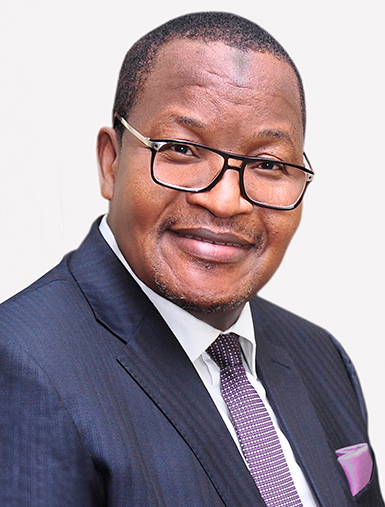
To this effect, the Commission has hosted a two-day maiden conference at its headquarters in Abuja, where its Executive Vice-Chairman, Prof. Umar Danbatta, said it has become imperative to minimize risks in the industry to ensure that services are not disrupted, and that consumers obtain the best services that are globally available.

The conference with the theme: “Nigerian Telecommunications Industry: Managing the Emerging Risks and Embracing Risk Opportunities,” called for collaboration between the regulator and other stakeholders in the industry, to achieve multi-stakeholder strategies aimed at identifying and addressing emerging risks in the telecommunications sector to ensure sustainable and impacting growth.

Director of Policy, Competition and Economic Analysis, Yetunde Akinloye, who stood for the EVC, said the essence of the forum was to examine myriads of issues that challenge the implementation of the National Digital Economy Policy & Strategy (NDEPS) 2020-2030, and to enhance the development of a sustainable ICT sector in Nigeria.

“The focus of this conference is to bring to the fore the ever-rising uncertainties in the global economy and the attendant regulatory/operational risks in the areas of increased data security regulations, new partnerships and transforming business models, fast-changing mix of mounting capital expenditure (CAPEX) burdens, shifting market structures, newly emerging disruption scenarios, regulatory and policy challenges amongst others,” Danbatta said.

The EVC told participants at the event, which also featured virtual participation, that the Commission has been at the forefront of ensuring that the telecoms industry is not adversely impacted by these uncertainties/risks.

He stated that one of our Strategic Visions is to ensure a competitive market for the communications services that foster fair inclusion of all players, promote local content and innovative services in ways that facilitate new investment, job creation and consumer satisfaction.

Danbatta said the NDEPS is the guiding document for the Federal Government’s activities to maximise the immense opportunities that are inherent in digital technologies to nudge the diversification of Nigeria’s economy and attain the key national objectives of improving security, reducing corruption, and expanding the economy.

“While risk management has been critical in our regulatory service delivery, we acknowledge that all stakeholders must be concerned about the varied uncertainties that confront the industry. There is no gainsaying the fact that the Information and Communication Technologies Sector is inherently filled with several business and technology risks,” Danbatta said.

“It is, therefore, important that regulatory risks be minimised to ensure that services are not disrupted, and consumers obtain the best and latest services that are globally available. The Commission in a bid to ensure that operators in the industry enjoy a conducive operating environment has had cause to seek government interventions and collaborate with other Agencies of Government in addressing major sectoral risks.

“These risks include cybersecurity and online fraud, regulatory burden, multiple taxation, vandalism of telecommunication infrastructure, right of way challenges, access to foreign exchange, inter-industry indebtedness, among others,” he said.


In his paper presentation titled ‘X-raying Telecommunications Risk Radar: The Operators’ Perspective’, a facilitator at the event, who spoke to issues of concern to operators, Eniola Olugboyega, said that risk-taking can have positive or negative impact on businesses.

He also stated that most common losses from improper management of risk in the sector include customer dissatisfaction, fines and litigation, product failure, and loss of business opportunities, among others.

According to him, effective risk management aids effective decision making, prevents financial and reputational loss and addresses potential threats.

Thus, telecommunication risk from the operators’ perspective includes regulatory risk, insecurity, data breach risk, foreign exchange risk, rising CAPEX risk, human resource risk, and the inability to take advantage of new business models.


Ecobank Group: Digital Transactions Hit $59.1bn in 9 Months

0

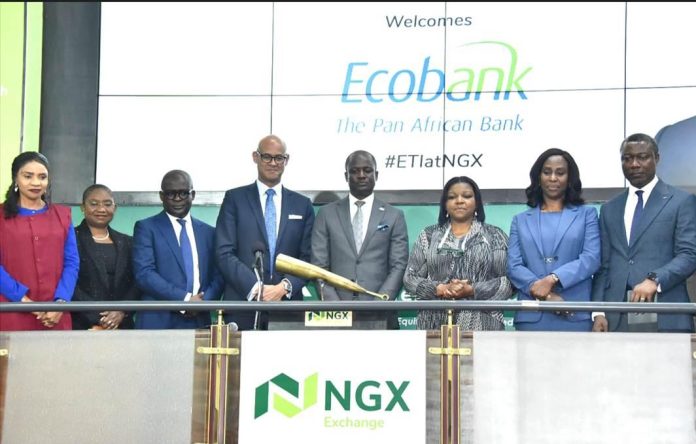
Ecobank Group said it recorded transactions valued at $59.1 billion across its digital channels in the first 9 months of 2022.

The company disclosed this in its audited financial report for the 9-month ended September 2022. According to the company, this represents a 44% increase compared with the $40.4 billion it recorded in the same period last year.

A closer look at the various digital channels of the company shows that the Ecobank Omni Plus recorded the largest transaction value within the period at $37.8 billion. Through its mobile app and Unstructured Supplementary Service Data (USSD), Ecobank recorded $4.2 billion within the period.

Its Omni Lite channel recorded transactions valued at $4.1 billion, while Ecobank Online and Xpress Points (Agency Network) recorded $755 million and $3.7 billion transactions respectively. The company also posted transactions valued at $8.1 billion through other indirect digital channels.

The company’s result: Ecobank in the 9-month financial result reported a 7% increase in revenue from $1.26 billion in the same period of 2021 to $1.35 billion in the period under review. The bank’s operating profit expanded by 12% to $593 million, up from $528 million filed in the corresponding period of 2021, Profit before tax rose to $401 million, a 14% increase from $352 million achieved in 2021. Profit paid to shareholders grew by 7% from $182 million to $196 million.

CEO’s comment: Ecobank Group’s CEO, Ade Ayeyemi, while commenting on the result, said: “We continued to deliver on our strategic priorities and are on track to meet full-year targets despite the complex operating environment. Group-wide return on tangible equity reached a record 21%, and profit before tax increased by 14%, or 48% at constant currency (i.e., excluding currency movements). These results reflect the resilience, strong brand and diversification of our pan-African franchise.

“We saw decent client activity in consumer and wholesale payments, trade finance and foreign currency markets. Additionally, despite inflationary pressures, we maintained a tight lid on costs, thereby improving our cost-to-income ratio to 56.3% from 58.3% in the previous year. The dampened economic outlook necessitated maintaining a sound balance sheet with adequate levels of liquidity and capital. As a result, our total capital adequacy ratio at 14.4% is well above our internal and minimum regulatory limits,” he said.

The President Nigeria Needs

0

By Haniel Ukpaukure

Nigerians know the president the country does not need in the post-Buhari era. We have had them in succession, from the military era to the present date.

As campaigns gather steam for the February, 2023 general election for which expectations are higher than any other in the nation’s chequered political history, we must focus attention on a rigorous search for that leader the country has not been fortunate to have since independence.

Fortunately, we still have about two months left to conduct that search during the period of electioneering that should take 18 job seekers who have submitted application for employment across the length of breadth of the country.

It is really not a good commentary that 62 years after independence, we are still in search of a leader who would end the description of Nigeria as a country that has remained stuck with having potential for every good thing under the sun, but unable to realize the potential. It should be possible, by the time the applicants turn up for the aptitude test on February 25, for Nigerians to have made up their minds on who gets the job.

We are looking for a president who has the attributes that are required to move Nigeria in an entirely different direction, and get it off the life support on which it is at the moment – attributes such as character, capacity, vision, courage, independent mindedness, clarity of mind, intellect and integrity, among others. Beyond attributes that are natural, Nigeria’s next president must be sufficiently educated, beyond paper qualifications, and well enlightened to keep pace with the changing dynamics of a world that is moving at the speed of lightening in the 21st century.

It is needless to add that he must be physically and mentally fit (in sound health, generally) for the arduous task of piloting the affairs of a country that currently bleeds on all fronts. After Yar’Adua, and Buhari whose frequent medical tourism to the United Kingdom made King Charles to ask him if he also has a house in that country (like other Nigerian political leaders), we don’t need a president who would raise the blood pressure of Nigerians each time he travels abroad on a “private” visit.

We need a leader who can speak extempore, quite unprepared, on any issue under the sun at any gathering, anywhere in the world, without having to refer to prepared speeches that may not have any relevance with the issue under discussion, or questions asked.

No official reason has ever been given for President Muhammadu Buhari’s failure to attend the World Economic Forum that holds in January of every year at Davos, Switzerland. It has been the responsibility of Vice President Yemi Osinbajo to attend an event that is meant for presidents, prime ministers and heads of government.

The event has segments that do not allow for the luxury of reading from prepared speeches, since discussions on critical issues that affect survival of humanity and the planet are sometimes done extempore.

This is probably the reason Osinbajo, whose eloquence, articulation, mastery of the English language and grasp of issues make him comparable to any leader anywhere in the world, has been the one attending an event that should have Buhari in attendance.

It should be taken as a given that the president we are looking for must understand the complexities of a country of more than 250 nationalities, and know how to weave the complexities into one truly indivisible (that word!) country – a leader that can heal and unite a country that today stands sharply divided along ethno-religious line.

Nigeria is in search of a leader who would always be conscious of the fact that he has responsibility for over 200 million people; someone who would not be encumbered by loyalty to family, friends and cronies, as well as ethnic, religious, business and other sundry interests. We have seen the worst form of nepotism under Buhari who, on October 21, 2022, identified it as one of the factors that aid corruption in public office – quite an irony!

While speaking at the maiden edition of the Nigeria Excellence Award in Public Service, the president said, inter alia: “Several reasons for these issues still exist because of the rooted problems like nepotism, political patronage, as well as lack of transparency and accountability. These vices distract them (public office holders) from delivering on their mandates and aspirations”.

It must have come as a rude shock to Nigerians to hear their president condemn nepotism, a major factor that has contributed to the woeful failure of his administration to deliver on the mandate Nigerians gave him in 2015 and 2019. It is one factor that renders the president too handicapped to hold his appointees to account when they demonstrate incompetence on their jobs.

We need to recall the strident attack on Buhari by none other than one of his closest allies and Second Republic senator, the late Junaid Mohammed, when the president came under severe criticism for the nepotistic disposition of his administration, shortly after assuming office in 2015.

Speaking in an interview with Punch in its issue of July 23, 2016, the fiery critic said, after listing the hoard of public appointees in the federal and even some state governments who are directly related to Buhari: “This is enough to prove to you that this is the worst form of nepotism in the history of governments in Nigeria, in fact, in the history of Africa. Let me make bold to say that I have never seen any level of nepotism that has equaled or surpassed this in my entire life – I am in my 67th year.”

He went on: “If this is not nepotism, then I don’t know what is nepotism; and anybody who has the guts, the brutal arrogance to appoint these relations, not bothering about public opinion, about the sense of justice, about competence, then you can say that he has a serious case to answer.” Quite instructively, Mohammed was Fulani, like Buhari.

We need a president who would see Nigeria differently. We need a leader with a clear idea of where he wants to take the country. Nigerians cannot recall a leader, since independence, who came into office with what could be described as a vision – something for which they can be remembered probably till the end of time, as Chief Obafemi Awolowo is still remembered more than 60 years after he left office as premier of the Western Region, and 35 years after his death. Everyone talks about vision, but not one has been able to clearly articulate would could pass for a vision.

Nigerians have the opportunity to effect the real change that they need, not one that is promised by political parties merely as a slogan. For them, therefore, it is 2023 or never.


Ukpaukure, a media consultant and writer, lives in Lagos.

[email protected]


Quickteller Unveils Toyin Abraham, Destiny Etiko as Brand Influencers

0

L-R- Priscilla Iyari, Brand Manager, Quickteller; Chidike Oluaoha, Group Head, Growth Marketing Inclusion and Paytoken, Interswitch Group;Toyin Abraham, Quickteller Ambassador; Destiny Etiko, Quickteller Ambassador; Olawale Akanbi, Group Head, Growth Marketing, Merchants and Ecosystem, Interswitch; Paul Okoye, CEO One Africa Prime Entertainment Nigeria Limited at the signing ceremony of the Quickteller brand ambassadors at the Interswitch Head Office on Monday, December 12, 2022.

Nollywood sensations Toyin Abraham and Destiny Etiko have been unveiled as brand influencers of Quickteller, a leading consumer digital payments platform, powered by Interswitch, in a bid to expand its message of convenient and secure payment to a wider audience.

The unveiling ceremony, which was held at Interswitch’s office on Monday, December 12, 2022, kicked off with the signing of contracts, and had in attendance representatives of the company’s Group Marketing and Corporate and Communications Department, who welcomed the actresses into the Quickteller family.

Speaking on the unveiling, Priscilla Iyari, Brand Manager, Quickteller, Interswitch Group, noted that as a brand that takes the business of payment convenience seriously, there is an ever-increasing need to ensure that more Nigerians become aware of the opportunities that abound with Quickteller.

Iyari shared, “We are thrilled to have Toyin Abraham and Destiny Etiko as part of the Quickteller family where we will work together to get their fans and even more people to join our expanding family, while getting more Nigerians to explore the possibilities and benefits that come with being a part of this ‘Everything Is Possible’ community.

“At Quickteller, we are keen on providing Nigerians with the easy life, and we are relentless in our efforts in ensuring that this message reaches a wider pool of Nigerians who seek easier ways to conduct daily transactions and pay their bills.”

Iyari also added that the brand will continue to tell its stories by using familiar faces, which will in turn build consumer-brand trust and improve user uptake.

Quickteller continues to place high value on payment convenience through its online and mobile payment channel that enables Nigerians to make electricity bills payments, airtime and data top-up, TV cable subscription, buy and rent homes, book flights, among others.

HIGHLIGHTS OF GUIDELINES ON ACCESSING RSA BALANCE TOWARDS PAYMENT OF EQUITY CONTRIBUTION FOR RESIDENTIAL MORTGAGE BY RSA HOLDERS

0

By Ibrahim Kangiwa

Head of Investment

National Pension Commission (PenCom)

  • Housing Finance Continues to be a Challenge in Nigeria

*Percentage of Home Ownership

Nigeria – 25%

Kenya – 75%

South Africa – 56%

  • Various Interventions / Initiatives aimed at the Nigerian Housing Market
  • Nigerian Housing Finance Program – NMRC, NMGC
  • Family Homes Fund, FMBN


The journey to the release of the Guidelines started over 8 years ago before the passage of the Pension Reform Act (PRA) 2014.

The National Pension Commission’s Corporate Strategy 2015 – 2019 had as one of its main focus areas to “…Deliver Measurable Impact on the Nigerian Economy…”

The Commission had explored a number of options that would enable it deliver ‘measurable impact in the economy, especially focusing on Infrastructure and Housing

Identification of Equity Contribution as one of the major challenges to Housing Finance (Mortgage Generation)

Section 89 (2) of the Pension Reform Act (PRA) 2014 allows RSA holders to apply a percentage of their Retirement Savings Account (RSA) balances as equity contribution for residential mortgage subject to Guidelines issued by the Commission.


Objective

  • Provide access to equity finance for RSA holders in the Contributory Pension Scheme (CPS).
  • Improve the standard of living of RSA holders under the CPS by facilitating their ownership of residential homes during their working life.
  • Improve enrolment in the CPS by providing incentives to employees who are yet to open RSAs.
  • Provide a sustainable source of long-term finance to the mortgage sector and spur development in the housing sector.


Coverage

  • Employees in active service or self-employed persons who are making monthly/periodic contributions to either of the following RSA Funds:
  • Funds I
  • Fund II
  • Fund III
  • Fund V
  • Fund VI Active


Exemptions

  • RSA Holders that have less than 3 years to retirement.
  • Existing Retirees on CPS.
  • Exempted persons under the PRA 2014.
  • RSA holders who do not have both employer and employee’s mandatory contributions for a cumulative minimum period of 60 months.


Clarifications on Use of Equity Contributions

  • Equity contribution is not for refinancing existing mortgage.
  • Not for outright purchase of property.
  • Not for purchase of land.
  • The property shall be for residential purpose only.


Conclusion

The objective is to provide Housing for first time home owners and improve the standard of living of RSA holders under the CPS by facilitating their ownership of residential homes during their working life.

For successful implementation, Stakeholders must work together to ensure effective implementation of the Guidelines.

Employers should ensure that contributions are deducted and remitted on time as required by law

Parties should ensure due diligence checks to preserve the integrity of the process.


PenOp Projects N14.8tn Pension Funds by End of 2022

0

Mr. Olumide Oyetan President, Pension Operators Association of Nigeria (PenOp) has projected that pensions funds in Nigeria will hit the N14.8 trillion mark by the end of 2022, from N14.6 trillion recorded as at September 30, 2022.

Oyekan said at a media retreat for pension editors in Lagos that pension is a sensitive subject, hence the need for the right information to be made available to members of the public.

“Pension is a sensitive subject and providing the right information to the public is important. And we have a big responsibility to get it right. Our responsibility today is how to sustain the success recorded so far. Pension should be relevant to the lives of people.”

Oyetan, who is also the Managing Director/CEO of Stanbic IBTC Pension Managers, emphasised the need for stakeholders to work together to ensure successful implementation of the guidelines on using Retirement Savings Account (RSA) to access their equity contributions for the acquisition of residential mortgage.

He said successful implementation of the initiative would improve people’s welfare and move the country forward.

Presenting the theme paper, Mr. Ibrahim Kangiwa, Head of Investment Department, National Pension Commission (PenCom), said for contributors under the Contributory Pension Scheme (CPS) to be eligible to use their RSA balance for acquisition of residential mortgages, they must have contributed for five years (60 months) cumulative of employer and employee’s mandatory contributions.

He said the same thing was applicable to the contributors under the Micro Pension Plan (MPP), adding that married couples, who individually met the eligibility criteria, were also eligible.

On authorised limit for equity contribution that qualifies a contributor, Kangiwa put the maximum allowed at 25 per cent of the RSA balance, noting that “where 25 per cent of RSA balance is more than equity contribution, the RSA holder can only access the amount equivalent to equity contribution required.

“Where 25 per cent is not sufficient for equity contribution, RSA holder may utilise Voluntary Contribution (VC) in line with the Voluntary Contribution guidelines. Where 25 per cent is not sufficient for equity contribution, Micro Pension (MP) contributor may utilise contingency portion in line with MP guidelines. Where 25 per cent is insufficient as equity contribution, RSA holder shall deposit the difference with the mortgage lender,” Kangiwa explained.

Those exempted from this initiative, according to Kangiwa, include RSA holders that have less than three years to retirement; existing retirees on CPS; exempted persons under the PRA 2014 and RSA holders who do not have both employer and employee’s mandatory contributions for a cumulative minimum period of 60 months.

He said that equity contribution was not for refinancing existing mortgage, outright purchase of property and purchase of land, noting that the property shall be for residential purpose only.

Kangiwa said the objective of the initiative was to provide housing for first time home-owners and improve the standard of living of RSA holders under the CPS by facilitating their ownership of residential homes during their working life.

The retreat was themed: “Pension: An Opportunity to Own Your Own Home, An X-Ray of the New RSA Plan on Home Ownership.”

NCDMB Earns Applause for Achievements, Wabote Explains Role of NCCF

0

Indigenous operators and service companies in the oil and gas industry have been advised to identify with appropriate Sectoral Working Groups under the Nigerian Content Consultative Forum (NCCF) to be able to receive adequate attention on operational difficulties of whatever nature.

The Forum, established to “identify issues and responsibilities, and propose interventions that can address issues and harness opportunities,” has helped many indigenous companies to find their footing in the industry.

These were part of explanations provided by the Executive Secretary of the Board, Engr. Simbi Kesiye Wabote, on Day 3 of the Practical Nigerian Content Conference which held in Uyo, Akwa Ibom State. He was responding to a question by a participant on how challenges confronting a member could be resolved. The NCDMB boss advised any such business owners not to hesitate to approach the NCCF.

It was a day that energy sector chief executives subjected the oil and gas industry regulatory framework and the enabling statute, Nigerian Oil and Gas Industry Content Development (NOGIC) Act, 2010, to critical evaluation, commending the implementing agency, the NCDMB, for phenomenal success in actualising objectives.

The energy chiefs were specifically interested in how what is known in industry as ‘The 7 Ministerial Regulations’ has impacted on oil and gas operations and, generally, how implementation of the Act has advanced objectives such as enhanced Nigerian content and value addition through sectoral and regional linkages.

All were in agreement with the explanation of a legal expert, Barrister Ilu Ozekhome, that “The regulations are a framework within which provisions of the Act could be enforced.” Preparatory work on the regulations had gone through several processes in which stakeholders had been fully engaged.

The Chairman, Petroleum Technology Association of Nigeria (PETAN), Nigerian Content Consultative Forum (NCCF), and member, Oil and Gas Trainers Association of Nigeria (OGTAN), Mr. Akin W. Osuntoki, noted that “The regulations have helped in bridging capacity” in the oil and gas industry.

He pointed out that with effectiveness and efficiency in enforcement of the regulations, indigenous companies found all the space and material support to grow their capacities and capabilities.

According to him, “The role of the NCDMB has been very strategic,” and that the Board has been “a referee and gate-keeper.” Continuing, he added, “Not only is NCDMB able to chart in-country demand, it is able to chart regional demands, and this enables investors to plan and to expand.” “Today,” he revealed, “PETAN is shaking hands across Africa,” a reference to Nigeria’s service companies now operating as international oil companies (IOCs) through creation of regional linkages.

Another industry chief, Dr. Timi Austen-Peters, Chairman, Fabrication, Nigerian Content Consultative Forum (NCCF) declared: “We are beneficiaries of the [NOGICD] Act,” explaining the many ways effective implementation of the statute has fostered growth among his and other oil and gas companies. He said cost-savings arising from NCDMB’s approach in ease of doing business enabled to take advantage of business opportunities.

The Managing Director, Tenaris, Mrs. Rosario Osobase, said, “NCDMKB is doing so much in mentoring other African countries” in local content practice. Dr. Pius Okigbo, Jnr, Chairman, ICT, NCCF, echoed the views of the other industry chiefs on the successes of the Board.

Other speakers commended the Management of the NCDMB for its Nigerian Oil and Gas Parks Scheme (NOGAPS), which is aimed at creating industrial parks for companies engaged in the manufacture of equipment components, spare parts and tools required in oil and gas industry operations.


Leadway Sponsors The Voice Nigeria to Support Entertainment Industry Insurance

0

In reinforcing its commitment to promoting insurance and deepening its penetration to a diverse ecosystem, Leadway, one of Nigeria’s foremost financial services provider, has announced its sponsorship of the fourth season of the much-anticipated singing reality TV show, The Voice Nigeria.

This strategic partnership which confirms the leading insurer as the Official Insurer of the reality TV show reinforces its quest to drive awareness and inculcate the culture of risk management and asset protection in the growing entertainment ecosystem in Nigeria.

Speaking on the significance of this partnership and its envisioned influence on the entertainment sector in Nigeria, the Managing Director of Leadway Assurance, Tunde Hassan-Odukale, expressed optimism about the impact of this ground-breaking sponsorship on the overall development of the bubbling entertainment space in Nigeria.

“It is no longer news that Nigeria is home to a huge market for entertainment, with the movie and music industries gaining expansive recognition and critical acclaim across global platforms and audiences. Statista, one of the world leaders in the market and consumer data, estimates that growth in the Nigerian Entertainment sector to reach 29.35 billion United State Dollars or 13 trillion Naira in 2022. Without a doubt, that is a market that well-placed insurers like ours must protect from financial losses.

“The crux of this sponsorship is to leverage the platforms to push education and awareness on risk identification, risk management, and assets protection for equipment service providers, musicians, producers, and most importantly, the young people who have become the heartbeat of our music and entertainment sector.

“Understanding that risk is a component of every business activity, including the creative and entertainment sector, we elected to provide suitable entertainment insurance policies towards inspiring a successful and rewarding reality program. Through this association, we want to reinforce entertainment insurance’s significance as an unnegotiable prerequisite for smooth and profitable business operations.

“I commend the organizers of the Voice Nigeria for their boldness to embrace insurance as a must-have alliance for this very successful talent development and industry promotion platform”, he added.

Commenting on the show, Managing Director, FAME Studios and Executive Producer, The Voice Nigeria, Akin Salami, stated that “what we do as a company goes beyond exposing African talents to the world through entertainment, we also impact young talents to embracing and homing their skills on a global scale. Hence, we have been able to highlight key learnings and feedback from our previous seasons and we have improved the different activities of the show which will be unpacked as the show begins and progresses. Our viewers can be assured of an exciting and entertaining time. We appreciate our sponsors First Bank, Airtel, Leadway Assurance, Coca-Cola, JAC Motors, and Zaron, for making this season possible.”

Before this initiative, Leadway has recently been deliberate in strategic partnerships and sponsorships of initiatives across diverse sectors, such as Lifestyle, Sports, Agriculture, and Education in its quest to provide education further and deepen insurance buy-in in Nigeria.


Linkage Assurance EGM 2022

0

L-R: Mr Okanlawon Adelagun, Executive Director; Mr Daniel Braie, Managing Director/CEO; Chief Joshua Bernard Fumudoh, Chairman of the Board; and Moses Omorogbe, Company Secretary, all of Linkage Assurance Plc during its Extra-Ordinary General Meeting held Thursday in Lagos.

TotalEnergies, Air France-KLM Sign MoU for 10-Year Supply of Aviation Fuel

0

TotalEnergies and Air France-KLM have signed a Memorandum of Understanding (MoU) for the delivery of more than one million cubic metres/800,000 tonnes of Sustainable Aviation Fuel (SAF) by TotalEnergies to Air France-KLM Group airlines over the 10-year period from 2023.

This sustainable aviation fuel will be produced by TotalEnergies at its biorefineries. It will be made available to Air France-KLM Group’s airlines, mainly for flights departing from France (in accordance with French legislation) and the Netherlands.

The sustainable aviation fuels produced by TotalEnergies reduce CO2 emissions by at least 80% on average over the entire lifecycle, compared with their fossil equivalent.

Air France-KLM has implemented a strict sourcing policy and is committed to purchasing only SAFs that do not compete with human food or animal feed, that are RSB* or ISCC** certified for sustainability, and that are not derived from palm oil.

With the signing of this MoU, Air France-KLM and TotalEnergies confirm their collaboration and their goal of furthering the development of a more responsible aviation sector.

Air France-KLM Group and TotalEnergies have been collaborating on the use of sustainable aviation fuel for nearly 10 years. Their partnership began with “Lab Line for the Future” in 2014, a two-year experiment during which 78 flights between Paris-Orly and Toulouse and between Paris-Orly and Nice were powered by 10% SAF supplied by TotalEnergies.

In January 2020, Air France and TotalEnergies participated, alongside Safran and Suez, in the Call for Expression of Interest launched by the French government aimed at developing sustainable aviation fuel production in France.

Over the last two years, TotalEnergies has also supplied SAF for a number of Air France-KLM Group commercial flights:

  • In May 2021, Air France’s first long-haul flight, between Paris and Montreal, powered by 16 % SAF produced in France;
  • In October 2021, an Air France flight between Paris and Nice powered by 30% SAF;
  • In May 2022, an Air France flight operated as part of the SkyTeam Sustainable Flight Challenge, between Paris and Montreal, powered by 16% SAF;
  • In June 2022, several flights operated by all of the Air France-KLM Group’s airlines as part of the Connecting Europe Days, powered by 30% SAF.

“Biofuel development is one of our Company’s strategic priorities. This new partnership with Air France-KLM exemplifies the excellence of industry and French aerospace in committing to a more sustainable aviation sector. By directly reducing the carbon intensity of the energy products used by our air transport customers, we are actively working with them to achieve net-zero emissions by 2050, together with society,” said Patrick Pouyanné, Chairman and CEO of TotalEnergies.

“Air France-KLM is fully committed to advancing SAF production in Europe and around the world. This Memorandum of Understanding with TotalEnergies is another building block in the development of French production that can meet the airlines’ needs, marking a milestone in the successful decarbonisation of our business. We continue to step up our efforts to reduce the impact of our operations as quickly as possible, and we look forward to working with TotalEnergies to accelerate our efforts to reduce the impact of our operations as quickly as possible,” said Benjamin Smith, Chief Executive Officer of Air France-KLM.

P+ Measurement Services Wins 6 Awards in 2022…LaPRIGA, Brandcom, Others

0

P+ Measurement Services, Nigeria’s leading Independent Public Relations measurement and evaluation agency, has through its quality services to clients in diverse sectors attained numerous feats comprising the ‘Best in the use of Research and Measurement’ award at this year’s Lagos State PR Industry Gala and Award (LaPRIGA), the ‘Best PR Measurement Company of the Year and the ‘Best Media Monitoring and Intelligence Company’ awards at the 2022 Brandcom and Nigeria Media Nite-out award ceremonies held respectively in Lagos.

With the latest award at the LaPRIGA (an NIPR Oscar) event held on 2 December 2022, P+ earned the reputation as the foremost company in its industry, outwitting others with cutting-edge services that are advantageous to clients’ successes.

It was also on that premise that the company with its ground-breaking approach to PR Measurement and Evaluation clinched other laurels, at this year’s Nigeria Media Nite-out and Brandcom awards held in October and November, respectively.

The Brandcom event was organised by Brand Communicator, a foremost brands and marketing magazine, which recognises brands and top personnel that have excelled in their industry, while the other is an annual award that celebrates winners in various categories of the media.

Given that, the leading-edge agency has in the past seven years engendered the needed growth for its clients, having worked with over 68 brands and 17 Public Relations agencies in Nigeria, Africa’s largest economy, which is known as the business destination for foreign investors.

Commenting on the honors, the Chief Insights Officer, Philip Odiakose, said P+ is well committed to boosting its clients’ productivity through its various offerings with up-to-the-minute expertise and a value-driven business model that outperforms others in its industry

He stated that the company’s quest for excellence also spurred other achievements like the ‘Most Resourceful and Innovative Media Monitoring & intelligence agency award, and the ‘Prestige Excellence award, both in 2022. Others are the ‘Leader in PR Measurement, Nigeria’ and the ‘PR Industry Influencer in Nigeria’ earned in 2021 by Odiakose.

According to him, P+ measurement and evaluation report is customised to suit brands’ valid metrics and are based on the AMEC Standard in accordance with the Barcelona Principle 3.0, for the provisioning of media monitoring, measurement, evaluation, and performance audit services for clients in the Banking, Telecom, Insurance, Airlines, Tourism, Government, Non-Governmental Organisations (NGOs), Pensions, Health Management Organisations (HMOs), Tobacco, Lifestyle and other sectors.

STI’s Lekan Oguntade Crowned Insurance 2022 CIO of the Year

0

L-R: Sanni Oladimeji, DGM, Risk Management & Compliance, Jude Modilim, Executive Director, Technical, Olaotan Soyinka, MD/CEO, Sovereign Trust Insurance Plc, Lekan Oguntunde, AGM/Head, ICT, Segun Bankole, DGM, Corporate Communications & Investor Relations and Kayode Adigun, GM, Finance & Corporate Services at the Head Office of Sovereign Trust Insurance Plc to celebrate with the winner of the 2022 CIO OF THE YEAR AWARD, Lekan Oguntunde, who clinched the coveted Award in the Insurance category.

Lekan Oguntunde is a 1993 Computer Science Graduate from the University of Lagos with a Masters Degree in Business Administration from the University of Port Harcourt.

He is a Microsoft Certified Professional, MCP, and a Microsoft Certified System Administrator, MCSA. He is a professional member of the Business Process Transformation Group, BPTG, in the United Kingdom.

Lekan is an alumnus of the Lagos Business School, having completed the Advanced Management Programme of the Institution. He is also an Associate of the Chartered Insurance Institute of Nigeria, CIIN.

Experts Query Passage of Bill to Exempt National Assembly Staff from Pension Scheme

0

A group of industry experts have queried the passage of bill to exempt staff of the National Assembly from the Contributory Pension Scheme (CPS) according to a statement from the Group.

Nigeria’s pension industry has grown over the last 18 years since the Pension Reform Act (PRA) was initially enacted in 2004.

The industry has ensured that the average Nigerian worker is able to retire in peace and dignity. The act brought about the professionalisation of pension fund administration and the growth of the pension industry in Nigeria. There are many gains that the pension industry has achieved and there is a great need to protect these gains from individuals seeking personal gain.

Over the last number of years, we have seen many actors try to reverse these gains, usually from seeking to amend the act that would allow groups of people to leave the scheme. These acts are typically done through legislative actions as certain groups sponsor bills to exit the Contributory Pension Scheme (CPS).

Newspaper reports have come to our attention stating that a “Bill for an Act to amend the Pension Reform Act, 2014, to Exclude/Exempt the National Assembly Service from the Contributory Pension Scheme and Establish the National Assembly Service Pension Board; and for Related Matters (HB 2025)” has been passed by the House of Representatives to exempt the National Assembly staff from the Contributory Pension Scheme by establishing a National Assembly Pension Board.

We are not convinced that this bill was passed in “good” faith. We also believe that an important bill of this nature, should go through the standard and due legislative processes. One of such processes is the convening of a public hearing where all stakeholders that are affected by the bill are invited to discuss and engage.

All the stakeholders like the workers union, labour, the Pension Fund Operators, the Regulators, Employers of labour and other critical stakeholders were not engaged in the process. We are also aware that some principal officers of the House who normally should oversee the passage of bills were unavoidably absent, bringing the integrity of the process into question. We are forced to question whose interests this bill is geared to serve. 

It needs to be ascertained, why the bill was passed without the crucial input of citizens and stakeholders? This breach of sacrosanct legislative processes and the rather hurried passage of this bill, triggers serious concerns and should be revisited urgently in the interest of both National Assembly staff, the pension industry and the nation in general.

As a matter of fact, there are a number of proposed amendments to the current pension act that have been proposed within the house for a number of years. So, for this bill to pass quickly, while the others left unattended to speaks to ulterior motives.

It is pertinent to note that the Federal Government had earlier issued a white paper stating that the Police Force or any other government agency should not leave the Contributory Pension Scheme as the scheme was the Federal Government’s way to have structured and sustainable pensions for its employees.

Furthermore, economic analysis and actuarial reports have shown that it would be impractical and irresponsible to move the police or other sectors of the Federal Civil Service from the current Contributory Pension Scheme (CPS) to a Defined Benefit Scheme (DBS) because of the amount of funds this would cost, the fiscal position of the government and the effect it would have on future retirees.

So, this makes this recent bill to exit the National Assembly staff quite puzzling and at a cross purposes with the Fiscal situation of the country or the stated position of the executive.