
The International Air Transport Association (IATA) released data for the 2017 safety performance of the commercial airline industry showing continued strong improvements in safety.
The all accident rate (measured in accidents per 1 million flights) was 1.08, an improvement over the all accident rate of 1.68 in 2016 and the rate of 2.01 for the previous 5-year period (2012-2016).
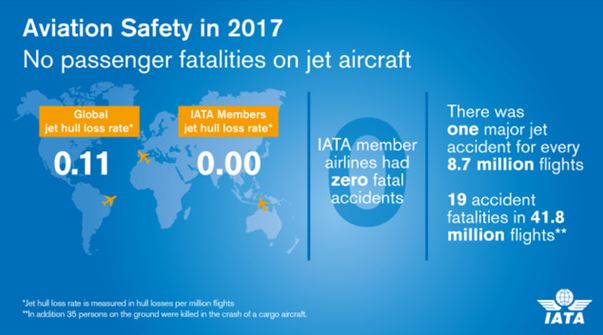
The 2017 rate for major jet accidents (measured in jet hull losses per 1 million flights) was 0.11, which was the equivalent of one major accident for every 8.7 million flights. This was an improvement over the rate of 0.39 achieved in 2016 and also better than the five-year rate (2012-2016) of 0.33.
There were 6 fatal accidents with 19 fatalities among passengers and crew. This compares with an average of 10.8 fatal accidents and approximately 315 fatalities per year in the previous five-year period (2012-2016). In 2016 there were 9 fatal accidents and 202 fatalities.
None of the 6 fatal accidents involved a passenger jet. Five involved turboprop aircraft and one involved a cargo jet. The crash of the cargo jet also resulted in the deaths of 35 persons on the ground, as well as the crew of the jet.
IATA member airlines experienced zero fatal accidents or hull losses in 2017 with jet or turboprop equipment.
“2017 was a very good year for aviation safety. Some 4.1 billion travelers flew safely on 41.8 million flights. We saw improvements in nearly all key metrics—globally and in most regions. And our determination to make this very safe industry even safer continues. In 2017 there were incidents and accidents that we will learn from through the investigation process, just as we will learn from the recent tragedies in Russia and Iran. Complementing that knowledge are insights we can gain from the millions of flights that operate safety. Data from these operations is powering the development of predictive analytics that will eventually enable us to eliminate the conditions that can lead to accidents. The industry knows that every fatality is a tragedy. Our common goal is for every flight to take-off and land safely,” said Alexandre de Juniac, IATA’s Director General and CEO.
2017 Safety Performance:
| 2017 | 2016 | 5-year average (2012-2016) | |
| On-board Fatalities ¡ | 19 | 202 | 314.6 |
| Total Accidents | 45 | 67 | 74.8 |
| Fatal Accidents | 6 | 9 ¡¡ | 10.8 |
| Fatality Risk ¡¡¡ | 0.09 | 0.21 | 0.24 |
| Fatal Accidents Passenger Flights | 2 | 3 | 5.6 |
| Fatal Accidents Cargo Flights | 4 | 6 | 4.6 |
| % of accidents involving fatalities | 13.3 | 13.4 | 14.4 |
| Jet hull losses | 4 | 13 | 10 |
| Jet hull losses with fatalities | 1 | 4 | 3.4 |
| Turboprop hull losses | 9 | 7 | 15 |
| Turboprop hull losses with fatalities | 5 | 4 | 7.2 |
Progress in Africa
Sub-Saharan Africa continued to make strong progress on safety. Airlines in the region had zero jet hull losses and zero fatal accidents involving jets or turboprops for a second consecutive year. Both the turboprop hull loss rate and the all accident rates declined against the average of the previous five years. However, the turboprop hull loss rate increased compared to 2016 (5.70 vs. 1.52). In turn, this largely was responsible for causing an increase in the all accident rate compared to 2016 (6.87 vs. 2.43).
“Airlines in Sub-Saharan Africa continued to improve their safety performance. The goal is to achieve world-class safety. For a second year in a row, airlines in the region experienced no passenger fatalities and no jet hull losses. But there is still a large gap to cover in the safety performance of the continent’s turboprop fleet. Global standards such as the IATA Operational Safety Audit (IOSA) are making a difference. Counting all accidents, the performance of African airlines on the IOSA registry was more than three times better than non-IOSA airlines in the region. That’s why we continue to encourage African nations to incorporate IOSA and the IATA Standard Safety Assessment (ISSA) into their safety oversight systems. ISSA, which is intended for those carriers that are not eligible for IOSA, also offers a one-term opportunity to operators of aircraft that would otherwise fall under IOSA, enabling an incremental approach to achieving IOSA,” said de Juniac.
In parallel, African governments must accelerate the implementation of ICAO’s safety-related standards and recommended practices (SARPS). As of year-end 2017, only 25 African countries had at least 60% SARPS implementation,” said de Juniac.
Six-Point Safety Strategy
IATA’s Six Point Safety Strategy is a comprehensive data-driven approach to identify organizational, operational and emerging safety issues:
- Reducing operational risk such as LOC-I (Loss of Control In-flight), CFIT (Controlled Flight Into Terrain) and RE (Runway Excursions)
- Enhancing quality and compliance through audit programs
- Advocating for improved aviation infrastructure such as implementation of performance-based navigation approaches
- Supporting consistent implementation of Safety Management Systems
- Supporting effective recruitment and training to enhance quality and compliance through programs such as the IATA Training and Qualification Initiative
- Identifying and addressing emerging safety issues, such as lithium batteries and integrating remotely-piloted aircraft systems (RPAS) into airspace.