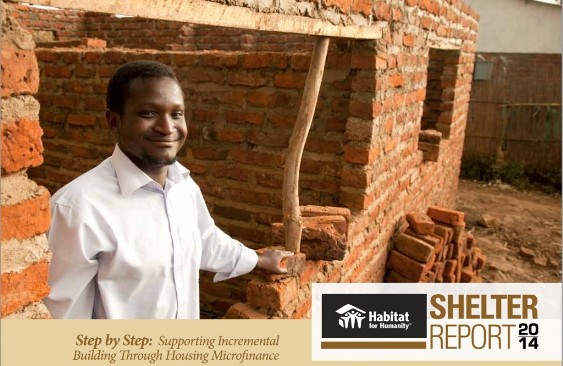

Habitat for Humanity has just published a report on how Housing Microfinance (HMF) can be effective when used in conjunction with incremental building: ‘In our rapidly urbanising world, decent living conditions are becoming scarce, especially in developing countries. The lack of economic opportunities in rural communities is encouraging a global urban migration, but many of the world’s cities do not have the capacity to support this influx of new inhabitants.
This trend, combined with unsupportive regulatory environments, the lack of adequate housing units, and the lack of access to financing for these poor populations, has led to the creation of informal settlements in and around many of the world’s growing cities.
Incremental construction is the way that these informally settled populations have adapted to the constraints of their situation. By slowly saving money under mattresses or in jars, people collect building materials to gradually expand and improve their homes.
These homes are usually not constructed by trained builders, and therefore they generally are not structurally sound. Building materials may be damaged, stolen or spoiled while in storage, resulting in an effective loss of savings that could be avoided through a more formalised savings system or access to financing.
Housing microfinance has the ability to support these households in this incremental building process by allowing them to purchase enough labour and building materials to complete an element of their home that will not degrade while waiting for the next phase of construction, therefore decreasing the loss of savings.
The advent of microfinance enabled large scale access to finance — and consequently economic growth — in informal sectors around the world. Similarly, housing microfinance has the ability to unlock the potential of progressive informal housing practices to increase access to safer, healthier and less impoverished living conditions for the world’s poor. By applying the principles that made enterprise microfinance successful to housing, policymakers, impact investors, developers, material suppliers and microfinance institutions have the ability to reshape inadequate living conditions around the world.
We need to encourage market solutions such as housing microfinance for high-quality incremental building. When bundled with basic housing support services, housing microfinance, including savings, credit, remittances and insurance services, can lead to scalable, replicable and sustainable solutions.
Image Credit: Opic