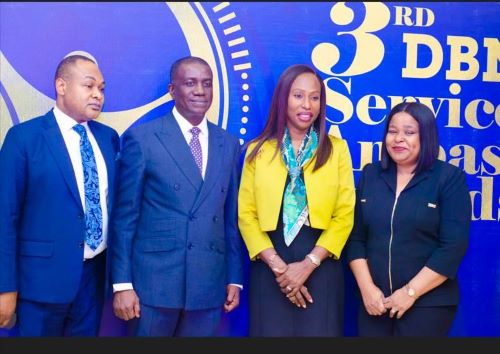
Polaris Bank Signs Up to PAPPS to Ease Customers’ Cross Border Payment

Polaris Bank, Nigeria’s leading digital retail Bank, has enrolled in the Pan-African Payment and Settlement System (PAPSS). The cross-border financial infrastructure empowers the Bank’s existing and potential customers to execute trade and payments across Africa seamlessly.

The inter-African trade payment gateway is a solution designed to empower those who trade international within African continent, with streamlined, efficient, and secure payment processes.

Speaking on the digital payment gateway, Polaris Bank’s Group Head, Global Trade Business, Ayo Adesanya, said the launch of PAPPS underscores the Bank’s commitment to leveraging innovative solutions to simplify processes for customers.

The Banker added that PAPPS is embedded with several unique key features and delivers immense benefits for the Bank’s current customers and prospects. These features include seamless transaction management; meaning merchants and those involved in regional trade can now initiate and track cross-border payments within a single, user-friendly platform.

“The payment gateway offers a centralised hub for managing transactions, and hitherto multiple currency exchange systems. This feature reduces currency exchange risks and associated costs, ultimately benefiting our customers’ bottom lines.” she further disclosed.

PAPPS also bolsters compliance and security as the payment gateway incorporates robust security measures to safeguard sensitive financial information, ensuring that transactions are executed securely and in compliance with international regulations.

“Polaris Bank signing up to PAPPS, developed by AfreximBank, is poised to ease international trade by simplifying payment processes, reducing risks, and enhancing efficiency. It empowers businesses to seize new opportunities in the continent and regional marketplace,” the Group Head stated.

Polaris Bank was adjudged Digital Bank of the Year in 2021 and 2022, 2023 by BusinessDay’s Banks and Other Financial Institutions (BAFI) Awards. It also emerged as the Best MSME Bank of the Year in 2022 and 2023 because of its ability to use technology to enable bottom-up support to the MSME sector.


spot_img
spot_img
spot_img
spot_img

Hot this week

What Every Brand, Tourism Board, Communications Leader Can Learn from Ojude Oba 2026

The Ojude Oba Festival is no longer merely one...

Understanding Why Corporates Need Credit Rating

As we transition into the second half of 2026,...

SERAP Sues NNPCL Over Alleged ‘Failure to Account for N5.9bn Rebranding Cost’

The Socio-Economic Rights and Accountability Project (SERAP) has filed...

RMB Supports Ministry of Finance Nigeria in Unlocking Regional Trade

RMB recently played a central role in concluding a...

Obasanjo Calls for National Drive to Develop Nigeria’s Adire Industry at Ecobank Adire Lagos Experience

Former President of Nigeria, Olusegun Obasanjo, has called for...

Topics

Nigeria Secures Permanent Seat on the Board of African Central Bank

During the just-concluded 39th Session of the Executive Council...

UN: $910m Urgent Aid Required for North-East in 2025

 A total of just over US$ 910 million is...

Africa Power Vision Plans to Electrify 80% of Households by 2040

Africa’s electrification recently welcomed a new advocate, Africa Power...

Equatorial Guinea to Build West Africa’s 1st LNG Storage, Regas Plant

Located at the Port of Akonikien, the landmark regasification...

Airtel Partners Ecobank for Access to Mobile Financial Services

Airtel Africa with operations in 14 countries across Africa,...

Nigeria Must Rethink Forex Policy to Spur Investment

There is need for Nigeria to seriously rethink her Forex policy to spur investment and quicker economic recovery. At the same time, the country recorded growth of only 3.96% y/y in Q1, 2015, down from 5.9% in Q4-2014, according to Razia Khan, Economist at Standard Chartered Bank, London. She said Nigeria’s oil sector contracted by 8% y/y in Q1, following growth of 1% in the previous quarter. “Decelerating growth was seen across most sectors in Q1, with the exception of crop production. Q2 growth may be slower still, reflecting a slowdown in activity around the elections, and the transition to a new government.”

Why Celestine Omehia Deserves No Pity

By Haniel Ukpaukure Did he not see it coming? I’d...
spot_img

Related Articles

Popular Categories

spot_imgspot_img