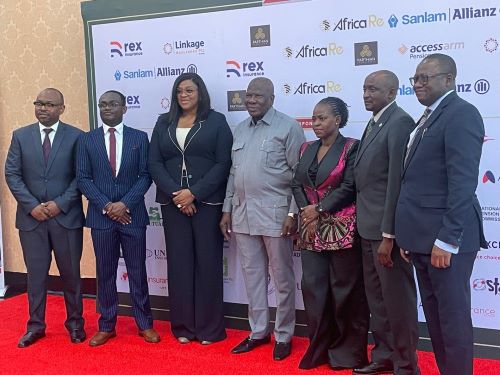

The National Pension Commission (PenCom) has reiterated that it will redesign the Micro Pension Plan to boost financial inclusion especially in the informal sector.
This was disclosed at the 2025 Annual Conference of the Nigerian Association of Insurance and Pension Editors, with the theme, “Strengthening Insurance and Pension Frameworks for Better Economy.”
Micro Pension Plan is an arrangement under the Contributory Pension Scheme that allows the self-employed and persons working in organisations with less than three employees to make financial contributions towards the provision of a pension for their retirement or upon incapacitation.
Speaking at the conference, the Director-General, PenCom, Ms. Omolola Oloworaran, who was represented by Head, Corporate Communications, PenCom, Mr. Ibrahim Buwai, averred that the majority of the Nigerian workforce was in the informal sector.
He said: “Let’s talk about this issue of expanding the Contributory Pension Scheme towards increasing financial inclusion to grow the informal sector. Even though the data out there of the Nigerian labour force says 70 million or 80 million or what have you. Be that as it may, the consensus there is that the labour force out there largely resides in the informal sector.
“How we bring the informal sector under the contributory pension scheme is made even more important in a country like Nigeria, in order to strengthen the social safety net.” is not that strong. So, pension is what will come in handy to achieve that.
The Micro Pension Plan was launched in 2019 by the National Pension Commission (PenCom), but unfortunately, it has not gained much traction as it has only about 200,000 contributors registered under that plan with an asset of about a billion naira, which is very insignificant.
“What we are engaged in doing now is looking at totally redesigning that product. And in the next few weeks, we are going to come out with a newly branded micro pension plan now called Personal Pension Plan. We recognise the issues with the product. One of the key elements of the product is that that product is going to be stratified to recognise that various segments of the sector. The new plan will be tailored towards the entire sector to cover Artisans, professionals, entertainers, sportsmen, amongst others.
“But the most important thing is to address the challenges especially around onboarding. I am happy because even the keynote speaker mentioned technology-enabled onboarding, so that is part of what we are looking at. We will put technology in place so that onboarding can be as simple as going to the POS to withdraw or lodge money,” Ms Oloworaran said.
The PenCom DG also disclosed that with the increase in FinTech, the regulators were considering a Super- Agent model for the onboarding in close collaboration with PFAs.
Regarding the deployment of pension fund to economic development, PenCom said that it was one area it was focusing on.
“At the moment, we are renewing impetus to ensure that pension funds are invested in infrastructure, private equity etc. This is a two-pronged approach. Apart from the issue of economic development, we are also concerned about the real returns on investment for the benefit of the retirees and contributors. This is to ensure that the real purchasing power of retirees is well protected.