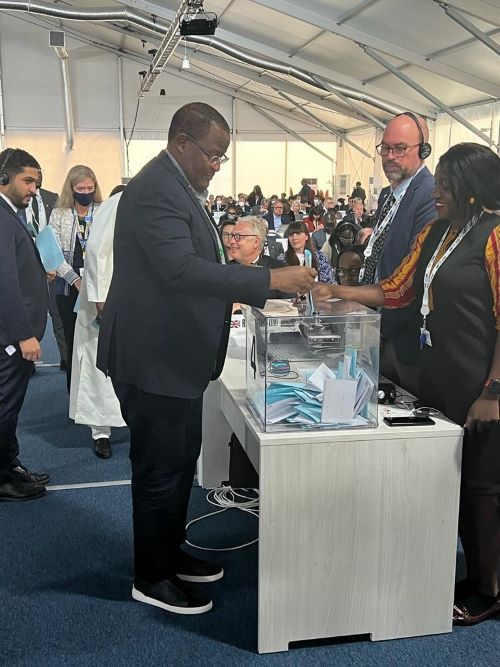

Professor Umar Garba Danbatta, Executive Vice-Chairman and Chief Executive Officer of the Nigerian Communications Commission (NCC) casting his vote at the on-going ITU Plenipotentiary Conference 2022 in Bucharest, Romania on Monday.
In clear recognition of the critical role Nigeria is playing on the global telecom stage, the country was re-elected earlier today as a Council member of the International Telecommunication Union (ITU), the United Nations specialised agency that oversees global telecommunication operations. Nigeria will serve on the Council again from 2023-2026.
The election of Nigeria and other countries, on Monday, October 3, 2022, into different regional groups that constitute ITU Council, was the highpoint of the Plenipotentiary Conference 2022 (PP-22) on-going in Bucharest, the capital city of the Republic of Romania.
The Nigerian delegation was successfully led to the global event by the Honourable Minister of Communications and Digital Economy, Prof. Isa Ali Ibrahim Pantami. Other members of the delegation include the Chairman, Board of Commissioners of the Nigerian Communications Commission (NCC), Prof. Adeolu Akande, and the Executive Vice Chairman/Chief Executive Officer of NCC, Prof. Umar Danbatta.
At the conference, which started on September 26, 2022 and scheduled to end on October 14, 2022, member states at the event voted on the composition of the next ITU Council and the 12 representatives to serve on the Radio Regulations Board (RRB) for the next four years.
The 21st Plenipotentiary Conference of the Council, also saw the election by member states, of Doreen Bogdan-Martin of the United States of America as the organisation’s next Secretary-General.
Like Nigeria and the countries elected into the Council, Bogdan-Martin, as the first woman to lead ITU in its 157-year history, will begin her four-year term from January 2023, when Houlin Zhao would have completed his second final term of four years in office as ITU Secretary General.
The seats in ITU Council are divided into five regions, A to E. Nigeria was elected into the ITU Council, Region D for Africa, which has 13 seats. Other 12 countries elected alongside Nigeria are Algeria; Egypt; Ghana; Kenya; Mauritius; Morocco; Rwanda; Senegal; South Africa; Tanzania; Tunisia; Uganda.
Elections of member states also took place into the Region A for The Americas (nine seats); Region B for Western Europe (eight seats); Region C for Eastern Europe & Northern Asia (five seats); and Region E, for Asia and Australasia with 13 seats as Africa.
Commenting on Nigeria’s re-election as ITU Council member, the Executive Vice Chairman and Chief Executive Officer, Prof. Umar Danbatta, thanked the ITU member states for the confidence it has in Nigeria expressed by the re-elected into the ITU Council, in which the country has been playing critical role over the years.
“The re-election of Nigeria as a member of ITU Council for the next four years, again, points to the globally-recognised leadership role Nigeria is playing in Africa and at the level of ITU Council in the area of telecommunications policy formulation and technical regulations development to drive ITU’s mission and vision,” the EVC said.
The ITU, originally established in 1865 as the International Telegraph Union and became a United Nations specialised agency in 1947, was set up to co-ordinate telecommunications operations and services throughout the world. It is headquartered in Geneva, Switzerland.
Nigeria became a member of ITU on November 4, 1961. The USA joined on July 1, 1908; United Kingdom, February 24, 1871, and UAE on June 27, 1972.
The ITU is governed by the Plenipotentiary Conference and the Administrative Council. The Plenipotentiary Conference is the supreme organ of the Union. It is the decision-making body which determines the direction of the Union and its activities.
The Council, on the other hand, acts as the Union’s governing body in the interval between Plenipotentiary Conferences. Its role is to consider broad telecommunication policy issues to ensure that the Union’s activities, policies, and strategies fully respond to today’s dynamic, rapidly changing telecommunications environment.
ITU Council also prepares a report on the policy and strategic planning of the ITU, and it is responsible for ensuring the smooth day-to-day running of the Union, coordinating work programmes, approving budgets, and controlling finances and expenditure.
The Council also takes all steps to facilitate the implementation of the provisions of the ITU Constitution, the ITU Convention, the Administrative Regulations (International Telecommunications Regulations and Radio Regulations), the decisions of Plenipotentiary Conferences, and where appropriate, the decisions of other conferences and meetings of the Union.