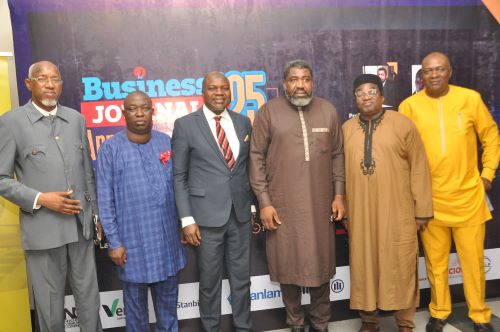

L-R: Garba Kurfi, Managing Director/CEO, APT Securities and Funds Limited; Prince Cookey, Publisher/Editor-in-Chief, Business Journal Media Group; Olatunde Amolegbe, Managing Director/CEO, Arthur Stevens Asset Management Limited and Keynote Speaker; Prof. Anthony Kila, Pro- Chancellor, Michael and Cecilia Ibru University/Chairman of the occasion; Tony Epelle, Managing Consultant/CEO, Samuelson Advisory Partners and Dotun Oladipo, Managing Editor, The Eagle Online, during the Business Journal Annual Lecture 2025 on the theme: ‘AI & Digital Economy: Projecting the Future of Economic Growth in Nigeria’ in Lagos.
Mr. Olatunde Amolegbe, Managing Director/CEO, Arthur Stevens Asset Management Limited has projected that Nigeria’s digital economy revenue will reach $18.30 billion by 2026, as against $5.09 billion in 2019 and $9.97 billion in 2021.
Delivering the keynote paper at the Business Journal Annual Lecture 2025 in Lagos, Amolegbe said:
“Nigeria’s digital economy is undergoing rapid transformation, positioning the country as one of Africa’s leading technology-driven markets. Global trends show the digital economy accounted for $11.5 trillion (15.5% of global GDP) in 2016, with projections to reach 25% by 2026. Aligned with this momentum, the Digital Economy for Africa (DE4A) initiative, anchored on inclusivity, homegrown innovation, collaboration and transformational scale, supports Africa’s vision of achieving full digital enablement by 2030.”
Amolegbe added that Nigeria leads Africa in start-up investment and hosts five unicorns: Interswitch, Flutterwave, OPay, Andela and Moniepoint, reflecting robust private-sector innovation, while Internet penetration reached 107 million users in early 2025, driven by mobile-first access, which now accounts for over 90% of connectivity nationwide.
He said key sectors such as telecommunications already contribute significantly, with 9.20% added to real Gross Domestic Product (GDP) in Q2 2025 while Fintech and digital payments are expanding rapidly, powered by the NIP network, forward-leaning regulations and increased consumer adoption across banking channels.
Speaking on the theme: AI & Digital Economy: Projecting the Future of Economic Growth in Nigeria, Amolegbe insisted that disruptive technologies, social media, streaming platforms, blockchain and Artificial Intelligence (AI) are reshaping Nigeria’s socio-economic landscape.
“Nigeria has demonstrated early adoption, including the launch of its central bank digital currency, the eNaira in 2021.”
The keynote speaker said major economic opportunities exist in agriculture, health, education, infrastructure and energy; sectors still lagging in technological innovation.
“AI can improve yields, strengthen healthcare delivery, expand digital learning, support smarter infrastructure planning and accelerate Nigeria’s transition to smarter and cleaner energy systems. Nigeria’s path to AI-driven digital growth is supported by strong demographics, emerging policy interventions such as NITDA’s AI Strategy and expanding connectivity through eight submarine cables totaling over 40 Tbps in capacity.”
He warned however, that to fully unlock the economic value in AI and digital economy, Nigeria must strengthen governance, talent pipelines, digital infrastructure and regional collaboration.
Key Gaps:
- Infrastructure Deficit in Rural Regions
As of August 2025, Nigeria’s broadband penetration stands at about 48.81%, well below the 70% target of the National Broadband Plan (2020–2025). Although over 45% of the population lives in rural areas, only around 23% of rural communities have internet access, highlighting a significant digital divide and widespread exclusion from digital opportunities.
- Slow Policy Harmonisation and Regulatory Bottlenecks
Despite a 2020 agreement to cap Right-of-Way (RoW) fees at ₦145 per meter, some states now charge as much as ₦9,477 per meter (e.g., Ogun State), raising operating costs for telecom firms to a record ₦5.85 trillion in 2024 — a key factor slowing infrastructure rollout and AI adoption.
- Low Adoption of Automation in Manufacturing, Agriculture and Public Services
In Nigeria’s manufacturing industry, only about 18% of firms have fully implemented AI or automation tools, while around 43% of surveyed companies report having no automation at all. In agriculture, less than 1% of farming households own tractors, and only 6% of arable land is irrigated, indicating a very low level of mechanisation and automation adoption.
Enablers of AI-driven Digital Growth in Nigeria:
- Demographics
220M+ population (Over 50% smartphone penetration by 2025); diaspora remittances fueling tech.
- Policy
NITDA’s AI Strategy- NITDA has established itself as a link connecting local innovators with global technology influencers. A recent instance is the NITDA–Google AI Fund, which assists ten Nigerian startups with funding and technical support.
- Infrastructure
Nigeria is home to eight active submarine cables, which provide over 40 terabits per second (Tbps) of international connectivity capacity landing at its shores.
- Private Sector
Nigeria is home to eight active submarine cables, which provide over 40 terabits per second (Tbps) of international connectivity capacity landing at its shores.
“Nigeria stands at a pivotal moment where digital transformation, powered by AI and disruptive technologies can accelerate long-term economic growth and global competitiveness. The foundations for this transformation, including youthful demographics, expanding connectivity, vibrant private-sector innovation and emerging regulatory frameworks are already established. Realising this potential requires a co-ordinated, ethical and investment-driven national strategy that aligns public-sector policy with private-sector innovation. Strengthening talent development, building digital infrastructure, promoting responsible AI governance and fostering regional collaboration will be critical. With the right investments and policy direction, Nigeria can scale its digital economy, enhance productivity across key sectors, create millions of jobs and position itself as a continental leader in the AI-powered global digital economy.”