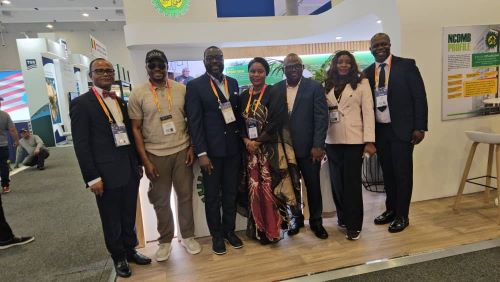

The Nigerian Content Development and Monitoring Board (NCDMB) on Wednesday in Cape Town, South Africa, identified key skill areas it would focus capacity building efforts for optimal job creation opportunities in the Nigerian oil and gas industry.
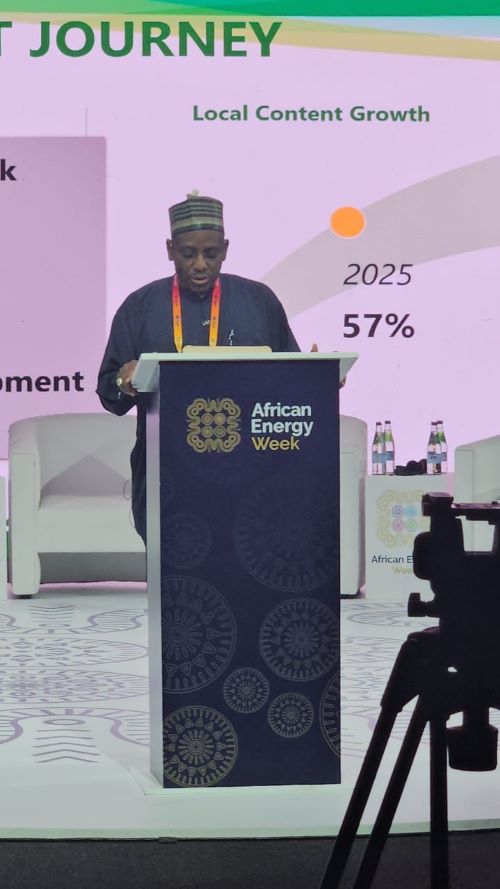
The Executive Secretary of the Board, Engr. Felix Omatsola Ogbe disclosed this in his keynote address at the on-going Africa Energy Week (AEW), as he shared Nigeria’s success story in local content development.
The skill areas highlighted for special focus include underwater welding, subsea engineering, geosciences, project management, deepwater operations (drilling, production engineers), instrumentation and controls.
Others are digitalisation including Artificial Intelligence (AI), helicopter pilots, with a delivery model that is based on classroom and hands-on approach.
Delivering the address entitled “From Policy to Prosperity: Scaling Local Content for Africa’s Energy Future,” the Executive Secretary said no policy succeeds without people, and that challenges such as infrastructure gaps and financing limitations “are not reasons to slow down” but “reasons to deepen collaboration between government, operators, service companies and host communities” to co-create solutions.
He pointed out that in the aforementioned challenges and expected solutions are a shared opportunity for African countries to “harmonise local content policies, create regional supply chains, and leverage continental institutions like the emerging African Energy Bank.”
He further charged African countries to ensure that the skills of citizens, the creativity of entrepreneurs and strength of their institutions define the future of African energy.
The Executive Secretary, who was represented by the Director, Corporate Services of the NCDMB, Dr. Adbdulmalik Halilu, noted that the local content strategy developed by the Africa Petroleum Producers Organisation (APPO) for member countries and the Africa Continental Free Trade Agreement policy of the African Union are “clear pathways towards fostering trade-based multilateral cooperation within the continent.”
He emphasised that scaling local content requires human capital development and deployment, infrastructure development, technology and innovation, cross-border collaboration and partnerships (common standards, tariff and demand), in addition to policy harmonization.
On Nigeria’s local content journey, with in-country value addition now at 57 per cent, up from five per cent in 2010, when the Nigerian Oil and Gas Industry Content Development (NOGICD) Act, 2010, the NCDMB boss said the overarching objective was to position Nigeria as the destination of choice for investment in exploration and production (E&P) but most importantly to create jobs for citizens and new industries supporting E&P value chain, while ensuring sustainable operations for future generations.
Local content implementation, according to him, was anchored on six broad pillars, namely, regulatory framework, gap analysis, capacity building, incentives and funding research and development (R&D), and access to market, and driven by several policy interventions.
The policy interventions include Equipment Component Manufacturing Initiative, which requires companies to obtain Nigerian Content Equipment Certificate to qualify for supply of equipment; marine vessel categorization scheme, which requires companies to provide proof of indigenous ownership of marine vessels to qualify for vessel contracts; project-based training, which requires project promoters to commit a percentage of project cost to industry-relevant training.
On accomplishments under the NOGICD Act, Engr. Ogbe declared: “Nigeria now hosts a world-class fabrication and integration yard for fabrication of production platforms and integration of Floating Production Offloading and Storage (FPSO) vessels, high voltage cables and fiber optics for LNG train.” Also, that production platforms are now produced from Nigerian cable manufacturers, while design engineering capacity exists for onshore, offshore, LNG, [and] gas gathering facilities.”
He disclosed that operators like Renaissance Africa Energy Limited, Seplat and Oando are taking over assets from international oil companies (IOCs), under a divestment programme, and would become key contributors to Nigeria’s target to achieve three million barrels per day production by 2030.
He noted that recent Executive Orders by the Administration of President Bola Ahmed Tinubu that introduced tax incentives tied to time-bound upstream investment and cost leadership and also intended to accelerate contract processing cycles for oil and gas projects, from 36 months to six months, have birthed major projects such as UBETA Gas Development Project and Bonga North Project, among others that are in the pipeline.
Engr. Ogbe concluded with a firm assurance to other oil- and gas-producing countries on the continent that NCDMB is committed to partnering them all “to build an African energy sector that is owned, operated, and sustained by Africans.
The African Energy Week, organised by the African Energy Chambers, is an interactive exhibition and networking event, attended by energy policymakers, operators and service companies in the oil and gas industry and prospective investors, among others.