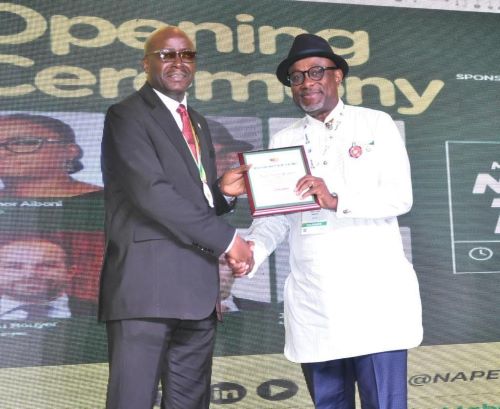

Executive Secretary presented with an award in appreciation for delivering a goodwill message at the 41st Annual International Conference and Exhibition
The Executive Secretary Nigerian Content Development and Monitoring Board (NCDMB), Engr. Simbi Kesiye Wabote has warned that Nigeria might resort to importing crude oil for its upcoming and existing refineries if concerted efforts are not made to increase the current low production numbers.
He gave the warning in his goodwill message at the 41st Annual Conference and Exhibition of the Nigerian Association of Petroleum Explorationists (NAPE) in Lagos.
The NCDMB ES bemoaned Nigeria’s low production of crude oil and gas despite the abundant reserves and challenged members of the Nigerian Association of Petroleum Explorationists (NAPE) and other industry stakeholders to initiate efforts to reverse the situation.
He emphasised that the nation’s 37 billion barrels of oil reserves needed close attention bearing in mind the various efforts at revamping the refineries and commissioning of greenfield refineries.
According to him, “it will be a sad outcome if we stop the importation of refined petroleum products only to replace it with the importation of crude oil for use in our local refineries.”
He praised the important role of petroleum explorationists in the energy mix, especially in discovering, evaluating, and establishing the reliability and sustainability of the size of oil and gas reserves.
Dwelling on gas, the Executive Secretary hinted that Nigeria has about 208 trillion cubic feet (TCF) of proven gas reserves and about 600TCF unproven reserves. He subsequently charged petroleum explorationists to apply their skills and technology toward confirming the recoverable volumes from these unproven reserves and developing the proven reserves.
He hinted that the focus on gas is important because gas is no longer Nigeria’s transition fuel but the destination fuel.
He assured that NCDMB is committed to providing all the necessary support to realise the gas business agenda of President Bola Tinubu.
Commenting on the conference’s theme which is “Repositioning the oil and gas industry for future energy dynamics,” the NCDMB boss noted that the world stands at a key point where adequate consideration must be made to address the Energy Trilemma, which is, achieving an appropriate balance between energy security, sustainability, and affordability.
He added that the oil and gas industry has been a key pillar of global energy as it has powered and continues to power industrial and economic developments across the world.
He indicated that repositioning the Nigerian oil and gas industry for national development required collaboration and partnerships with key players and agencies across the upstream, midstream and downstream sectors and its entire value chain.
He added that the Nigerian Oil and Gas Content Development Act (2010) provided the compass to enable the development and growth of local capacities and capabilities in the Nigerian oil and gas industry.
Waboted commended the Federal Government’s determination to sustain the gains realized in the oil and gas industry and the eagerness to consolidate them rather than reverse the gains of Nigerian Content.
He conveyed the Board’s readiness to support various oil and gas initiatives that would ensure patronage of local investments, boost investors’ confidence, and create jobs to sustain the relative peace in the oil and gas sector.