



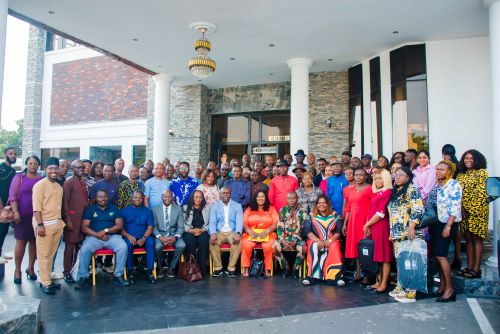


The Nigerian Content Development and Monitoring Board (NCDMB) in Port Harcourt challenged practising journalists and other media stakeholders to deploy their skills in interrogation of reports on Nigerian Content performance in the oil and gas industry, so as to make the facts behind the resounding success in in-country value addition known to citizens.
Speaking at a one-day workshop themed “The Role of the Media in Maintaining the Tempo of Nigerian Content Implementation,” the Executive Secretary of the NCDMB, Engr. Felix Omatsola Ogbe, said the Board profoundly appreciates the capacity of the mass media to inform and educate the populace and has chosen forums such as the workshop to bring practitioners up to speed with its activities.
According to him, “in 2025 NCDMB will be 15 years; looking at what we have been doing, the impact we have made in the oil and gas industry, moving Nigerian Content from less than five per cent in 2010 when we started to now 56 percent…we have made significant progress.”
Putting the growth in local content in context, he said, “for every N100 spent in the industry by operators and service companies, N56 is now retained in-country in terms of value addition [local assets, goods, expertise, etc. utilised].” Continuing, he added, “Our target is to be at 70 per cent by 2027.”
“You need to interrogate us more,” he reasoned, noting, “How did we get there? What are the metrics used [in computation]? That’s what will make your reporting adequately informative.” He assured the journalists that the Board would be supportive whenever they seek such clarification.
The Executive Secretary, who was represented by the General Manager, Corporate Communications and Zonal Coordination, Barrister Esueme Dan Kikile, said the Board has identified the integration of host communities into the oil and gas supply chain as one of the critical enablers of the strategic goal of 70 per cent by 2027, and has decided on appropriate measures.
He reaffirmed that the Board would implement the Back-to-the-Creeks Initiative designed to deepen the contributions of the oil and gas industry to the local communities through support of basic education, making affordable finance accessible to community contractors, equipping youths with relevant industry skills among other support that would benefit the local economy.
He emphasised that the Board has reviewed upwards its Community Contracting Financing Scheme to enable contractors in host communities to secure and execute reasonable contracts in the oil and gas industry. The single obligor has now been raised from N20 million to N100 million which, as the Board explained, “gives local contractors more opportunities to access higher figures.”
These measures, among others, are intended to minimise or completely eliminate conflicts, and thus create a peaceful and harmonious operating environment for oil and gas companies.
He identified the role journalists to the sustenance of the local content programme. According to Engr. Ogbe, “We expect the media to interrogate these [policy initiatives and planned interventions] and also follow up and ensure that NCDMB is able to accomplish these, because it will help our communities; it will help our young people.”
The workshop also had three paper presentations and two sessions of panel discussion. In the first presentation entitled “Implementing Nigerian Content New Contracting Guidelines,” Engr. Bashir Ahmed, a Supervisor of the Project Certification and Authorisation Directorate (PCAD), NCDMB, threw light on foundational facts regarding the NCDMB and its operations, such as Mandate and Mission Statement, Necessity for a Local Content Framework, a Regulatory Framework, Ministerial Regulations, Presidential Directives, and Guidelines.
He dwelt at length on the Presidential Directives issued by President Ahmed Tinubu in March 2024, in a deliberate effort to reverse the decline in foreign investments in the oil and gas industry.
The Directives were three, namely, “Presidential Directive on Local Content Compliance Requirement,” “Presidential Directive on Reduction of Petroleum Sector Contracting Cost and Timeline,” and “Presidential Directive on Oil and Gas Companies (Tax Incentives, Exemptions, Remission, etc.). Only the first two impact the operations of the NCDMB significantly.
Goals of the Presidential Directives, according to Government, include reducing the time it takes to conclude oil and gas contracts, eliminating intermediaries, and developing processes to verify and document in-country capabilities.
In his explanation Engr. Ahmed said the Directive on Reduction of Petroleum Sector Contracting Cost and Timeline “aims to hold the NCDMB and operators to strict reviews and approval timelines,” among other things.
He pointed out that “Timelines were never alien to NCDMB,” as the Board had introduced and put into use service-level agreements (SLAs) years ago. According to him, “SLA-compliance has driven our PEBEC (Presidential Enabling Business Environment Council) rankings.” (PEBEC ranked NCDMB as the Best Performing Agency for efficiency and transparency among ministries, departments and agencies in 2022, 2023 and 2024.)
Generally, the Directives were aimed at protecting companies with investments in-country and eliminating briefcase agents. Capacity audit of key segments of the industry have to be carried out to eliminate intermediaries.
On the gains of Federal Government’s initiative, he said, “the PDs have given new life to prospects of new final investment decisions (FIDs) for major projects. Projects that had been dormant are now being revived as the affected investors are returning to Nigeria for fresh negotiations.
He pointed out that “More FIDs mean new investments and more jobs, more projects more local content,” which is good for the economy, he added.
In the second presentation entitled “Nigerian Content Measurement Metrics and 10-Year Strategic Road Map,” the General Manager, Midstream of NCDMB, Mrs. Tassala Tersugh, explained that performance monitoring involves “monitoring of progress against Nigerian Content commitments and the NOGICD Act.” Compliance monitoring, on the other hand, is checking compliance with statutory requirements.
On key parameters for sustainable local content, she listed Regulatory Framework, Capacity Building, Gap Analysis, Research and Development, Funding and Incentives, and Access to market.
The third presentation, “Purpose-driven Journalism in the Age of Artificial Intelligence,” by Mr. Lekan Otufodunrin, a former Editor with The Punch and Media Career Coach, dwelt on the value Artificial Intelligence (AI) brings to the work of the journalist and the limitations that have to be dealt with.
According to him, “If you have data, AI can analyse it for you”, it can sift data and give content; AI tools would “generate images, videos, photos, transcribe, and turn text to audio and vice versa.” Nonetheless, the tools cannot replace the individual’s capacity to think.
A journalist that is purpose-driven must have a goal, a vision, passion, and more, and would spare no efforts in acquiring appropriate skills and knowledge to make the best of AI, according to him. AI would enhance content sourcing and production, but mastery of the tools is required for efficiency.
Otufodunrin advised journalists to have timelines to measure their careers and to be intentional, to set out that they want to succeed at what they are doing. They have to be ethical, to indicate that AI tools are used wherever applicable and never claim to be creator of such material.
In the first panel session, the discussants, namely, Engr. Bashir Ahmed and Mrs. Tassala Tersugh, with the moderator, Dr. Obinna Ezeobi, Deputy Manager, Corporate Communications, examined what it would take to achieve the 70% target for Nigerian Content by 2027. Engr. Ahmed said the Board has to “take cognizance of market realities – how do we increase projects.”
In addition, it would be rewarding if indigenous oil and gas companies strive for specialisation, concentrating their resources and energies where they could deliver value best.
To the second question, has the Monitoring and Evaluation (M&E) Directorate got the tools, capacity for its tasks?” Mrs. Tersurgh answered in the affirmative, adding, “We are not afraid to ask for help when necessary,” and that “The Board allows the M&E Directorate to engage Third Party monitors.” Besides, NCDMB works closely with other agencies in the industry, notably, the Nigerian National Petroleum Company Limited (NNPCL), Nigerian Upstream Petroleum Regulatory Commission, the Nigeria Immigration Service, and others.
In the second panel session were Professor Diri Teilanyo and Dr. Doubra Timi-Wood, with Dr Ezeobi as moderator.
Media practitioners and stakeholders from over 90 media organisations attended the workshop. Key Management staff at the workshop included Mr. James Eyetigha, Zonal Coordinator, Delta and Edo States and Dr. Emma Ohanere, Zonal Coordinator, Abia and Imo States.