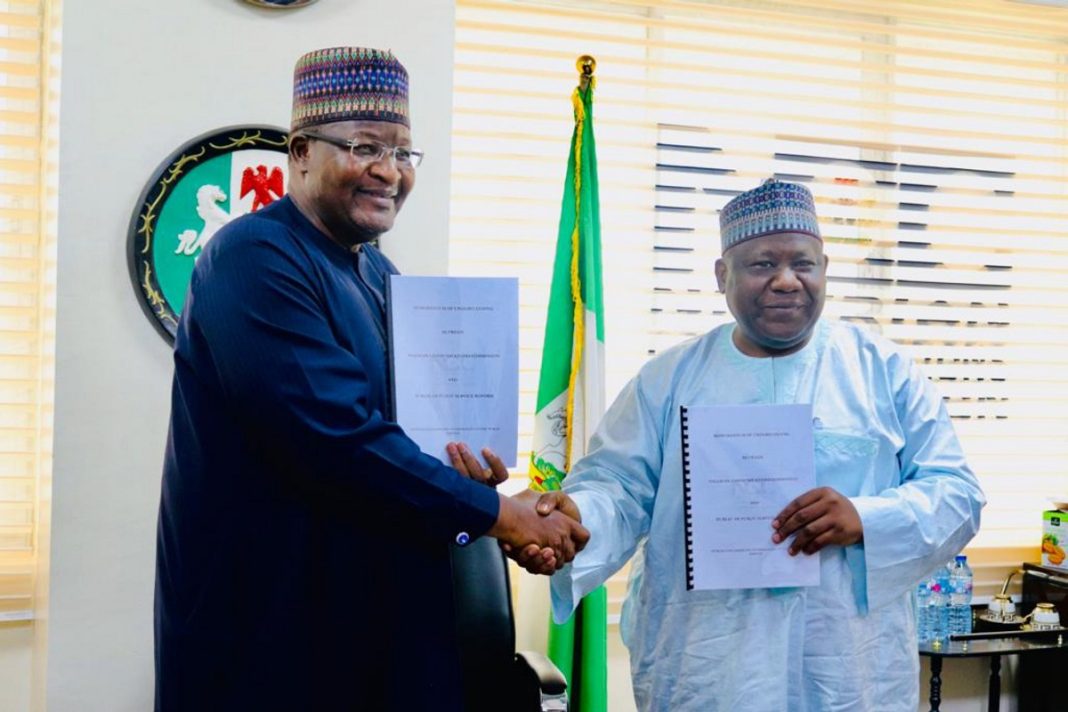

From Left: Prof. Umar Danbatta, Executive Vice Chairman/Chief Executive Officer, Nigerian Communications Commission and Dr. Dasuki Arabi, Director General, Bureau of Public Service Reform, during the Memorandum of Understanding (MOU) signing ceremony to strengthen collaborations between the agencies at the NCC’s Head Office in Abuja recently.
For a start, the Executive Vice Chairman of the Nigerian Communications Commission (NCC), Prof. Umar Danbatta and the Director-General, Bureau of Public Service Reforms (BPSR), Dr. Dasuki Arabi have penned a Memorandum of Understanding (MoU) to jointly work towards accelerating the digitisation reform process in government.
Speaking at the event, which took place at the NCC’s Head Office in Abuja recently, Danbatta said collaboration between the two organisations is consistent with NCC’s Strategic Vision Plan (SVP) to partner and collaborate with relevant stakeholders.
He noted that the MoU will enhance efficiency and productivity as it adequately captured the roles of enabling policies and implementing institutions, which are key features of digital transformation.
He also said the Commission will continue to drive broadband penetration, which provides the backbone upon which such process will thrive.
According him, “it is for this reason that the Nigerian National Broadband Plan document, made adequate provisions for the deployment of broadband infrastructure across the country. It is this same infrastructure that will drive services that will result in the transformation of governance as well as the key services sector in the economy,” he said.
Danbatta said at the completion of the process, governance will be paperless, chief executive officers would be able to deal with their mails without necessarily signing most things offline because virtually everything will be done online.
“Indeed, the transition will be worth it, as the process is associated with efficiency, which naturally results from operating a paperless system of governance or administration at the level of entities such as the Bureau for Public Service Reforms and the Nigerian Communications Commission,” he said.
“We attach a lot of importance to the way and manner we collaborate with sister agencies of government to give translation or to ensure the actualisation of that important item of our Strategic Vision Plan that is strategic collaboration and partnership, it explains why we are signing this Memorandum of Understanding.
In his response, Arabi revealed that the Bureau took the decision to work with the Commission in driving the reforms for the adoption of emerging technologies as a result of NCC’s emergence as the first organisation to win the Platinum Award of BPSR, exceeding expectations in the way it conducts its businesses.
“Historically speaking, this partnership had begun in 2016 when the Commission became the first agency of government to undergo the BPSR online Self-Assessment Tool (SAT). Remarkably, at the end of the assessment, NCC emerged as the first agency to be rated Platinum Organisation by the Tool, having exceptionally exceeded expectations in all good practices built around nine domain areas” Dasuki stated.
Underscoring his submission, Arabi said: “Given the successful outcomes of the workshops and conferences NCC organised in collaboration with BPSR on the Distributed Ledger Technologies (the Blockchain) in 2022 in Lagos and Abuja, the MoU is providing a window of opportunity to consolidate efforts to deliver strong and resilient public service that will lead a well-functioning federal system wherein zero tolerance for corruption is made practicable.
“The MoU will also help in fostering of a high degree of cooperation between Federal and State governments in improving service delivery and addressing Transparency International Corruption Perception Index to significantly improved safe and secured environment that encourages economic growth and investment.”
Arabi said that efforts to improve equitable and unhindered access to government information and services through the Federal Government’s Scorecard for ranking websites of Ministries, Departments and Agencies (MDAs) are producing a direct impact on the socio-economic development of the country.