
- LTE subscriptions will expand by 47 percent from 30 million in 2017 to 310 million by 2023 in Sub-Saharan Africa.
- Sub-Saharan Africa mobile broadband subscriptions are forecasted to grow by 16 percent from 350 million in 2017 to 880 million by 2023.
- The first 5G subscriptions in the Middle East and North Africa are expected from 2020, reaching around 17 million subscriptions by the end of 2023.
The latest regional appendix to the upcoming Ericsson Mobility Report forecasts that LTE subscriptions will expand by 47 percent from 30 million in 2017 to 310 million by 2023 in Sub-Saharan Africa.
The report also announces that mobile subscriptions in Sub-Saharan Africa are expected to grow by six percent, between 2017 and 2023, from 700 million mobile subscriptions in 2017 to 990 million subscriptions by 2023.
Moreover, mobile traffic in the Middle East and Africa (MEA) will increase at a compound annual growth rate (CAGR) of 49 percent while mobile subscriptions for the total MEA region are expected to grow at four percent CAGR between 2017 and 2023, from 1.59 billion in 2017 to 2.03 billion by 2023. This equates to three percent growth in the Middle East and North Africa, from 890 million mobile subscriptions to 1.04 billion subscriptions between 2017 and 2023.
On the other hand, mobile broadband subscriptions are forecast to grow by 15% for the MEA region from 820 million in 2017 to 1.85 billion by 2023. This is broken down into a 13 percent increase for the Middle East and North Africa from 460 million mobile broadband subscriptions in 2017 to 980 million by 2023. Similarly, Sub-Saharan Africa mobile broadband subscriptions are forecasted to grow by 16 percent from 350 million in 2017 to 880 million by 2023.
When it comes to LTE subscriptions, the MEA region is expected to grow by 29 percent from 190 million to 860 million by 2023. This means that LTE subscriptions in the Middle East and North Africa will grow by 23 percent from 160 million in 2017 to 570 million by 2023. For the Sub-Saharan Africa region, LTE subscriptions will expand by 47 percent from 30 million in 2017 to 310 million by 2023.
Rafiah Ibrahim, Head of Ericsson Middle East and Africa, said: “Total mobile traffic for the region is forecasted to grow by around 49 percent annually between 2017 and 2023. This rapid growth is seeing operators increasingly exploring methods of optimizing their networks with more capacity and coverage. We are supporting operators across the region throughout the different phases of the network evolution, enabling best performing networks and differentiated customer experience.”
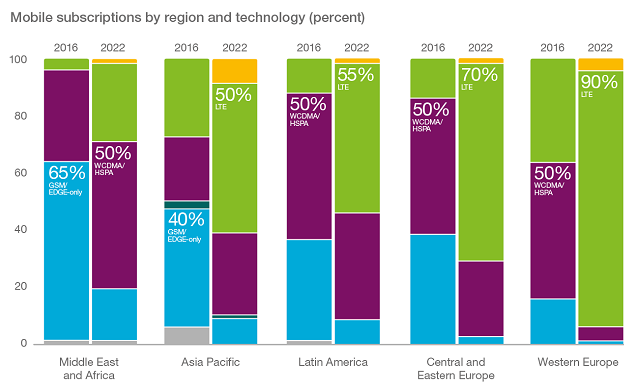
Finally, the report mentions that in the Middle East and North Africa, strong growth is forecasted for both WCDMA/HSPA and LTE during the period. Combined, these technologies will see a rise from 50 percent to over 90 percent of total subscriptions by the end of the period.
The first 5G subscriptions in the Middle East and North Africa are expected from 2020, reaching around 17 million subscriptions by the end of 2023.
Further highlights from the regional appendix of the Ericsson Mobility Report include:
The Internet of Things (IoT) is facilitating the digital transformation of industries, and providing mobile operators in the Middle East and Sub-Saharan Africa with opportunities to explore new revenue streams.
Cellular IoT subscriptions in the Middle East and Africa are expected to grow from 35 million to 159 million between 2017 and 2023 – a compound annual growth rate (CAGR) of around 30 percent.
Exploring new digitalisation revenues
For mobile service providers, traditional revenue sources are shrinking, and so new revenue streams are being explored. As the world becomes more connected, industries are experiencing an ICT-driven transformation. Industry digitalization revenues for ICT players come from adopting or integrating digital technologies into a specific industry. 5G-enabled industry digitalization revenues for IoT in the Middle East and Africa are predicted to reach $242 billion through 2026.
5G will be an important technology in growing industrial digitalization, particularly for use cases dependent on extra-low latency and high reliability. This presents an opportunity for service providers that are ready to explore smart revenue streams addressing B2B2X industry players.
IoT and 5G serving communities
Even though IoT is still in its infancy throughout most parts of the Middle East and Africa, there are still examples of how it has helped improve the livelihood of communities and industries in the region.
For example, in South Africa, Narrowband-IoT (NB-IoT) is being introduced to address the utilities sector, enabling tools for energy efficiency such as smart meters.
The global edition of the Ericsson Mobility Report will be released later this month.