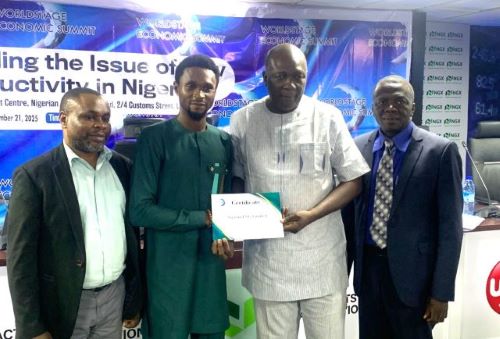
L-R: Dr. Abidemi Cornelius Adegboye, Department of Economics, University of Lagos; Mr. Adeniran Adebayo, Chief Superintendent of EFCC representing Mr. Olanipekun Olukoyede, Executive Chairman, Economic and Financial Crimes Commission (EFCC); and Mr. Segun Adeleye, President/CEO, World Stage Limited at WorldStage Economic Summit 2025 at the Event Centre, Nigeria Exchange Limited, Lagos on November 21, 2025.
The Economic and Financial Crimes Commission (EFCC) has confirmed that it’s investing heavily in capacity building, digital forensics, and public education, especially among young entrepreneurs who represent the future of Nigeria’s economy in order tackled the emerging challenges such as cybercrime, cryptocurrency fraud, and illicit trade financing require continuous innovation in our enforcement and preventive strategies.
Mr. Olanipekun Olukoyede, Executive Chairman, Economic and Financial Crimes Commission (EFCC) in his address on Friday at the World Stage Economic Summit 2025 (WES 2025) with the theme: ‘Tackling The Issue of Low Productivity in Nigeria” said: “We are aware that corruption is adaptive; it evolves with new technologies and economic models.”
Represented by Mr Adeniran Adebayo, Chief Superintendent of EFCC, he said emerging challenges such as cybercrime, cryptocurrency fraud, and illicit trade financing require continuous innovation in our enforcement and preventive strategies.
The EFCC boss who spoke on the topic “Anti-Corruption Efforts of the EFCC to Boost the Ease of Doing Business in Nigeria” said: “It is an indisputable fact that corruption is not just a moral or legal issue; it is also an economic albatross that undermines productivity, discourages investment, and erodes public trust in institutions.”
He said every Naira lost to corruption translates to fewer schools, fewer hospitals, less infrastructure, and ultimately, fewer productive jobs.
“Globally, investors have been found to consider the adverse effects of corruption on their businesses, so they try to avoid any perceived corruption-filled environment. The reason is not far-fetched: in any environment where corruption thrives, there is bound to be a distortion of competition, an increase in the cost of doing business, and a drag on innovation. Consequently, productivity inevitably declines,” he said.
He said to tackle corruption should not be seen only from the point of view of enforcing laws, but about creating a fair, transparent, and efficient economic ecosystem where legitimate enterprise can thrive.
He said: “Over the years, the EFCC has implemented consistent reforms and policies towards achieving a more effective role in economic governance. Since its establishment, the EFCC has been a key institution in Nigeria’s anti-corruption architecture. Our mandate is clear: to investigate, prevent, and prosecute economic and financial crimes.
“I urge you to take more than a passing interest in our cherished mandate, and you will be greatly thrilled to know that our mandate directly supports the ease of doing business and combats the root causes of low productivity.”
He explained that EFCC had in recent years restructured its operations along Prevention, Investigation and Prosecution and statutorily, “we have collaborated with both local and international organisations to enforce all extant laws and regulations relating to economic and financial crimes.”
He listed the EFCC major anti-corruption initiatives, which had significantly enhanced entrepreneurship and positively impacted Nigeria’s business climate to include anti-corruption compliance framework for businesses; Collaboration with the Presidential Enabling Business Environment Council (PEBEC); Use of Technology and Data Analytics; Strengthening International Partnerships; Asset Recovery and Restitution
“The Commission has raised the bar on convictions and recovered assets worth billions of Naira. These funds are being redirected toward improving social infrastructure, education, and other productive sectors. Each recovery is a clear statement that corruption will no longer be profitable in Nigeria,” he said.
He also noted the activities of EFCC at promoting integrity as a driver of productivity, saying, a transparent business environment fuels productivity in multiple ways; It reduces uncertainty, allowing entrepreneurs to plan long-term; It encourages fair competition, which drives efficiency and innovation; It attracts both local and foreign investment; it builds public trust-the most valuable currency in any economy.
“The EFCC is not an enemy of business; rather, it is your partner in progress. Under the current administration, the Commission has continued to deploy all the instruments of the anti-corruption campaign to stimulate the economy, with the firm belief that ethical business practices are the foundation of sustainable prosperity,” he said.
He also said that the EFCC is engaging the judiciary, the National Assembly, and civil society to ensure that anti-corruption reforms are not only enforced but also institutionalised for long-term sustainability.
However, he said that the EFCC cannot win this battle alone while very sector of the society has a vital role to play.
“Integrity must become a national culture. When businesses refuse to pay bribes, when public servants reject inducements, and when citizens insist on accountability, we can collectively build a Nigeria where productivity thrives and poverty declines,” he said.
He concluded by saying that the ease of doing business is not just about reducing bureaucratic hurdles, it is about building trust in the Nigerian system.
“At the EFCC, our vision is simple yet powerful: to make corruption unprofitable and integrity rewarding. Together, we can create an economy where diligence is rewarded, enterprise is protected, and productivity becomes the natural outcome of a fair and transparent society,” he said.
He commended World Stage Limited, the organisers of the WorldStage Economic Summit for their choice of the topic, “Anti-Corruption Efforts of the EFCC to Boost the Ease of Doing Business in Nigeria,” and for spearheading the important national platform that stimulates dialogue, innovation, and collaboration between the public and private sectors towards economic growth and productivity.
Other speakers at the summit held at the Nigerian Exchange, Lagos include Dr. Olasupo Olusi, Managing Director/CEO, Bank of Industry (BOI) and Dr. Abidemi Adegboye, (Economics), Lecturer at University of Lagos.