Ecobank Deepens Financial Inclusion with EcobankPay Zone

The Managing Director, Ecobank Nigeria, Patrick Akinwuntan, has launched EcobankPay zone at Alaba International Market, Lagos, and expressed the bank’s commitment to continue innovating more payment and financial solutions to best serve traders across the country.

According to Akinwuntan, the bank has designated Alaba market as an EcobankPay zone, meaning that patrons of the market, Ecobank and non-Ecobank account holders, have more easy, secure and convenient ways to pay when they visit the market. He added that  EcobankPay’s unique offering is that anyone from any bank in Nigeria can pay with MasterPass, mVISA and mCASH with any phone by scanning QR code or using USSD.

Traders, he said, can now enjoy more possibilities to grow their business as they can also sell to customers with EcobankPay in 32 countries in Africa. He added that “EcobankPay is free to set up as the shop owner only needs his/her QR code and phone for notifications to start receiving quick and easy payments.
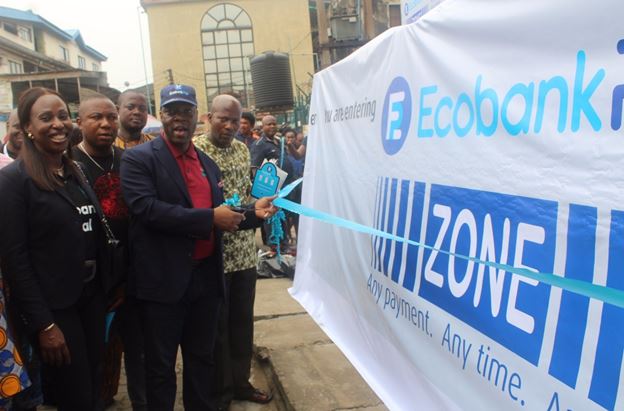
Left: Carol Oyedeji, Executive Director, Commercial Banking, Ecobank Nigeria; Ben Okolie, General Secretary, Alaba International Market Association (Electronics); Patrick Akinwuntan, Managing Director, Ecobank Nigeria; Okwelogu Romanus, Managing Director, Ajuoye Dynamic Concept, (customer of Ecobank) and Jude Esedebe, Managing Director, J-Clax International (customer of Ecobank) at the launch of EcobankPay zone at Alaba International Market by Ecobank in Lagos on Friday.

EcobankPay, a special merchant QR Code product of the Pan African Bank, enables customers make seamless payment for goods and services across the three major payment platforms without the use of plastic cards. The uniqueness of the digital product according to the bank is that it has MasterPass, MVisa and Mcash embedded in the merchant identity QR Code. If the person that wishes to buy goods is coming from a bank that has MVisa and wishes to pay, the same QR Code would accept MVisa payment and vice versa. That creates interoperability and convenience for the merchants. The QR Code is much cheaper than having a point of sale (PoS).

For the merchants, the beauty of EcobankPay is in the cost of setting up, as the shop owner simply prints the QR Code on a paper and can stick it anywhere and do not run any risks. It is convenient and the mobile app is ubiquitous, allowing you 24/7 access and affordabl for every Nigerian.

As a merchant on EcobankPay, you automatically have a QR Code that accepts all the three payment platforms – MasterPass, MVisa and Mcash. Shoppers who used the EcobankPay QR Code are right now treated to special discount transactions at selected shops in Lagos, Abuja, Port Harcourt and Aba.


spot_img
spot_img
spot_img
spot_img

Hot this week

NCDMB to Launch Oil and Gas Trainers Certification

The Nigerian Content Development and Monitoring Board (NCDMB) is...

World Yeye Adesola Odeyeyiwa Day: Celebrating a Woman of Great Industry and Elegance

      By Goke Ilesanmi It is another WORLD YEYE ADESOLA ODEYEYIWA...

NAICOM, Ghana’s NIC Strengthen Regional Integration, Drive Insurance Innovation

L-R: Dr. Abiba Zakariah; Commissioner for Insurance, National Insurance...

NCC, CAC Inform Telecom Stakeholders of New Ownership Structure Requirements

The Nigerian Communications Commission (NCC) and the Corporate Affairs...

NCC Appoints Princess Oforitsenere Emiko as Interim Chairman of Digital Bridge Institute Governing Board

The Board of the Nigerian Communications Commission (NCC) has...

Topics

NCDMB, Petroleum Commission Ghana Sign MoU on Local Content Development

Executive Secretary, Engr. Felix Omatsola Ogbe, represented by Director...

Top 5 Business Risks for West Africa in 2018

As Nigeria exits the recession of 2017, investor sentiment...

GOCOP 2025: Conference on Governance Challenges, Prospects Set for October 9

The Guild of Corporate Online Publishers (GOCOP) has announced...

Oil Prices Driving Lower Growth in Sub-Saharan Africa

Latest report by the World Bank Group suggests that low oil prices have considerably reduced growth in commodity-exporting countries in Sub-Saharan Africa, especially in Nigeria and Angola etc. and have also slowed activity in non-oil sectors. The report says that although South Africa is expected to be one of the main beneficiaries of low oil prices, growth is being held back by energy shortages, weak investor confidence amid policy uncertainty, and by the anticipated gradual tightening of monetary and fiscal policy. Growth in the region is forecast to slow to 4.2 percent, slower than previously expected.

How Nigerian Politics Rivals Nollywood for Drama

In our series of letters from African journalists, novelist and writer, Adaobi Tricia Nwaubani looks at why Nigerians are hoping to be entertained by a crackdown on corruption. Two major industries in Nigeria share similar elements of melodrama and wildly implausible plots -films and politics.

9mobile Mentors Jos SMEs with Hack Business Master Class

L-R: Head, HR Business Partnering, 9mobile, Sherriff Popoola; Business Growth...

NIA Congratulates Segun Bankole on Election as CAMCONIA Chairman

The Nigerian Insurers Association (NIA) has sent a message...

Gas to Play Significant Role in Africa’s Energy Mix, says NLNG’s MD

Dr. Philip Mshelbila Managing Director and Chief Executive Officer Nigeria LNG...
spot_img

Related Articles

Popular Categories

spot_imgspot_img