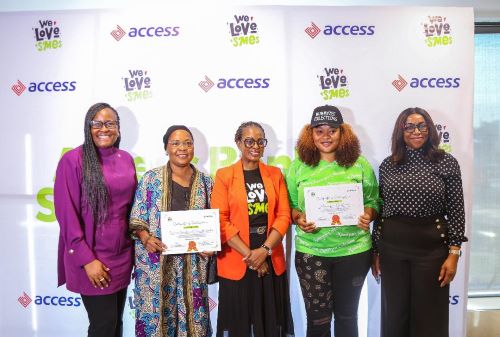

L – R: Oge Kasie – Nwachukwu, Acting Group Head, Retail Marketing and Communications, Access Bank Plc; Modinat Tijani, Chief Executive Officer, Inclusive Development Consult Ltd; Olalekan Ajibade, Managing Director, Kaizen Paints; Abiodun Olubitan, Group Head, SME Banking, Access Bank Plc; Kemi Balogun, CEO, Anikky and Belles; and Chinonso Mbaike, Managing Director, Mummyzee Collections, during the presentation of certificates to participants of the Access Bank SME Academy 3-Day Free Training which ended in Lagos recently.
More than 100 small business owners who participated in Access Bank’s maiden SME Academy have commended the programme for demystifying tax compliance, improving their understanding of business structuring, and strengthening their financial management skills.
Participants described the three-day training as timely and transformative, particularly the sessions on taxation and business planning, which addressed long-standing gaps that have hindered the growth of many small enterprises. They noted that the academy helped dispel widespread misinformation following recent tax policy changes that had created anxiety among SME operators.
Gbenga Agoye of Grandmade Limited, a logistics and export company, said the tax module provided clarity on issues that previously stalled aspects of his operations.
“I’ve been struggling with that, so I quite had an impressive knowledge about what it is and how to go about it,” he said. He added that the classes on leadership and customer service were equally valuable in strengthening his service delivery and operational discipline.
Another participant, Mosebolatan Ladi-Lawal of M2M Stores, noted that she entered the academy with limited understanding of both old and new tax requirements.
“I didn’t know so much about the new tax, even the old tax, but we were really taught about it in this training and I believe it will help me scale better,” she said. She highlighted modules on VAT, business planning and the Pro-Max tax system as particularly impactful. According to her, learning the importance of structuring her business was a major takeaway: “Before, I was doing this one-man business. I have learnt now that I need to structure so that when I’m structured, I can diversify while this business can be managed effectively even in my absence.
The Academy focused on the most pressing challenges faced by early-stage enterprises, including valuation, proper record keeping, customer retention, and navigating evolving government policies.
According to Abiodun Olubitan, Group Head for SME Banking Products at Access Bank, these concerns were deliberately prioritised when developing the curriculum. She explained that the academy was designed for SMEs that have operated for at least two to five years and are now experiencing the complexities of scaling. “Valuation is a problem, taxation is another key thing, finance management. Then we had to delve into customer service so they are able to build their customer base and retain them,” she said.
Olubitan added that confusion triggered by the recent tax policy changes was a key reason for incorporating detailed tax education into the programme. “The most recent is the tax policy that just came out. It caused a lot of confusion. People are like, ‘Do I still need to run my business account?’” she said. She noted that the academy created space to simplify the rules and show SMEs how the new requirements directly affect their businesses.
She emphasised that Access Bank does not view government policies as harsh; rather, compliance feels burdensome because many small business owners lack the right guidance. She acknowledged that policymakers’ engagement with stakeholders, including SMEs and financial institutions, has improved in recent years. She also highlighted the availability of government-backed financing opportunities, such as those channeled through the Bank of Industry (BOI, even though access remains a challenge for many SMEs.
Olubitan further noted that Access Bank is extending support to unregistered businesses by recognizing consistent cash flow on personal accounts as a basis for credit qualification.
“We know that they are running their businesses. We can see you even at your state as an individual. We’ve also put together facilities to support them using that cash flow so that we can give them financial support, grow with them, even give them opportunities to now register their business and start identifying as an SME,” she explained.
She encouraged entrepreneurs to remain informed, leverage available support channels including social media and capacity-building programmes, and remain committed to the long journey of building a sustainable business. “Entrepreneurship is not a sprint, it’s a marathon,” she said.