





A new global programme to advance research in digital finance and accelerate digital financial inclusion in developing countries, the Financial Inclusion Global Initiative, has been launched by the World Bank Group, the International Telecommunication Union (ITU) and the Committee on Payments and Market Infrastructures (CPMI), with support from the Bill & Melinda Gates Foundation.
The three-year programme focuses on three different “model” developing countries – China, Egypt and Mexico – and consists of two complementary operational and knowledge work streams.
The operational work stream supports each country’s national authority – countries in which digital financial inclusion can significantly improve access to financial services for a large number of people without access to financial services.
The knowledge work stream is designed to advance research and develop policy recommendations in three key areas of digital finance: security of information and communication technology (ICT) infrastructure and trust in digital financial services; digital IDs for financial services; and acceptance and use of e-payments by micro and small-scale merchants and their customers.
The inter-agency working groups tackling these issues will share findings at annual symposia. The first of these is scheduled to be the Financial Inclusion Global Initiative Symposium 2017, will be held in Bangalore, India, from 29 November to 1 December 2017, hosted by the Government of India.
“We are excited to work with ITU and CPMI on this new global initiative that will enable our partner countries to better harness the potential of digital technologies for financial inclusion, and to manage associated risks,” said Ceyla Pazarbasioglu, Senior Director for the Finance and Markets Global Practice, World Bank Group.
As part of the initiative, the three model countries are also receiving technical assistance from the World Bank Group with a view to putting into practice the guiding principles set out by the CPMI-WBG report on Payment Aspects of Financial Inclusion (PAFI). In particular, the assistance will contribute to further strengthening public and private-sector commitment and improving legal and regulatory frameworks, financial markets and ICT infrastructure for financial access and inclusion. It will also focus on improving financial product design; financial literacy and awareness; diversified access points; and large-volume, recurring payment streams. The World Bank Group leads the operational work, with ITU handling activities related to telecommunications authorities.
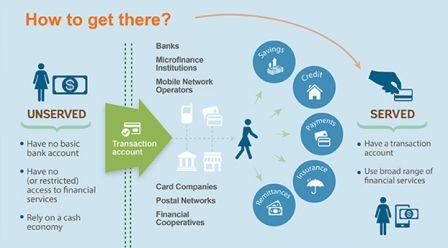
“An estimated two billion adults are still without access to a bank account, and yet some 1.6 billion of them have access to a mobile phone, creating the potential for e-finance access,” said ITU Secretary-General Houlin Zhao. “The ITU community is excited to leverage our unique technical expertise to make e-finance a reality for millions of people through the Financial Inclusion Global Initiative, and in so doing, contribute to poverty eradication and the achievement of the global Sustainable Development Goals.”
“The Bill & Melinda Gates Foundation is pleased to support the Financial Inclusion Global Initiative, which we believe will bring digital financial services to some of the world’s most vulnerable unbanked populations as well as advance knowledge on creating a robust digital payments ecosystem,” said Jason Lamb, Deputy Director, Bill & Melinda Gates Foundation.
The three countries selected were chosen based on potential for country programmes, level of national government and private-sector commitment to financial inclusion, number of people that could be reached through digital financial services, and potential for reforms to encourage innovation and digital technologies use.
According to analyses carried out by the World Bank Group, Egypt has the potential to bring a large number of people into the formal financial sector (more than 44 million adults). These analyses found that Egypt has adequate laws, regulations and financial and ICT infrastructure, but a lack of funding to cover related reforms.
Considered a ‘last-mile’ challenge, China has an increasingly well-developed legal and regulatory environment and financial infrastructure, as well as a supportive ICT infrastructure. The People’s Bank of China has requested support from the World Bank Group for digital financial inclusion measures to reach rural people without access to financial services.
Mexico has shown a strong commitment to financial inclusion with its new National Financial Inclusion Strategy launched in June 2016, as well as a draft fintech law. Mexico has the potential to become a regional and global model for digital financial inclusion, despite relatively low levels of financial inclusion.
China, Egypt and Mexico are already part of the Universal Financial Access 2020 (UFA2020) initiative. Led by the World Bank Group, this seeks to bring two billion unbanked adults in 25 countries into formal financial systems.
The design of country programmes under the Financial Inclusion Global Initiative will be informed by the same guiding principles of UFA2020 – the PAFI guiding principles – as well as the Level One guidelines for enabling payments infrastructure, and the recommendations of the ITU-T Focus Group Digital Financial Services.
The Financial Inclusion Global Initiative is supported by the Bill & Melinda Gates Foundation through a US$ 12,238,635 grant. This will be used to fund country-level implementation led by the World Bank Group, the organisation of the initiative’s annual symposia by ITU, and the activities of the initiative’s established working groups.