






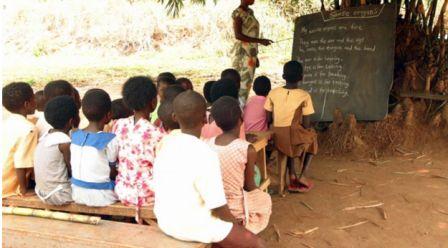


Millions of young students in low and middle-income countries face the prospect of lost opportunity and lower wages in later life because their primary and secondary schools are failing to educate them to succeed in life.
Warning of ‘a learning crisis’ in global education, a new Bank report said schooling without learning was not just a wasted development opportunity, but also a great injustice to children and young people worldwide.
The World Development Report 2018: ‘Learning to Realize Education’s Promise’ argues that without learning, education will fail to deliver on its promise to eliminate extreme poverty and create shared opportunity and prosperity for all. Even after several years in school, millions of children cannot read, write or do basic math. This learning crisis is widening social gaps instead of narrowing them. Young students who are already disadvantaged by poverty, conflict, gender or disability reach young adulthood without even the most basic life skills.
“This learning crisis is a moral and economic crisis,” World Bank Group President Jim Yong Kim said. “When delivered well, education promises young people employment, better earnings, good health, and a life without poverty. For communities, education spurs innovation, strengthens institutions, and fosters social cohesion. But these benefits depend on learning, and schooling without learning is a wasted opportunity. More than that, it’s a great injustice: the children whom societies fail the most are the ones who are most in need of a good education to succeed in life.”
The report recommends concrete policy steps to help developing countries resolve this dire learning crisis in the areas of stronger learning assessments, using evidence of what works and what doesn’t to guide education decision-making; and mobilising a strong social movement to push for education changes that champion ‘learning for all.’
According to the report, when third grade students in Kenya, Tanzania, and Uganda were asked recently to read a sentence such as “The name of the dog is Puppy” in English or Kiswahili, three-quarters did not understand what it said. In rural India, nearly three-quarters of students in grade 3 could not solve a two-digit subtraction such as “46 – 17”—and by grade 5, half still could not do so. Although the skills of Brazilian 15-year-olds have improved, at their current rate of improvement they will not reach the rich-country average score in math for 75 years. In reading, it will take 263 years.
Relying on evidence and advice gathered during extensive consultations in 20 countries, with governments, development and research organisations, CSOs, and the private sector, the report offers three policy recommendations:
- First, assess learning, so it can become a measurable goal.
Only half of all developing countries have metrics to measure learning at the end of primary and lower secondary school. Well-designed student assessments can help teachers guide students, improve system management, and focus society’s attention on learning. These measures can inform national policy choices, track progress, and shine a spotlight on children who are being left behind.
- Second, make schools work for all children.
Level the playing field by reducing stunting and promoting brain development through early nutrition and stimulation so children start school ready to learn. Attract great people into teaching and keep them motivated by tailoring teacher training that is reinforced by mentors. Deploy technologies that help teachers teach to the level of the student, and strengthen school management, including principals.
- Third, mobilise everyone who has a stake in learning.
Use information and metrics to mobilize citizens, increase accountability, and create political will for education reform. Involve stakeholders, including the business community, in all stages of education reform, from design to implementation.
“Developing countries are far from where they should be on learning. Many do not invest enough financial resources and most need to invest more efficiently. But it is not only a matter of money; countries need to also invest in the capacity of the people and institutions tasked with educating our children,” said Jaime Saavedra, a former Peruvian Education Minister, and now the World Bank’s Senior Director for Education. “Education reform is urgently needed and requires persistence as well as the political alignment of government, media, entrepreneurs, teachers, parents, and students. They all have to value and demand better learning.”
















