






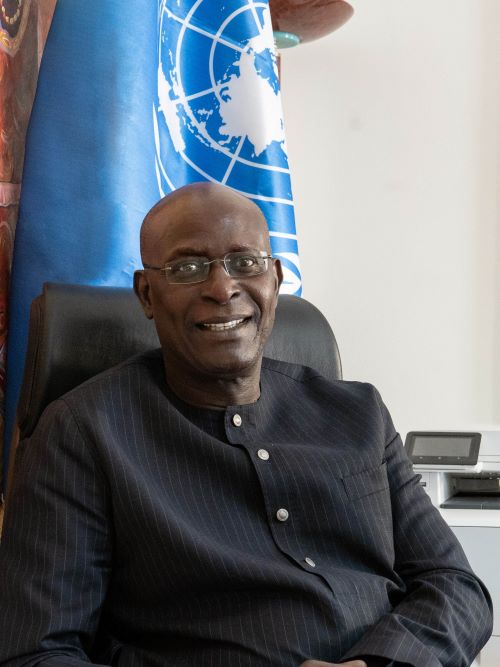


By Mohamed Malick Fall
The indescribable destruction caused by the first and second world wars led many to desire an international organisation dedicated to maintaining world peace.
The United Nations (UN) was therefore established on 24 October 1945, to maintain international peace and security and to achieve cooperation among nations on economic, social, and humanitarian challenges.
As we commemorate the ‘birth’ of the UN, we are reminded of its enduring legacy in promoting peace, development, and humanitarian relief across the globe. The creation of the UN, nearly eight decades ago was a pivotal moment in international history – anchored in the vision of a world united to prevent conflict, protect human rights, and ensure dignity for all.
The values enshrined in the UN Charter resonate strongly in Nigeria, a nation that joined the UN on 7 October 1960, just days after gaining its independence.
Some will argue that the need for the UN has never been greater than it is today, at a time when multilateralism and interstate collaboration is under threat in an increasingly divided world. Not only is the spectre of conflict rearing its ugly head, but pandemics have also killed millions of people in the last few years. Most importantly, humankind is facing an existential challenge through climate change.
If we are to survive, we will need to put our own interest aside for that of humanity and common survival.
The UN’s engagement with Nigeria has been deep and transformative, spanning development initiatives, and humanitarian responses to the challenges faced by vulnerable people. Through decades of partnership, the UN has played a central role in support of the Government of Nigeria, positively impacting the lives of millions through its wide-ranging interventions.
First, humanity is at the heart of the UN’s work in Nigeria. Across Nigeria, each region faces distinct humanitarian challenges. The UN, through its agencies, in collaboration with local and international partners, with the Nigerian Government taking the lead, has acted as a beacon of hope for those in crisis. Interventions have ranged from providing life-saving food and medical supplies, to addressing the long-term needs of displaced people, including education, and psychosocial care.
The UN supports resilience building, agricultural recovery, food security, and livelihoods in affected communities, as well as reproductive health and protection services against gender-based violence. Furthermore, the UN aids displaced people and refugees, providing shelter and basic needs, while also supporting child protection, education, health, and nutrition programmes.
In Borno, Adamawa, and Yobe states, where conflict and displacement have left millions vulnerable, UN-coordinated humanitarian responses have been crucial. Over the past decade, at least five million people have received aid annually, courtesy of the UN and partners, ensuring their access to food, water, healthcare, and protection services.
Beyond emergency responses, the UN has continued to support Nigeria’s development. It has been pivotal in fostering sustainable development through a focus on capacity building, governance reform, and the empowerment of women and youth. Over the years, the UN has supported numerous educational and vocational programmes that have enabled thousands of Nigerians to rise above poverty and build better futures for themselves and their families.
More so, the UN has supported the implementation of projects aimed at enhancing the resilience of communities. Initiatives in agriculture, renewable energy, and economic diversification have been particularly impactful in promoting food security and mitigating the effects of climate change. Similarly, its support for the fight against gender-based violence and human trafficking is helping protect vulnerable people and upholding human rights.
Despite these successes, the road has not been without challenges.
Conflict, displacement, food insecurity, malnutrition, natural disasters, and climate change impacts remain significant hurdles in Nigeria’s path to sustainable development.
The humanitarian crisis in the north-east persists, with violence continuing to disrupt lives and livelihoods. The northwest struggles with escalating banditry and communal clashes, displacing thousands. The north-central region faces recurrent farmer-herder conflicts, threatening food security and livelihoods. The south-west grapples with violence and kidnapping, posing risks to safety. The south-south is grappling with environmental degradation affecting both livelihoods and ecosystems. In the south-east, rising insecurity has disrupted local economies and essential services, intensifying the humanitarian needs of affected communities.
Moreover, rising inflation and the global economic downturn have compounded the struggles faced by Nigeria’s most vulnerable people.
As we celebrate the UN’s impact in Nigeria, let us remember that the journey continues.
Let all hands be on deck!
Mohamed Malick Fall is the UN Resident and Humanitarian Coordinator in Nigeria.
















