






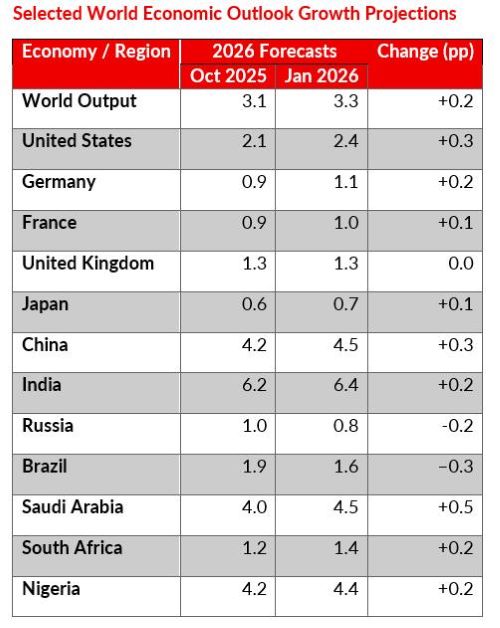


| Global economic activity is projected to remain resilient in 2026, with world output growth at 3.3%, easing marginally to 3.2% in 2027.
The outlook reflects a global economy that is steady amid divergent forces, as technology investment, accommodative financial conditions, and private-sector adaptability continue to offset headwinds from trade policy uncertainty and geopolitical tensions. Growth across advanced economies remains modest but stable. The United States is projected to expand by 2.4%, supported by easing financial conditions and productivity gains linked to technology adoption. The Euro Area records gradual improvement Germany (1.1%), France (1.0%), and the United Kingdom (1.3%) though structural constraints and weak investment continue to limit growth potential. Japan (0.7%) remains weighed down by demographic and demand-side pressures. Emerging market and developing economies continue to drive global growth. China (4.5%) reflects a moderated but stable expansion consistent with structural rebalancing, while India (6.4%) remains the fastest-growing major economy, underpinned by strong domestic demand and investment. Sub-Saharan Africa is projected to grow by 4.6%, with Nigeria (4.4%) benefiting from reform momentum and services-sector expansion. In the Middle East, Saudi Arabia (4.5%) reflects diversification efforts and normalisation in the oil sector. |
















