








Everybody loves chocolate. Hundreds of years ago, the Greeks referred to chocolate as the ‘food of the gods’. It’s a highly demanded luxury product and an impulsive treat for millions of people around the world.
No wonder the global market for chocolate and cocoa beverages is now worth over $100 billion (and growing) every year. Although the developed and fast developing countries (especially in Europe, Asia and North America) consume over 90 percent of the chocolate produced every year, chocolate largely exists because of Africa.
This is because up to 70 percent of cocoa, the major ingredient for making chocolate, is grown and harvested in Africa!
Yes, you’re right; no Africa, no chocolate! Cote D’Ivoire (Ivory Coast), Ghana, Nigeria and Cameroon are our continent’s largest
producers but there is still unexploited potential in other West and Central African countries that are also well suited for
cocoa production.
This article explores the interesting opportunities for African entrepreneurs in cocoa production and trade which would benefit from the explosive global demand for chocolate in the near future.
Why is Cocoa such an Important and Lucrative Crop?
Why is cocoa such a valuable commodity in today’s and tomorrow’s world? As is my usual practice on smallstarter.com, I love to explore the basics of every idea so everybody reading this can appreciate the potentials of the business.
My goal is to teach and inspire. In this section, we’ll explore the interesting journey of cocoa from its origins as a common raw material (cocoa beans) to international hot-selling product (chocolate).
The cocoa plant is a small, evergreen tree (usually between 13 to 26 feet tall) that grows exclusively in the deep tropical
regions of the world.
In West and Central Africa –especially Ivory Coast, Ghana, Nigeria and Cameroon – some 2 million small-scale farmers are responsible for more than 70 per cent of all the cocoa produced in the world today.
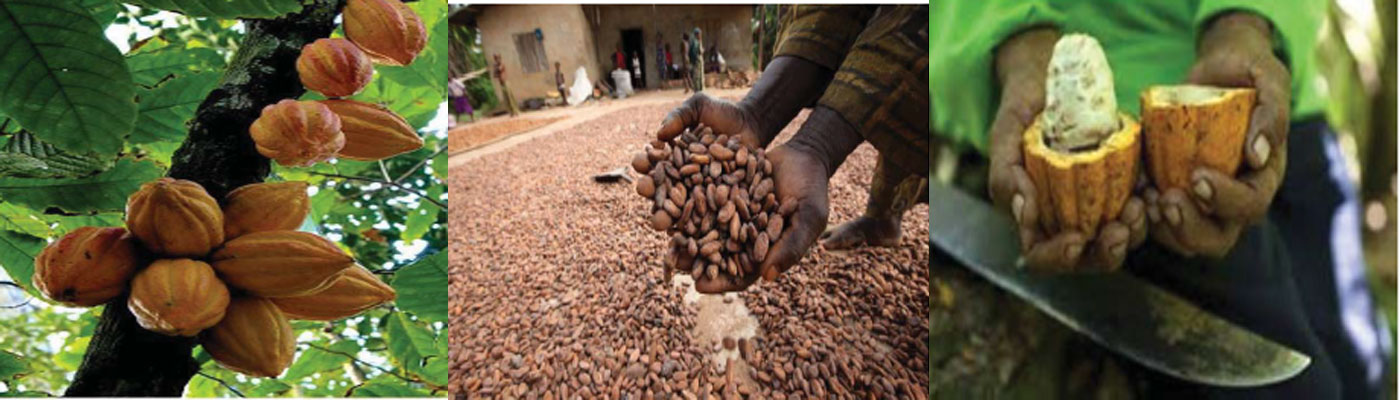
A cocoa tree usually matures and begins to bear fruit (pods) when it is about four or five years old. On the average, a single cocoa tree produces between 20 and 30 pods, which are the oval-shaped yellow/orange things you see hanging on the tree trunk in the picture to your right.
Each pod contains about 20 to 50 seeds, known as cocoa beans. These beans are the goldmine of the cocoa plant because they are processed into cocoa liquor, cocoa butter, cocoa powder, and most popularly, chocolate!
After the pods ripen, they are harvested and cut open to extract the valuable cocoa beans. Surprisingly, the beans usually have a strong bitter taste. As a result, they must be fermented for a couple of days (about five days) to develop the sweet flavor that we enjoy in chocolate.
After fermentation, the cocoa beans are dried, cleaned, roasted and processed into several valuable products, the main ones being: Cocoa Butter: This is a creamy-coloured edible vegetable fat with a cocoa flavor and aroma that is extracted from cocoa beans. Cocoa butter makes up more than 50 percent of the weight of cocoa beans and is used to make chocolate, as well as several ointments, toiletries and pharmaceutical products.
Cocoa Solids: is the light brown or reddish-brown substance that remains after cocoa butter is extracted from cacao beans. It is often sold as a final product in the form of cocoa powder (or cacao) which is a major ingredient in beverages and drinks across Africa.
Cocoa solids are also used to make chocolate, chocolate syrup and other chocolate-based confections.
The Global Madness for Chocolate!
Chocolate is a huge business and one of the best-selling products in the world. A 2012 KPMG Report reveals that the psychology behind chocolate suggests consumers see it as a ‘naughty but nice’ impulse treat.
Although Western Europe remains the world’s largest chocolate market, the United States consumes more chocolate than any other country in the world. There is also a fast-growing demand for chocolates in emerging economies like Russia, Brazil, Mexico, India and China. In fact, the demand for cocoa for chocolate is growing so fast that experts now warn we may run out of affordable cocoa supplies within 20 years.
Of all the countries in this snapshot, only two (Mexico and Brazil) produce any cocoa at all. In spite of the fact that Africa supplies up to 70 percent of the cocoa beans that are used to make chocolate, very little of this sweet-tasting product is consumed on our continent.
For example, in the West African country of Cote D’Ivoire (Ivory Coast) which is the world’s biggest cocoa producer, many of the farmers who produce the cocoa beans have never tasted chocolate before.
Why African Entrepreneurs Should be Interested in Cocoa Business?
There are a couple of reasons why the cocoa business remains an interesting opportunity for African entrepreneurs. Let’s take a look at three of them…
1. Africa has a Strong Advantage in Cocoa Business
Although the cocoa plant is not native to Africa and was introduced to our continent over 100 years ago from South America, Africa now dominates the global supply of cocoa.
Fortunately, a significant portion of our continent lies within the narrow belt around the earth’s equator that is best suited for cocoa cultivation.
Outside this belt, cocoa trees may find it impossible to grow. In addition to Africa’s suitable location, the evergreen forest and climatic conditions (adequate rainfall and favourable temperatures) makes West and Central Africa a sweet spot for cocoa production.
Like I already mentioned, Africa dominates the world’s cocoa supply with over 70 percent of the market. This makes Africa very invaluable to the cocoa business and its related products, especially chocolate. Over two million smallholder families and communities in Cote D’Ivoire, Ghana, Nigeria and Cameroon have been cultivating cocoa for decades.
As a result, there is a lot of experienced labour in the region who have accumulated extensive knowledge about the cocoa business over the years.
There are over 25 countries in the West and Central Africa region which, by virtue of their location, have a significant advantage to make money from the international cocoa business.
However, only four countries in this region (Cote D’Ivoire, Ghana, Nigeria and Cameroon), are dominant cocoa producers. There still remains a lot of unexploited opportunities in cocoa production in Guinea, Sierra Leone, Liberia, Central African Republic, Congo and several other countries in this region with fertile land and favourable climate that is suited for cocoa production.
In addition to the countries in the region that are yet to exploit the potentials of cocoa, there are also countries like Nigeria and Cameroon that are under-utilising their potentials for cocoa. Nigeria, for example, which used to be Africa’s top cocoa producer now produces significantly less.
There is still a lot of room in Nigeria and Cameroon for more cocoa.
2. There is On-going and Future Boom in Demand for Cocoa
Statistics show that people develop a taste and appetite for impulse and luxury products as their incomes increase.
















