






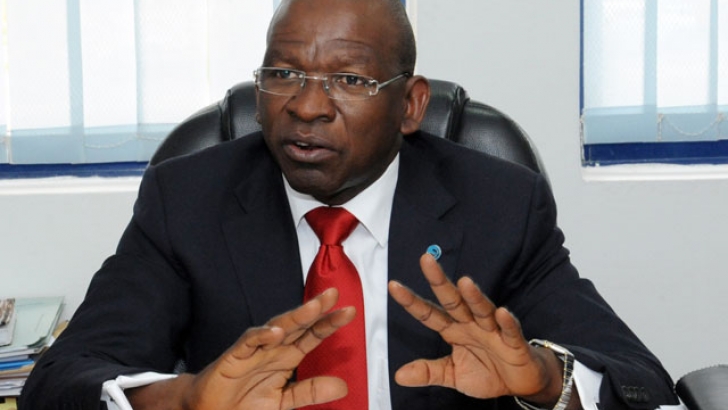


Written By: Roberts Orya is Managing Director and Chief Executive Officer, Nigerian Export – Import Bank.
‘We have to defeat pessimism and embrace our common economic future with optimism in order to bring about the change that we desire.’
As widely acknowledged, the ‘old normal’ of high oil prices – oil prices at $100.00 per barrel and above – has given way to a ‘new normal’ of prices well below this range. The 2016 crude oil price outlook is very gloomy.
The most authoritative optimistic price outlook for the product in 2016 is by the International Monetary Fund, which forecasts $42.00 per barrel average price. Equally, the 2017 oil price outlook is also not much expansive.
Quite clearly, therefore, Nigeria, like all other oil exporting-countries, are having to make fiscal and monetary adjustments in response to this reality.
The Administration of President Muhammadu Buhari recognises this immediate need for adjustment. For instance, unlike Russia which budgeted on $50.00 a barrel price for oil in 2016, the Benchmark Price for oil in the Nigerian budget proposal is $38.00. This tends to counter the argument that Nigeria’s 2016 budget is overboard on oil price optimism. But this is by the way.
Right from inception of the Administration last May, when the Brent Crude was still selling at a decent price range of $55 to $60.00 a barrel, President Buhari signalled his preparedness to move forward the agenda of structural diversification of the Nigerian economy.
Moving in this direction, the 2016 budget proposal seeks to stimulate investments in infrastructure, agriculture and solid minerals. The resolve to also increase tax revenues and build social safety nets are sure signals that the government, indeed, wants to decouple the economy from oil dependency.
The implementation of this bold plan is critical in moving beyond the rhetoric of structural transformation of the economy to its actualisation. Most oil producing economies of OPEC (Organisation of Petroleum Exporting Countries) were also stuck in the rhetoric of economic diversification. High crude prices and the accruing huge revenue paradoxically bred complacency and lacklustre commitment to policy actions.
Nonetheless, economic diversification requires funding. The cumulative gain from last ten years of high oil prices was the fillip we should have seized to make much more progress with this agenda. But in practice, it didn’t work out like that. Perhaps, one could say it hardly works out like that.
What we didn’t do when petrol dollars was a deluge, we now must do with historically low oil prices and historically low oil revenue for Nigeria.
The Nigerian Export – Import Bank had been talking up the imperative of non-oil sector growth during the last season of high oil prices. For us, oil sector-led growth is a jobless growth. It is also pro-cyclical; the potential to expose the country to the current brutal external shocks was always there.
Making the Transition
The adjustments we need to make as a country now are pointedly two-fold. We have to curb imports by boosting domestic production. And we have to develop local capacity to produce non-oil value-added products for export.
We no longer have the benefit of high oil price to delay further actions on either of these. So, here is the rub. We have to start making the adjustments and the transition now albeit in the middle of volatile global market conditions and unpleasant domestic economic situation arising from a sharp decline in government revenue.
Some analysts believe we can make cosmetic tweaking of market policies to, in effect, keep the old order in place. In this regard, the Central Bank of Nigeria (CBN) has come under great pressure to lift the rein on importation by being more accommodative with its foreign exchange policy.
While it is true that the capital controls may have inadvertently impacted some activities negatively – and happily the President and the CBN have promised to continue to fine-tune the foreign exchange regime – import substitution and diversification of export base have no viable substitutes for long-term performance of the Nigerian economy.
Yes, this adjustment will not be easy. It would mean near drastic lifestyle changes for even people who have the naira to continue indulging in their foreign taste. For others, it would impose the need to reinvent their businesses and commercial sourcing. Yet, for everyone, immediately, it could mean a squeeze and an economic discomfort.
The inconvenience will not last forever. But it would last in the period that we all have to make the psychological adjustment.
Recent monetary and fiscal policy decisions will have to penetrate the system with the desired effects. Financial institutions would have to respond positively to the policy priority of improvement in real sector and SME funding. We also have to bring about significant expansion of non-oil exports.
Inspite of the current personal discomforts and market turmoil, especially in the foreign exchange and equity markets, opinions are converging that, finally, we have reached a critical turning point in economic management in our country. This portends to be for good.
Help on the Way
The CBN upheld its Monetary Policy Committee decisions of last November at its January meeting. The main reason would be to allow the banks to respond to the November decisions, which initiated a process of injecting additional liquidity in the banks.
This was by way of reduced Cash Reserve Ratio, from 25% to 20%. This liquidity, estimated above N1 trillion, would filter into the system only through lending to real sector businesses and Small and Medium Scale Enterprises. These are the sectors that will underpin the strength of the Nigerian future economy.
This targeted credit boost, however, requires the banks to develop additional risk management capacities and new credit products.
Some of such products have started to reach the market, like the one that now wants to help SMEs improve their capital assets. Such facilities would improve operational efficiency and outputs of domestic producers and manufacturers.
CBN and NEXIM Bank Collaboration
The Nigerian Export – Import Bank, which has the responsibility for promoting non-oil exports, is scaling capacity to intermediate external sector revenue generation. One of our latest activities include a collaboration with the CBN to create additional funding resources for Nigerian export manufacturers. This has led to the creation of a new N300 billion Export Stimulation Fund that will lend at 9% interest rate.
This fund targets immediate impacts. Our quick-win strategy is to expand the businesses of companies that are already exporting. We will give them funding to produce and export more. This facility is in line with the fiscal outlook of the Federal Government, which requires helping the private sector to generate additional $2 billion in non-oil exports in 2016.
Inadequate financing, according to the CBN, had led to the drop in government’s non-oil export revenues from $10.53 billion in 2014 to $4.39 billion in 2015.
Nigerian export manufacturers, like other critical stakeholders in the economy, need to step forward and embrace government’s efforts. For too long, the profile of Nigeria as a predominant oil exporting-country had stuck, and with no correlating benefits.
While aggregate domestic credit to the economy has been on the rise, credit to non-oil exports has been declining at an average of 0.6% of total domestic loans to the private sector in the last five years, according to data from the CBN. We are set to reverse this.
Trumping Pessimism
A pessimistic view of the adjustment taking place in Nigeria now cannot be validated by our past failure with structural transformation of our economy. The truth is that such pessimism is incompatible with our instinct to survive and prosper, given that the cards we have for shared prosperity are what we are playing now. We have to defeat pessimism and embrace our common economic future with optimism in order to bring about the change that we desire.
At NEXIM Bank, we look forward to working with Nigerian businesses that would help rebalance our economy more in favour of domestic production and non-oil exports, against dependency on oil revenue and unbridled importation of consumer goods. In the medium- to long-term, we will see a significantly transformed Nigerian economy for our benefits.
By: Roberts Orya is Managing Director and Chief Executive Officer, Nigerian Export – Import Bank. He is also the Honorary President, Global Network of Exim Banks and Development Finance Institutions (G-NEXID).
















