








The Middle East and Africa (MEA) tablet market declined 24.2% year on year (Y-o-Y) in the final quarter of 2016 to total 3.07 million units, according to the latest figures announced today by International Data Corporation (IDC).
The global IT research and consulting services firm’s Middle East and Africa Quarterly Tablet Tracker shows that for 2016 as a whole, tablet shipments in MEA declined 14.7% Y-o-Y to total 13.8 million units, which is in line with global tablet market’s 15.6% decline over the same period.
“Tasks that were previously performed on tablets are increasingly moving to bigger-screen smartphones, so tablets are becoming redundant in the consumer ecosystem of gadgets,” says Nakul Dogra, senior research analyst for client devices at IDC MEA.
“Indeed, consumers are now investing more time and money into smartphones than tablets, which has led to a slowdown of tablet markets around the world, not just here in MEA. That said, there are still countries in Africa that harbor scope for further tablet penetration.”
In terms of vendor rankings, Samsung continued to lead the MEA tablet market in Q4 2016 with unit share of 17.6%, despite experiencing a significant decline in shipments of -28.0% on the previous quarter and -43.6% on the corresponding period of 2015. Lenovo remained in second place, increasing its share to 10.8% from 9.9% in Q4 2015. Apple climbed into third spot, capturing 8.7% share despite suffering a -41.2% Y-on-Y decline in shipments. UAE-based vendor i-Life rose to fourth in the rankings with a market share of 7.4%, spurred by the popularity of its low-cost offerings. Huawei’s shipments fell -39.6% Y-on-Y in Q4 2016 to account for market share of just 5.1%, a considerable drop from its 13.5% share in the previous quarter.
“With the lack of any noteworthy innovation taking place in much of the tablet space, there is little reason for the majority of consumers to upgrade to newer-generation tablets,” says Fouad Rafiq Charakla, senior research manager for client devices at IDC MEA. “This is prolonging the refreshment cycle for tablets in the region and causing an inevitable slowdown in the market.”
Taking the above factors into account, IDC’s tablet market forecast has been revised downwards. IDC now expects the market to decline -8.1% Y-on-Y in 2017 to total 12.76 million units. The longer-term forecast has also been revised downwards, with IDC now expecting the market to decline at a compound annual growth rate (CAGR) of -0.2% over the 2016–2021 period to total 13.64 million units in 2021.
“e-Tailers are expected to grow strongly in the coming years,” says Dogra. “Increasingly, local retailers are investing more in the online channel. Also, newer players are expected to enter the market in the coming year, which is going to further intensify competition in the online retail segment.
The above factors, coupled with aggressive pricing, will further drive the growth of the e-tailer segment, with IDC expecting that by the year 2021, 12% of tablets will be sold through e-tailers in the MEA region.”
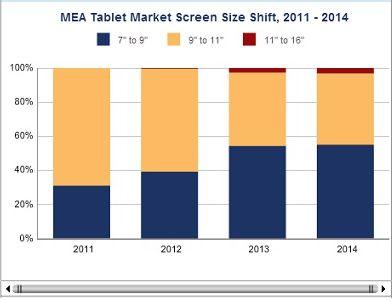
IDC’s Middle East and Africa Quarterly Tablet Tracker provides insightful analysis of key market developments, covering vendors, operating systems, screen sizes, user segments and distribution channels, quarterly market share data, and a comprehensive 5–8 quarter and five-year forecast.
















