






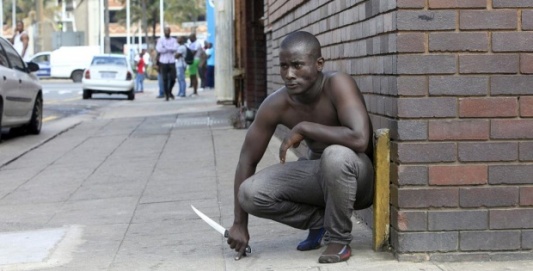


The recall of Nigeria’s top diplomat after a spate of xenophobic attacks in South Africa follows several similar spats that expose the two countries’ deep rivalry for economic and political dominance in Africa.
Nigeria’s Acting High Commissioner to South Africa Martin Cobham said he had been “invited” to Abuja to discuss this month’s anti-immigrant attacks in South Africa, which have killed at least seven people. Televised images of armed gangs attacking immigrants and looting foreign-owned stores in Johannesburg have sparked a backlash in Nigeria, where hundreds protested in front of shops owned by South African brands like MTN and Shoprite.
South Africa’s foreign ministry called Cobham’s recall an “unfortunate and regrettable step”, before taking a swipe at Abuja for its own record on protecting foreigners. Last September, a church hostel collapsed in Lagos, killing 115 people, most of them South African.
Nigeria was criticised for its slow response to the disaster and what some saw as a haphazard rescue effort. “It would be curious for a sisterly country to want to exploit such a painful episode for whatever agenda,” a foreign ministry statement said in response to Cobham’s recall.
“We did not blame the Nigerian government for the deaths and more than nine months’ delay in the repatriation of the bodies of our fallen compatriots.”
Such tit-for-tat slights are becoming increasingly common. Weeks after the hostel collapse, South Africa seized $9.3 million from a private jet carrying two Nigerians, funds Abuja said were for a legitimate arms deal. South Africa said the deal was being conducted without relevant permits.
Abuja accused South Africa of xenophobia when Nigerians were deported after staff at Johannesburg airport believed their yellow fever certificates were fake. Arik Air, Nigeria’s biggest airline, briefly canceled flights to South Africa.
Cannibals
Nigeria banned 2009 film “District 9”, a hit movie directed by a South African that depicted Nigerians as cannibals, criminals and prostitutes who had sex with aliens. Rows over Hollywood movies and yellow fever certificates are reflective of a more serious battle for economic dominance and control over Africa’s representation on the global stage.
Nigeria overtook South Africa as the continent’s biggest economy last year after re-basing its GDP. Pretoria said the numbers reflected Nigeria’s larger population and not the sophistication of their respective economies.
“Despite what was said publicly, Nigeria’s rebasing was resented by the South African government,” a Pretoria-based Western diplomat told Reuters. Diplomats say that when South African politician, Nkosazana Dlamini-Zuma, the ex-wife of President Jacob Zuma, won a close race to chair the African Union Commission in 2012, Nigeria strongly backed her opponent.
Both countries are also lobbying for a permanent position to represent Africa on the United Nations Security Council. Given their political and economic heft – together, the two economies are larger than the rest of sub-Saharan Africa’s combined relations between South Africa and Nigeria could be decisive for the future of a continent of 1 billion people.
“Nigeria and South Africa are like two prisoners in the same cell of poverty, inequality and bad leadership,” Nigerian writer and political commentator, Elnathan John told Reuters.
“Together, they could muster the strength to break their bonds and overpower the jailer but instead they spend time feuding with each other in a needlessly fractious relationship.”














