






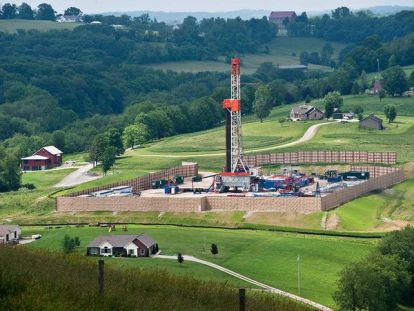


Doubts about the sustainability of the North American oil and gas boom centre on rapidly declining output from many shale wells after they are initially drilled.
Shale sceptics point to the need to drill an ever-increasing number of new holes just to replace the declining output from existing wells, let alone expand production. At some point, it will become impossible to keep up, they argue.
The problem has been likened to the Red Queen’s Race in Lewis Carroll’s “Through the Looking-Glass” where the chess piece warns Alice that “it takes all the running you can do, just to keep in the same place.”
Geologists have worried about the problem of replacing declining output from old wells for more than a century. U.S. geologist Carl Beal voiced concern that the “limit of production in this country is being approached” as long ago as 1919.
“Although new fields undoubtedly await discovery,” he wrote, “the yearly output must inevitably decline, because the maintenance of a given output each year necessitates the drilling of an increasing number of wells.”
“Such an increase becomes impossible after a certain point is reached, not only because of a lack of acreage to be drilled, but because of the great number of wells that will ultimately have to be drilled,” Beal explained in a careful monograph for the U.S. Bureau of Mines on the “Decline and Ultimate Production of Oil Wells”.
Ultimate Recovery
Shale’s doubters point to the faster decline rates on horizontally drilled and fractured wells bored into shale compared with conventional wells drilled into more-permeable reservoirs to suggest the replacement problem is much worse for unconventional oil and gas plays.
But there are plenty of reasons to think the focus on decline rates is misplaced and is unlikely to constrain North American oil and gas output in the next decade.
First, oil and gas producers have learned to drill and fracture wells much faster, using mass production techniques borrowed from manufacturing, so the same number of rigs and crews can drill many more wells than before.
Second, the sceptics focus too much on the decline rate rather than the total amount of oil and gas recovered from a well over its lifetime, which is more relevant to the sustainability of the shale revolution.
The relationship between initial production (IP), the decline rate (DR), and the estimated ultimate recovery (EUR) is subject to tremendous uncertainty. It varies significantly from play to play, county to county and even well to well.
But in general, producers want oil and gas wells with a large EUR and high IP, because that means they receive more revenue overall, and more of it in the first few months after the well is completed rather than having to wait for years.
Wells cost millions of dollars to drill and fracture, and all the costs must be paid up front, either by the producer using their own funds or with borrowed money. The faster the oil and gas are produced, the faster the costs are covered and the more profitable the well will be.
Well Decline Curves
From a financial standpoint, rapid decline rates are not a problem. What matters is the EUR. But the relationship between IP, decline rate and EUR is fairly loose and notoriously difficult to pin down.
There is some evidence to suggest oil and gas wells that have high initial flow rates tend to decline fastest but yield the most oil and gas over their lifetime.
“In general, wells of small initial yearly production decline more slowly than those of large,” Beal said of conventional fields. But the more barrels per day a well produced in its first year of production, the more it was likely to produce during its lifetime.
Still, it remains notoriously tricky to predict ultimate production accurately from initial flow rates because there is so much variability and the data is not readily available.
(There is a clear data availability bias in much of the published research. Most analysis uses commonly available data on the total number of wells and average daily production for large aggregates, such as whole states, and then tries to draw conclusions about the sustainability of shale production, even though such numbers are not really relevant.)
For individual wells and plays, forecasters use “decline curves” based on the average of past experience to estimate how much oil and gas a well might eventually produce.
Even so, the forecasts can be out by a wide margin. “Estimates of future production based on the first few months of initial production can differ significantly from later estimates for the same well,” according to the U.S. Energy Information Administration (EIA).
For example, one well examined by the EIA was predicted ultimately to yield 574,000 barrels of oil based on the first year of monthly production data, but that was later slashed to just 189,000 barrels once four years of data was available.
In another case, an initial EUR of 105,000 barrels based on 12 months of production data was raised to 224,000 barrels based on four years of data.
In general, however, it is possible to make a reasonably stable and accurate forecast of EUR after about three years, when almost all wells will have produced more than half their eventual output, according to the EIA (“U.S. tight oil production: alternative supply projections and an overview of the EIA’s analysis of well-level data”, April 2014).
Productivity Boom
There is plenty of evidence that oil and gas production companies are improving productivity and extracting more oil and gas from each shale well.
The EIA analysed EURs from more than 5,000 wells drilled into the Eagle Ford shale formation in Texas . The average EUR was almost 170,000 barrels, but it has been rising, with wells drilled in 2012 (191,000 barrels) and 2013 (169,000 barrels) far more productive than wells drilled near the start of the play in 2009 (57,000 barrels) and 2010 (117,000 barrels).
There is enormous variability in the play, with wells in DeWitt county expected to average 334,000 barrels compared with 226,000 in Karnes and 80,000 in Webb. Even in DeWitt, EUR varies from 98,000 barrels (25th percentile) to 440,000 (75th percentile).
But across the United States there is a clear trend of rising average EUR from shale wells.
Productivity improvements can be traced to several factors. Shale producers are drilling and fracking longer laterals, increasing the amount of shale accessed by each well.
Through a combination of trial-and-error and better seismic work, drillers are increasingly able to target the highest-yielding parts of shale plays, improving average recovery factors and minimising the cost of drilling subpar wells.
Other productivity improvements are in the pipeline. In most sedimentary basins, including North Dakota’s Bakken and West Texas’s Permian, there are multiple oil- and gas-bearing formations, layered one on top of another like a stack of pancakes. The most advanced drillers are experimenting with wells that have several laterals at different depths to produce from different formations all from the same surface hole.
Well-spacing is another area where improvements are being tried. Minimum spacing is set to ensure two wells do not communicate with one another underground (drain the same part of the formation). But the minimum gap between wells is being reduced to cover the whole shale formation more completely as producers learn more about how big an area each well drains.
Individual shale wells are therefore becoming more productive, and plays are being exploited more efficiently and completely. And there are good reasons to think that the shale revolution is still in its infancy, with scope for further efficiency as current best practice is applied more widely.
There are also plenty of other shale plays in the United States, and internationally, with subtly different geology, which makes them harder to produce at present, but which might be brought into successful production with comparatively minor innovations.
For all these reasons, the shale boom are not about to bust any time soon. As long as the oil is needed, and prices remain fairly high, shale production is set to grow.
















