










As world leaders gather at COP31 to advance global climate action, the World Economic Forum has released Top 10 Emerging Technologies for Planetary Health: Energy Edition, highlighting innovations that could help transform the future of energy.
Produced in collaboration with Frontiers, the report examines 10 technologies that could make energy cleaner, more reliable and more secure by 2030. It comes amid volatile energy prices, concentrated supply chains and rising demand for electric vehicles, data centres and extreme heat, while storms, droughts and heatwaves place further strain on power grids.
The urgency is underscored by the breach of seven of the nine planetary boundaries, according to the Potsdam Institute for Climate Impact Research.
“Energy is not abstract. It determines if families can keep their homes cool during a heatwave, whether businesses can stay open and whether children grow up with clean air,” said Sebastian Buckup, Managing Director, World Economic Forum. “That means clean energy alone is not enough. A technology that is expensive and relies on limited resources will not scale, and one that doesn’t scale won’t change anything for the people who need it.”
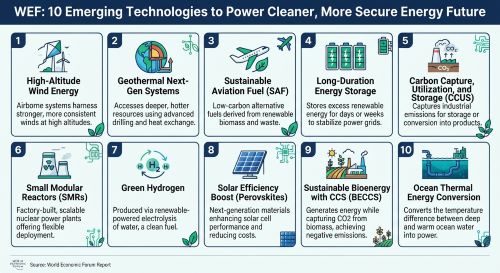
The 10 technologies are:
- Calcined-clay limestone cement (LC3): Cement, the glue in concrete, is produced by baking limestone and clay at extreme heat, which releases large amounts of carbon dioxide. LC3 processes limestone and clay differently and reduces the need for high-temperature processing, lowering emissions from the construction of roads, bridges, homes and other infrastructure.
- Virtual power plants and grids: Software links home batteries, electric cars and smart thermostats so they work together as a coordinated energy system. During periods of peak demand, this could reduce pressure on the grid and limit reliance on carbon-intensive backup generation.
- Abundant materials batteries: Using widely available materials such as sodium, zinc and iron instead of lithium and cobalt, whose supplies are concentrated in fewer countries, these batteries can offer better performance in cold conditions, greater fire resistance and longer-duration storage, helping keep homes and businesses powered when sunlight or wind is limited.
- Thermal energy storage (heat batteries): Heat batteries can absorb surplus or low-cost renewable energy, including wind and solar, and store it as heat in simple materials such as sand or brick. Factories can then use that heat instead of burning gas or coal, potentially reducing emissions and reliance on imported fuels.
- Perovskite-silicon tandem solar cells: These solar panels add a second light-catching layer on top of silicon, enabling them to convert more sunlight into electricity. This could allow homes, businesses and solar farms to generate more power from the same roof area or patch of land.
- Advanced subsea HVDC interconnectors: Undersea high-voltage direct current (HVDC) power cables carry electricity between countries, helping transfer surplus renewable power such as wind and solar power to where it is needed. They could improve energy security and help reduce exposure to price volatility when weather conditions vary between regions.
- Modular nuclear reactors: These are smaller nuclear reactors built in factories and assembled on site, rather than custom-built over many years. They could provide a continuous supply of low-carbon electricity to cities, data centres and remote communities, potentially reducing reliance on gas or diesel.
- Building-integrated photovoltaics: Solar cells are built into roofs, walls and windows, allowing buildings to generate electricity. This could enable cities to produce clean power close to where it is used, without requiring additional land for separate solar installations.
- Floating offshore wind: Wind turbines sit on floating platforms anchored like ships, so they can be placed far out at sea where the winds are strongest. This could open up a new source of clean power for coastal regions and islands.
- Next-generation lithium batteries: These batteries store more energy at lower weight, with some replacing flammable liquids with solid materials. They could extend electric vehicle range, reduce drone weight and improve battery safety.
These technologies deliver the greatest impact when deployed together. For example, subsea cables are more valuable when batteries can store the electricity they carry, while heat batteries can absorb surplus power only when a smart grid can direct that power to them. Together, they could make energy systems more resilient by addressing three interconnected challenges: generating enough power, moving it where it is needed and storing it until demand rises.
Decisions in the coming years will determine whether these technologies deliver benefits at scale. Governments can accelerate adoption through clear standards and purchasing rules, opening electricity markets to household batteries and thermal storage, and investing in infrastructure for wind farms and power cables. These measures can give businesses the confidence to expand manufacturing, build equipment that works across systems and source critical materials from more places.
“Many of the energy solutions we need already exist in labs. The challenge is getting them into homes, factories, and power grids fast enough to matter,” said Frederick Fenter, Chief Executive Editor of Frontiers. “Open science speeds this up by letting engineers, business leaders and governments build on shared research. This report puts trusted evidence in the hands of those deciding how to strengthen energy security while reducing harm to the climate.”
The report uses a multi-stage process, beginning with an AI-enabled discovery tool that screened and ranked 80 technologies against criteria including readiness, deployment potential and planetary impact.
An advisory committee of experts from 10 countries then assessed a shortlist and helped shape the final selection. The process was designed to identify technologies with the potential to move beyond the laboratory and deliver broad, real-world benefits.
















