






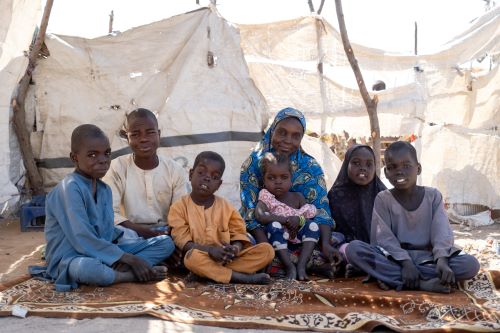


A total of just over US$ 910 million is required to respond to the humanitarian needs of 3.6 million people in need of life-saving assistance in Borno, Adamawa and Yobe (BAY) states in north-east Nigeria in 2025. A total of 7.8 million people are considered to be in need of humanitarian assistance.
The UN Resident and Humanitarian Coordinator in Nigeria, Mohamed Malick Fall, stated that the needs are “driven by conflict, climate shocks, and economic instability”, with the compounding effects of flooding, disease outbreaks, food insecurity and malnutrition deepening vulnerabilities.
Mr. Fall was speaking in Abuja at the launch of the 2025 Nigeria Humanitarian Needs and Response Plan (HNRP), where he was joined by the Federal Minister of Humanitarian Affairs and Poverty Reduction, Professor Nentawe Goshwe Yilwatda, high-level representatives of the diplomatic corps and senior officials from diverse government agencies as well as national and international non-governmental organisations.
Minister Yilwatda highlighted the growing humanitarian needs in north-west and north-central Nigeria. He called for combined humanitarian, development and peacebuilding efforts for that region as well. “This will enable us to get humanitarian efforts translated into durable solutions that can move people out of poverty and provide livelihoods to reach sustainable development,” he said.
Minister Yilwatda said that the restructured Ministry of Humanitarian Affairs and Poverty Reduction was committed to timely, effective life-saving humanitarian responses and poverty reduction. “We will continue to coordinate interventions at all levels, ensuring they align with national humanitarian and poverty-reduction priorities,” he said.
In their remarks, the Governor of Borno State, Professor Babagana Zulum, the Governor of Adamawa State, Ahmadu Umaru Fintiri, and the Governor of Yobe State, Mai Mala Buni, reaffirmed their commitment to sustaining collaboration with the UN and partners to address pressing humanitarian needs and foster sustainable development.
Given declining global funding for humanitarian efforts, the 2025 Nigeria HNRP aims at strengthening efficiency in the delivery of aid. This includes acting before disaster strikes, through anticipatory action to events such as floods and disease outbreaks, to mitigate their impact.
It also aims to increase direct funding to local partners on the frontline of the response and scaling up multipurpose cash assistance, as well as reducing transaction costs.
In 2025, 33 million people in Nigeria will face acute food insecurity during the lean season* with alarming levels of malnutrition threatening millions of children. In the BAY states, 5.1 million people will be affected.
Urgent funding and resources are required from donors and the Government to ensure that food and nutrition assistance and other urgent support is provided to people in critical need.
















