






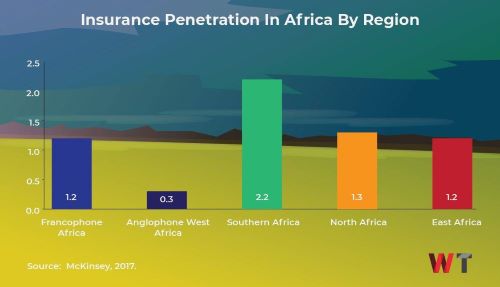


One of the major challenges of insurance business in Africa is low penetration despite the huge population of the continent.
As at 2024, the 54 countries that make up the continent had a total population count of 1.5 billion.
As insurers grappled with this hindering setback to sustainable insurance industry growth, the COVID-!9 pandemic of 2020 came with the promise of digitalisation to scale some of the challenges of reaching the vast majority of potential customers outside the brick-and-mortar model at a relatively lower cost.
In this article, Prince Cookey of Business Journal explores the problem of low insurance penetration in Africa and the promise of digitalisation to close the gap.
Why Low Insurance Penetration in Africa
In 2022, South Africa was reputed with insurance market penetration of 11.3%, the highest on the continent. It was quickly followed by Namibia at 7%; Morrocco (2.1%); Kenya (1.2%) and other countries in Africa coming in at less than 1% percent.
In 2021 however, the penetration level in Africa stood at 2.1%, which was regarded as the second lowest in the world after the Middle East with 1.7%.
In contrast, the United States of America (USA) accounted for the highest insurance penetration in 2022 as the value of generated market premium came to almost 12% of the country’s Gross Domestic Product (GDP).
And for Africa, The Africa Report of September 23, 2024 states that even a ‘1% increase in the insurance penetration rate would automatically lead to a 4.8-point increase in GDP growth on the continent.’
In an interview with New African magazine on the reasons for such low insurance penetration in Africa, Eunice Kinungi, the CEO of Kenya’s Griffin Insurance stated that “insurance, unfortunately, does not have the best reputation, and there is a general distrust of insurance companies perpetuated by poor customer service and unpaid claims.”
According to the Journal of Financial Risk Management, some of the reasons for low insurance penetration in Botswana are poverty and lack of awareness.
In the Journal of Developing Country Studies (2020), the lack of funds for intense marketing of insurance products and services to potential clients was also cited as a reason, But other reasons monitored by insurers include poor legal and judicial systems, lack of qualified personnel, religious beliefs, poverty and lack of awareness as the cited case of Botswana.
Atlas Magazine: Insurance Penetration Rate 2022 in Africa
| Country | 2022 penetration rate | 2021 penetration rate | 2021-2022 evolution | ||||||
| Life | Non-life | Total | Life | Non-life | Total | Life | Non-life | Total | |
| South Africa | 9.1% | 2.2% | 11.3% | 10.0% | 2.2% | 12.2% | -9.0% | 0.0% | -7.4% |
| Namibia | 5.8% | 2.0% | 7.8% | 5.1% | 2.0% | 7.1% | 13.7% | 0.0% | 9.9% |
| Morocco | 1.8% | 2.1% | 3.9% | 1.8% | 2.2% | 4.0% | 0.0% | -4.5% | -2.5% |
| Kenya | 1.1% | 1.2% | 2.3% | 1.0% | 1.2% | 2.2% | 10.0% | 0.0% | 4.5% |
| Tunisia | 0.6% | 1.6% | 2.2% | 0.5% | 1.6% | 2.1% | 20.0% | 0.0% | 4.8% |
| Côte d’Ivoire | 0.5% | 0.7% | 1.2% | 0.5% | 0.7% | 1.2% | 0.0% | 0.0% | 0.0% |
| Algeria | 0.1% | 0.5% | 0.6% | 0.1% | 0.6% | 0.7% | 0.0% | -16.7% | -14.3% |
| Egypt | 0.3% | 0.3% | 0.6% | 0.3% | 0.4% | 0.7% | 0.0% | -25.0% | -14.3% |
| Nigeria | 0.2% | 0.2% | 0.4% | 0.2% | 0.2% | 0.4% | 0.0% | 0.0% | 0.0% |
| Ghana | – | – | – | 0.5% | 0.6% | 1.1% | |||
Digital Economy as Enabler
A key feature of the digitalisation concept in addressing low insurance penetration is rapid mobile connectivity and growing ownership of smartphones in Africa.
A GSMA report of November 6, 2024 stated that ‘by the end of 2023, nearly 44% of the population in Sub-Saharan Africa subscribed to a mobile service, amounting to 527 million subscribers.’
In his publication (African Countries with the Highest Number of Mobile Phones) of July 26, 2024, Kofi Diallo stated: “As of 2024, Nigeria leads Africa with a mobile phone penetration rate of 85%, with 92% of adult males owning a smartphone. South Africa follows with a mobile phone penetration rate of 82%, translating to approximately 54 million mobile phone connections.”
Digitalisation and Insurance Penetration
A recent report by the Oxford Business Group (OBG) states that the conditions for technology-led insurance adoption have continued to improve.
According to OBG, as of the beginning of 2023, there were an estimated 122.5 million Nigerians using the Internet and nearly 194 million mobile phone connections.
The number of mobile Internet subscriptions stood at 152.2 million as of October 2022, up 8.7% year-on-year compared to the 140 million reported in October 2021.
“Nigeria’s insurance sector has been upended by the global growth in digitalisation, meaning that investing in digital infrastructure has become imperative for companies to remain competitive,” Lekan Ajisafe, CEO of Lagos-based insurance company, Post Assurance Brokers told OBG.
“The digital adoption rate has been robust, permeating the entire value chain, and the regulators have taken the initiative by automising their portal.”
A February 25, 2022 Report by Cenfri on Understanding insurance distribution and automation in Africa (Lucia Schlemmer and Nigel Bowman), states:
“Limited digitalisation of the insurance sector in Africa constrains uptake. Less than 10% of adults across nine sub-Saharan African countries have private insurance. The low uptake is in part due to high delivery costs and low levels of digitalisation. African insurers, banks and brokers typically rely on manual processes for selling insurance, onboarding and engaging with clients and settling claims. Insurers also tend to have costly and outdated legacy systems, which limit their integration and automation capabilities with distribution partners, who then struggle to originate and administer policies efficiently.
Digitalisation of processes presents opportunities for efficiency gains. COVID-19 strengthened the imperative for insurance markets to digitalise, as the lockdowns and restrictions in movement constrained insurers’ operations and new sales. In addition, distributors face increasing pressure to lower operating costs, increase productivity, automate tasks and efficiently meet compliance requirements.”
Mr. Akinjide Orimolade, Managing Director/CEO, Stanbic IBTC Insurance Limited (Nigeria) stated in ‘Digitalisation Potential in Addressing the Challenge of Low Insurance Penetration in Africa’ that
digitalisation can significantly boost insurance penetration in Africa in six key areas:
Enhanced Accessibility: Digital platforms can reach a wider audience, including remote areas, through mobile apps and online portals, allowing customers to purchase and manage policies without visiting physical offices.
Streamlined Processes and Cost Reduction: Automation can simplify processes, reduce paperwork, and cut costs for insurers, leading to lower premium products, faster turnaround time and making insurance more affordable.
Improved Customer Engagement and Transparency: Real-time engagement through digital channels helps insurers understand customer needs better. Data analytics and blockchain enhance transparency and trust, with customers able to track claims in real time.
Personalised Products: Digital tools allow insurers to analyse data and offer tailored insurance products, increasing their relevance and appeal.
Education and Awareness: Digital platforms can educate the public on the benefits of insurance using social media, online campaigns, and educational apps.
Fraud Prevention: Improved data collection and analysis through AI and machine learning detect and prevent fraudulent claims, enhancing the efficiency and reliability of the insurance sector.
The Challenge
The lingering question in the market is how far digitalisation can go to solve the problem of insurance penetration in Africa.
Again, the Centri report stated: “However, digitalisation is not a silver bullet. While improved digitalisation and integration can help insurers and distributors overcome many of the challenges faced in distributing insurance, the needs and realities of the markets in which they operate need to be considered. Consumers lack trust in, and have a poor understanding of insurance and often lack the digital skills required to engage through fully remote channels. A digital approach thus needs to be balanced with in-person engagements.”
Conclusion
The Covid-19 pandemic of 2020 has become an unexpected blessing to the insurance sector in Africa. The pandemic created the need for digitalisation which in turn has rapidly assisted underwriters in Africa to rapidly increase insurance penetration beyond the traditional means of providing insurance products and services.
In essence, digitalisation remains the future of insurance business in Africa given the growing numbers of the youth population and digital means of communication on the continent.
















