






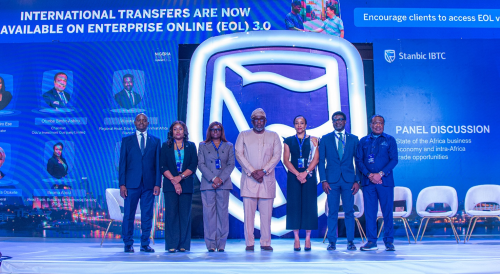


Stanbic IBTC, a leading financial services provider in Nigeria, successfully hosted the 2026 edition of the Nigeria Business Summit from Wednesday, 01 April to Thursday, 02 April 2026, at the Landmark Event Centre, Victoria Island, Lagos.
The two-day summit brought together industry leaders, policymakers, entrepreneurs and stakeholders across multiple sectors to explore sustainable business practices, foster economic growth and unlock global trade opportunities.
With the theme, ‘Nigeria Means Business: Powering Sectors, Growing Sustainable SMEs & Unlocking Global Trade’, the summit addressed critical issues across key sectors, including agribusiness, renewable energy, trade and Africa–China banking, as well as ICT and telecommunications. Additional sessions covered areas such as family business sustainability, artificial intelligence, employee value banking, insurance, pension and wealth management.
The event featured a keynote address by the Minister of Finance and Coordinating Minister of the Economy, Wale Edun, who emphasised the urgent need for Nigeria to reposition itself as a leading export-driven economy to achieve sustained growth.
“Our true potential lies in becoming a leading export economy,” Edun stated. “Increased participation in regional and global trade will be critical to diversifying foreign exchange earnings and driving inclusive growth.”
He noted that while Nigeria’s GDP growth has improved to approximately 4 per cent, it remains below the level required to significantly reduce poverty. According to him, the country’s economic strategy is now shifting from stabilisation to growth acceleration, with trade expansion playing a central role.
Edun highlighted ongoing reforms, including improved foreign reserves, rising non-oil revenues and renewed investor confidence, as indicators of a more resilient economy. However, he stressed that enhancing trade competitiveness would require continued investment in infrastructure, logistics and policy coordination. He also highlighted the importance of small and medium-sized enterprises (SMEs), which account for over 90 per cent of businesses, noting that inclusive growth will depend on stronger collaboration between the public and private sectors.
Participants engaged in a rich line-up of activities, including expert presentations, panel discussions and high-level networking opportunities. Highlights of the summit included the Africa Trade Barometer presentation, client testimonial showcases and insightful discussions on the state of the African economy and intra-African trade opportunities.
Breakout sessions on agribusiness, ICT and healthcare, Africa-China banking and Trade as well as renewable energy provided attendees with deeper, practical insights into some of the most critical sectors driving Nigeria’s economic future.
Speaking at the event, Chuma Nwokocha, Chief Executive of Stanbic IBTC Holdings, represented by the organisation’s Chief Finance and Value Management Officer, Kunle Adedeji, emphasised the importance of collaboration and innovation in driving sustainable growth.
“This summit has reinforced the importance of creating platforms where ideas can flourish and businesses can grow sustainably. By working together, we can unlock new opportunities and drive economic advancement across Nigeria and the African continent,” he said.
The summit also spotlighted practical strategies for integrating sustainability into business operations, encouraging organisations to adopt environmentally conscious practices while maintaining profitability and competitiveness.
Remy Osuagwu, Executive Director, Business & Commercial Banking, expressed satisfaction at the level of interest from participants, a critical element for a successful summit.
“From our conversations on energy and healthcare to the deep dives into trade, Africa-China relations, and agribusiness, Day 1 has offered perspectives that were both insightful and practical. I believe we’re all leaving with a stronger understanding of the opportunities emerging across our industries” Remy said.
He acknowledged the level of engagement, questions, contributions and willingness of participants to share experiences; describing this as the real power of the Nigeria Business Summit, and a solid foundation for tomorrow.
The Chief Executive of Stanbic IBTC Bank, Wole Adeniyi, who was represented by Bunmi Dayo-Olagunju, Deputy Chief Executive of Stanbic IBTC Bank, opened Day Two of the Nigeria Business Summit by highlighting the focus of the summit’s SME Day.
Bunmi said: “Today, we build on Day One’s momentum with conversations that are equally critical for the future – from the dynamics of family businesses to the growing influence of artificial intelligence; the evolution of insurance, and the emerging space of electric vehicle banking.”
She further added, “Our goal on Day Two is simple: to explore what’s next. To understand how these developments will shape our businesses and how we can position ourselves ahead of the curve.”
Stanbic IBTC’s inaugural Nigeria Business Summit stands as a testament to the organisation’s commitment to empowering businesses, strengthening key sectors and positioning Nigeria as a competitive player in the global economy.
















