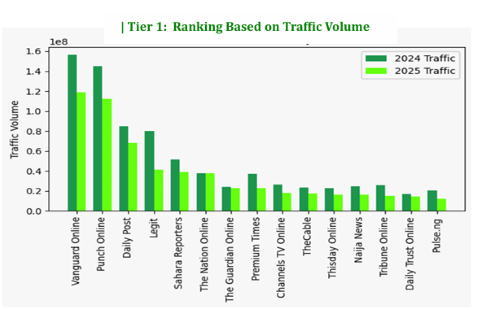


Nigeria’s digital media ecosystem recorded a 26.2% decline in total readership traffic in 2025, according to the newly released SquirrelPR RANKED 2026 Report, signalling a major shift in how audiences consume news and how influence is measured across the industry.
Total traffic across Nigerian digital media platforms fell from over 1.04 billion visits in 2024 to 769 million in 2025, marking one of the most significant structural changes in the country’s media landscape in recent years.
The report notes that this decline does not reflect reduced relevance, but a recalibration driven by artificial intelligence. AI-powered search overviews are increasingly answering user queries directly, reducing the need to visit publisher websites while still relying on those same publishers as primary sources.
“The old model of digital media was built on clicks. That model is breaking down,” said Jonah Solomon, Co-founder of SquirrelPR. “Today, influence is defined by authority, trust, and the ability to shape conversations—even when users don’t click through.”
Delivering the keynote address, Keni Akintoye, CEO and Lead Strategist at KT Communication, described the shift as a fundamental evolution in how influence is created and distributed.
“Influence has not declined—it has evolved,” he said. “People are still consuming content, but increasingly without arriving at the source. In that reality, traffic is no longer a complete measure of relevance. Trust is.”
He added that media platforms are transitioning from destinations to sources of authority within a broader information ecosystem, where credibility determines whether content is referenced and amplified.
The report highlights that domain authority and credibility are emerging as key indicators of influence, as high-authority platforms continue to dominate visibility in AI-driven discovery environments.
Across sectors, performance patterns vary. Legacy news platforms continue to dominate traffic and remain central to the information ecosystem powering search and AI systems. In business media, specialist platforms are gaining traction with more targeted, insight-driven content. Technology media faces the most direct pressure from AI summarisation, while entertainment and lifestyle platforms remain relatively resilient due to their cultural and engagement-driven nature.
Insights from the panel session reinforced the shift away from volume-driven metrics. Múyiwa Mátuluko, CEO of Businessfront, said media organisations must prioritise depth and relevance over scale. Rasheed Bolarinwa, Group Head of Brand Marketing and Communications at Polaris Bank, noted that brands are increasingly focused on conversion, trust, and audience quality.
From the newsroom perspective, Olufemi Ajasa, Online Editor of Vanguard, emphasised that credibility and quality journalism remain central to relevance. Damilola Bright-Ukwenga, a communications professional, highlighted the growing role of creators and micro-influencers in shaping narratives. Ifeanyi Abraham, PR Director at CIG Motors and moderator, described the shift as seismic, urging industry players to reposition for resilience.
The report concludes that traffic alone is no longer a sufficient performance metric, calling for a more strategic, authority-led approach to media visibility.
“PR can no longer be guesswork,” Solomon added. “You need data to understand which platforms truly shape perception.”
SquirrelPR also unveiled SquirrelPR 2.0, an AI-powered PR management platform built for Africa, and SMT Monitor, a media monitoring and social listening platform designed to support more data-driven communication strategies.
The RANKED 2026 Report positions Nigeria’s media landscape not as declining, but evolving into a more complex, AI-mediated ecosystem where trust, credibility, and influence matter more than ever.