








- Major arms imports to sub-Saharan Africa rose 13% by volume between 2016–2020 and 2021–2025, according to the Stockholm International Peace Research Institute (SIPRI), highlighting the region’s continued reliance on foreign military suppliers.
- Morocco, Nigeria and Burkina Faso are expanding domestic defence manufacturing to attract investment, create jobs, conserve foreign currency and reduce exposure to global supply chain disruptions.
- South Africa exported 10.1 billion Rand worth of defence products in 2025, including 4.8 billion rand in ammunition, demonstrating the industry’s export potential despite high production costs and technological challenges.
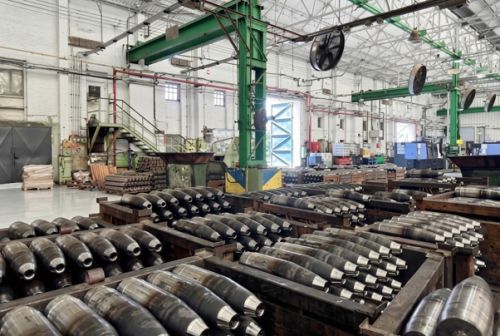
From Morocco to Burkina Faso and Nigeria, African governments are expanding domestic defence manufacturing to retain more military procurement spending within their economies. Local production could create jobs, support suppliers, conserve foreign currency and generate export revenue.
Moroccan Military Industry (MMI) plans to deliver its first turrets to Morocco’s armed forces in March 2027, its chief executive told Reuters on October 8. The company will supply the equipment for armoured vehicles that India’s Tata assembles in Morocco. MMI is also developing an ammunition factory in Sidi Yahya, north of Rabat.
Attracting Investment and Conserving Foreign Currency
Morocco introduced legislation in 2020 to regulate military equipment production by domestic and foreign investors. In June 2024, the Council of Ministers approved the establishment of two industrial zones dedicated to defence equipment, weapons and ammunition.
The strategy focuses on “attracting foreign investment and localising military-related technologies,” Abdeltif Loudyi, Minister Delegate in charge of the National Defence Administration, said on October 7.
Tata inaugurated its Moroccan factory in September 2025, with plans to create 90 direct jobs and 250 indirect jobs. The project aims to increase the share of locally sourced components from 35% at launch to 50% through workforce training and the integration of Moroccan suppliers.
Nigeria is pursuing a similar strategy. The country’s 2023 Defence Industries Corporation of Nigeria (DICON) Act seeks to attract private investment into defence research and manufacturing. Authorities established DICON in 1964 to produce weapons and ammunition.
“By localising production, we save foreign exchange currently lost to imports, which account for more than 95% of security equipment in Africa, and we also reduce our vulnerability to supply chain disruptions and geopolitical pressures,” lawmaker Babajimi Benson, who sponsored the legislation, said in March 2026.
Established Manufacturers Show Economic Benefits
Benson also highlighted the potential for local manufacturing to reduce supply chain vulnerabilities and expand defence exports across West Africa.
South Africa already demonstrates the sector’s export potential. In September 2026, Trade Minister Parks Tau reported that the country exported 10.1 billion rand in defence products in 2025, including 4.8 billion rand in ammunition.
The industry also supports employment and domestic supply chains. Rheinmetall Denel Munition, a joint venture between Germany’s Rheinmetall and South African state-owned defence group Denel, employed approximately 2,500 people and worked with 1,500 direct suppliers, according to figures released in September 2025.
Egypt, another established defence manufacturer, illustrates how public procurement can support technology transfers and local industrial capabilities.
The country ordered four Gowind corvettes from French naval defence manufacturer Naval Group and built three of them in Alexandria through a technology transfer agreement.
Maintenance contracts can extend these economic benefits beyond the initial manufacturing phase. In December 2025, Naval Group announced a five-year extension of its maintenance contract covering seven Egyptian naval vessels, including the four Gowind corvettes.
The company also outlined plans to recruit additional staff in Egypt and said it was holding discussions with local suppliers about their participation in maintenance operations.
Cutting Production Costs and Adapting to Emerging Threats
In Burkina Faso, President Ibrahim Traoré has emphasised affordability and the need to adapt military equipment to local operating conditions.
In September 2026, Traoré said imported armoured vehicles cost nearly CFA500 million ($855,000) each and claimed that Burkina Faso had produced approximately 300 Nanga vehicles domestically.
Authorities describe the Nanga vehicles as locally modified and armoured pickup trucks, reflecting efforts to develop equipment suited to the country’s operational needs. However, available cost and performance data do not provide enough evidence to quantify the savings from domestic production.
Local assembly also remains dependent on imported engines, electronic systems and other components. Governments must therefore weigh potential economic benefits against factory construction costs, technology acquisition expenses and public subsidies.
Long-term financial sustainability presents another challenge. In November 2025, South Africa’s Denel, which had faced financial and governance difficulties, stressed that its recovery depended on securing sufficient orders and maintaining enough liquidity to fulfil them.
Meanwhile, African defence manufacturers must adapt to changing battlefield requirements, particularly the growing use of drones.
South African company Milkor manufactures the Milkor 380 drone in Cape Town for surveillance and combat missions. In Morocco, MMI is developing an anti-drone version of its turret and plans to manufacture its ammunition locally.
These developments highlight the need for sustained research investment and technological adaptation.
Ultimately, African governments will need to assess more than factory openings to determine whether domestic defence manufacturing delivers lasting economic benefits.
Actual deliveries, production costs, orders placed with local suppliers, and the ability to maintain and upgrade equipment will provide clearer measures of industrial competitiveness and long-term returns.
Credit: Emiliano Tossou