






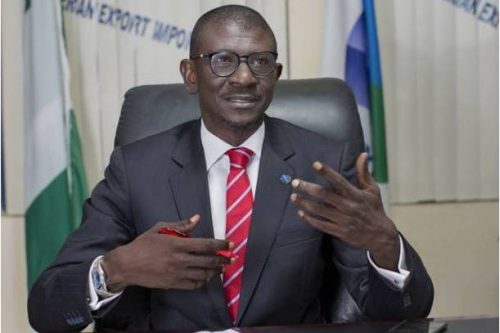


Abubakar Bello
Managing Director/CEO
Nigerian Export-Import Bank (NEXIM)
Mr. Tayo Omidiji, the Deputy General Manager (DGM), Strategic Planning and Corporate Communications at the Nigerian Export-Import Bank (NEXIM), says that plans are at advanced stage by NEXIM to float a regional shipping line to address the challenges associated with relying on foreign ships.
Omidiji made the disclosure at the 2022 Annual Conference of the Finance Correspondents Association of Nigeria (FICAN) in Lagos with the theme “Boosting Domestic Capacity for Sustainable Export Earnings.”
Omidiji noted: “In order to have an efficient port operation, there has to be a regional shipping/carrier so that we do not continue to rely on foreign ones. Hence, the need for us to have our own shipping line. That is why we are working on our own shipping line called the Sealink Project.
He said by the first quarter of 2023, the Sealink Project will be in operation, adding that there is a huge need for more players to come into the domestic shipping sector.
“The idea was to raise funds but a series of things happened, first it was Ebola, we could not find a partnership agreement apart from their contribution in conceiving the idea. In terms of credit, we are quite advanced. We later thought of further expanding the scope of the project in addition to having a shipping project that allows moving our goods on international water. We also felt that we should find adequate scope in inland waterways for the project,” Omidiji further explained.
Meanwhile, an Assistant Director at the Nigerian Shippers Council (NSC), Mrs Adaora Nwonu, has stressed the need to fast-track the full automation of the country’s ports, explaining that this is crucial to boost its export.
She maintained that the cumbersome manual processing of export documents has been having negative impact on Nigeria’s export business, thereby inhibiting its forex inflow from non-oil exports.
According to her, there has been a significant improvement in the country’s ports with the introduction of the electronic call-up system by the Nigerian Ports Authority (NPA), which has reduced the gridlock that usually characterised Apapa Port and its environs and has reduced export time by almost 50 percent.
“We have advocated that we must automate. Automation is the key. When you automate, it takes care of all the arbitrary manual processes. So, we cannot run away from it” she said.
She added that the reduction in the number of government agencies physically present at the ports has also contributed to the current improvement in the country’s ports, noting that automation would further reduce the number of agencies needed at the ports, though the agencies at the ports have been reduced from 14 to 8.
Nwonu argued that the port clearing processes could be streamlined manually with the use of scanners at the ports and address the long manual processes, thereby shortening the time exporters and importers spend clearing their goods.
“We can’t run away from the fact that we need to automate our ports, our processes. We have been doing that to ensure port processes are seamless operations. We ensure documents are exchanged remotely in an automated manner. Every operator at the port right now must automate their processes. We can tell you that as at today, we are at about 60 percent completion. If we have the scanners for example, in less than five minutes, we scan and the data is shared with every other agency. That is what a scanner does.”
She urged the government to build hard and soft infrastructure at the country’s ports to make them competitive and to attract more foreign earnings into the country.
“We at the Shippers Council know that if we don’t export, we will perish. The more trade we facilitate, the more trade that will happen. So- having this at the back of our mind means that we are doing everything within our purview to ensure that we facilitate trade. The more trade we do, the more economic prosperity for us,” the NSC Assistant Director added.
















