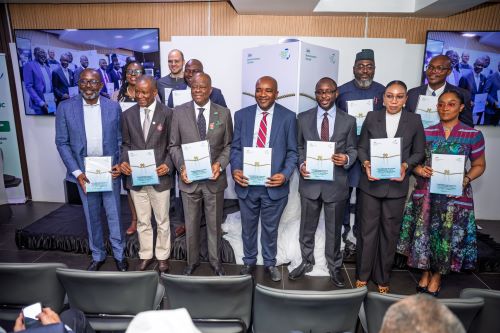


L-R: Mr. Omoboyede Olusanya, Vice Chairman II, Nigerian Economic Summit Group (NESG); Sen. John Owan Enoh, Honourable Minister of State for Industry, Federal Ministry of Industry, Trade and Investment; Mr. Wale Edun, Honourable Minister of Finance and Coordinating Minister of the Economy; Mr. Niyi Yusuf, Chairman, NESG; Dr. Muhammad Sani Abdullahi, Deputy Governor for Economic Policy, Central Bank of Nigeria (CBN); Ms. Nancy Illoh-Nnaji, Anchor/Executive Producer, Moneyline with Nancy on AIT; and Ifeoma Williams, Senior Special Adviser on Strategic Communications, Office of the Honourable Minister of State for Industry, at the launch of the NESG’s Macroeconomic Outlook Report 2026.
The Nigerian Economic Summit Group (NESG) on Thursday, 15th January, 2026 held its 2026 macroeconomic outlook event at the NESG Summit House in Lagos.
The outlook declared that Nigeria has emerged from a prolonged period of acute economic crisis, projecting a stronger growth trajectory as reforms transition from stabilisation to consolidation.
This outlook was unveiled at the launch of the 2026 Macroeconomic Outlook, themed “Consolidating Economic Stabilisation Gains: Pathway to Sustainable Growth in Nigeria.”
While delivering the opening remarks, NESG Chairman, Mr. Niyi Yusuf, noted that while recent structural reforms were necessary, they represent only the first phase of a longer transformation journey. “Nigeria has just emerged from one of the most disruptive adjustment periods in its recent economic history,” he said, adding that “economic transformation is not an event, but a sequenced and perpetual process.”
He stressed that stabilisation alone does not guarantee prosperity, as growth remains modest, uneven, and insufficiently linked to job creation and household incomes.
Whie delivering the keynote address, Minister of Finance and Co-ordinating Minister of the Economy, Mr. Wale Edun, noted that despite the nominal increase in public debt, Nigeria’s debt-to-GDP ratio has declined to 36.1 per cent, one of the lowest in Africa and well below global averages.