






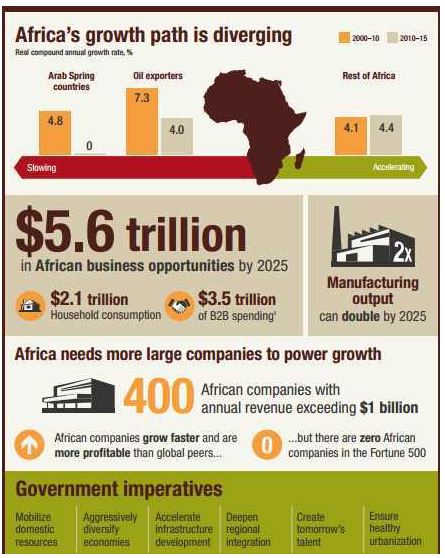


A new book by McKinsey confirms that Africa is poised for economic acceleration, akin to the Asian boom. While other geographies are seeing incremental growth, global companies that get in early and join the African champions shaping the right strategies, can sustain double-digit profit growth over the next few decades.
In Africa’s Business Revolution: How to Succeed in the World’s Next Big Growth Market (Harvard Business Review Press, November 20, 2018) Acha Leke, Mutsa Chironga, and Georges Desvaux detail the research that McKinsey & Company has done and share insights into Africa’s future growth prospects.
The conclusions they draw are distilled from 3,000 McKinsey client engagements, in-depth proprietary research and interviews with 40 of Africa’s most prominent business and development leaders. The authors reveal how companies can better understand the African market and seize the opportunities for building profitable, sustainable businesses.
Major trends indicate Africa is poised for explosive growth
Africa has a fast-growing, rapidly urbanizing population with big unmet needs. This means there is a trillion-dollar opportunity to industrialize Africa, to meet rising domestic demand and create a bridge-head in global export markets.
In addition, there has been a big push by governments and the private sector to close infrastructure gaps. There is a continued resource abundance in agriculture, mining, and oil and gas, with innovation and investment in these sectors unlocking new production on the continent. The rapid adoption of mobile and digital technologies could leapfrog Africa past many obstacles to growth.
Leke and Desvaux, both Senior McKinsey Partners and Chironga, an executive at Nedbank, one of South Africa’s largest banking groups, say:
“With over 400 African companies earning annual revenues of US$1 billion or more, we can identify what works. The highly successful businesses are often African companies, but many are entrepreneurial firms with Western, Indian, or Chinese founders. The most consistently profitable businesses demonstrate a higher tolerance for risk, are eager to adapt their products, production and distribution for African consumers, and commit to investing and building their businesses for the long-term.”
African success stories
The book examines several examples of African businesses that have translated opportunities into enduring business value. For instance, it shows how Nigerian conglomerate, Dangote Industries, industrialised to serve regional markets through import substitution and improved margins through vertical integration. South African retail giant, Shoprite, adapted its supply chain and distribution centres for local logistics. SABMiller created products for regional tastes and invested heavily in multiple markets and skills transfer. Technology driven start-up, Kenya’s M-Kopa, is providing mobile money financed off-grid solar energy kits. The authors also study global companies which have succeeded in Africa for decades, like Coca-Cola, GE, and Total.
Four imperatives to achieve long-term sustainable growth
Leke, Chironga and Desvaux believe that building a successful business in Africa requires a long-term approach and four essential practices:
- Mapping an Africa strategy – setting a clear aspiration, prioritising markets, defining how to achieve scale and relevance and creating an ecosystem to thrive.
- Innovating business models – truly engaging with customers, creating products and services to fulfill unmet needs, getting lean to drive down costs and price points, and harnessing technology.
- Build resilience for the long term – riding out short-term volatility, diversifying portfolios, integrating up and down the value chain, understanding local context and engaging with governments.
- Unleashing talent – developing skills in frontline workers, creating robust talent development processes and harnessing the power of women’s advancement.
Acha Leke says:
“At the heart of these four imperatives is a commitment to doing well by doing good. We have had the privilege of meeting and working with many remarkable business leaders from around the world. What has struck us time and again is how many of them are driven by a deeper purpose. They look closely at Africa’s high levels of poverty; its gaps in infrastructure, education and healthcare, and its governance problems. But they don’t just see barriers to business – they see human issues they feel responsible for solving. They show us that contributing to the social and economic development of the countries within which their thriving businesses operate creates value for both shareholders and stakeholders.”
















