






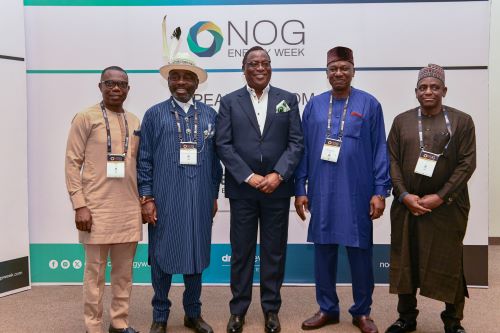


The recently held 2025 Nigeria Oil and Gas (NOG) Conference in Abuja highlighted the pivotal role of the Nigerian Content Development and Monitoring Board (NCDMB) in advancing local content policies and driving Nigeria’s energy sector transformation.
At different sessions at the conference, leaders of the of the Nigerian oil and gas industry lauded the contributions of NCDMB and highlighted the impact the Nigerian Oil and Gas Industry Content Development (NOGICD) Act has played in transforming the oil and gas landscape, emphasising the need for continued support by Government and other stakeholders.
Through strategic initiatives, partnerships, and policy advocacy, NCDMB has empowered indigenous companies, fostered economic resilience, and positioned Nigeria as a leader in regional energy collaboration.
NCDMB’s Strategic Contributions to Local Content
The NOG Conference, spanning June 30 to July 2, 2025, showcased NCDMB’s leadership in implementing local content policies that have significantly reshaped Nigeria’s oil and gas industry.
At the gala dinner, Green Energy International Limited (GEIL) praised NCDMB for enabling the commissioning of the Otakikpo Crude Export Terminal in Rivers State, Nigeria’s first indigenous onshore crude oil export terminal in over 50 years.
With a $400 million initial investment and a projected total cost of $1.3 billion, the terminal, featuring a 750,000-barrel storage capacity (expandable to 3 million) and a 360,000-barrel-per-day pumping capacity, exemplifies NCDMB’s success in fostering indigenous infrastructure development. By reducing evacuation costs by up to 40%, the terminal enhances the economic viability of marginal fields, aligning with NCDMB’s goal of boosting Nigeria’s crude output to 2 million barrels per day.
NCDMB’s “Nigeria First” policy, emphasized by Executive Secretary Engr. Felix Omatsola Ogbe during the conference’s opening, underscores a commitment to prioritising local goods, services, and capabilities across the oil and gas value chain.
Building on the Nigerian Oil and Gas Industry Content Development (NOGICD) Act of 2010 and President Bola Tinubu’s Executive Orders, the policy mandates local procurement unless foreign alternatives are justified, aiming to retain economic value, create jobs, and drive technological innovation. NCDMB is operationalizing this through a “Nigeria First Procurement Policy,” integration into Nigerian Content Plans, and studies to assess local service provider capacities, ensuring transparency and accountability.
The revamped Community Contractors Financing Scheme, part of the Nigerian Content Intervention (NCI) Fund, was another focal point. Restructured to address past inefficiencies, the scheme now offers up to ₦100 million in loans to community contractors, with simplified collateral requirements and partners with financial institutions like FCMB and the Bank of Industry (BOI), to enhance accessibility and participation in the value chain for oil-producing communities. This initiative reflects NCDMB’s dedication to inclusive growth, ensuring host communities benefit directly from energy projects.
The “Back-to-the-Creek” initiative, showcased during the conference, further demonstrates NCDMB’s focus on human capital development. Targeting underserved oil-producing communities, it promotes STEM education, vocational training, and digital skills through digitization programs, heritage preservation, and educational empowerment schemes. By aligning with President Tinubu’s 8-Point Agenda, this initiative aims to create a skilled workforce, fostering inclusive development and economic opportunities in marginalized areas.
Local Content Achievements and Industry Impact
NCDMB’s local content policies have driven a significant shift in Nigeria’s energy landscape, with indigenous producers now accounting for over half of the nation’s oil and gas output, as highlighted by Abdulrazaq Isa, Chairman of the Independent Petroleum Producers Group (IPPG).
The Divestment and the transfer of onshore and shallow water assets from international oil companies (IOCs) to local operators has enabled IPPG members to target 1.3 million barrels per day of oil and 4.5 billion cubic feet of gas by 2027. The successful transfer of assets to local players were enabled by the growth of Nigerian Content in the operating and service sides of the oil industry, as Nigerian operators have shown capacity to play in the big league.
NCDMB’s support for financing, policy stability, and capacity building has been instrumental in this transition, fostering economic linkages and industrialization.
The conference also underscored NCDMB’s role in major infrastructure milestones. Engr. Bashir Bayo Ojulari, Group CEO of NNPC Ltd, highlighted NCDMB’s support for the Ajaokuta-Kaduna-Kano (AKK) Gas Pipeline’s progress, including its successful crossing of the River Niger, with completion expected by Q4 2025. NCDMB’s collaboration with the Nigerian Upstream Petroleum Regulatory Commission (NUPRC) also supported initiatives like the Project 1 Million Barrels, contributing to a production increase to 1.7 million barrels per day, with a target of 2.5 million by 2026.
Also at the NOG, industry leaders defended NCDMB’s local content framework against criticisms that it inflates costs, arguing that its economic benefits, including job creation and GDP growth, far outweigh short-term expenses.
Dr. Daere Akobo of Pana Holdings highlighted NCDMB’s role in projects like Africa’s first digital refinery, emphasizing technology’s role in enhancing efficiency. Mr. George Onafowokan of Coleman Cables and Wires praised NCDMB’s data-driven approach, noting a 56% local content achievement as a significant milestone.
Regional Influence and Challenges Ahead
NCDMB’s local content model is gaining traction across Africa, with Nigeria’s policies serving as a blueprint for regional energy collaboration.
Dr. Ernest Nwapa, NCDMB’s pioneer Executive Secretary of NCDMB, noted that over 16 African nations have adopted similar laws, inspired by Nigeria’s NOGICD Act. The conference highlighted initiatives like the West African Gas Pipeline and the Nigeria-Morocco Gas Pipeline, which position Nigeria as a key gas supplier to Europe. Ghana’s Deputy Chief Executive, Nasir Alfa Mohamed, called for standardized regulations and joint regulatory bodies to enhance cross-border collaboration, while Engr. Farouk Ahmed of NMDPRA emphasised the PIA’s Midstream and Downstream Gas Infrastructure Fund as a model for de-risking investments.
Despite these achievements, challenges remain. Panelists at NOG Energy Week stressed the need for sustained investment in human capital to support Nigeria’s refining ambitions, as infrastructure alone is insufficient without skilled professionals.
Mr. Anibor Kragha of ARDA highlighted Nigeria’s $2 billion expenditure on imported petrochemicals in 2023 as a gap that local capacity development could address. NCDMB’s focus on training and education, through initiatives like “Back-to-the-Creek,” aims to bridge this gap, but scaling these efforts requires broader stakeholder collaboration.
Criticisms of local content policies as cost-inflationary were addressed head-on, with panelists arguing that fragmented data and operational inefficiencies, not local content mandates, are the primary cost drivers. NCDMB’s emphasis on technology integration and data consolidation was seen as critical to addressing these issues, ensuring cost efficiency while maintaining local participation.
NCDMB’s participation at the 2025 NOG Conference underscored its transformative impact on Nigeria’s energy sector. By championing local content through policies like “Nigeria First,” revitalising community financing, and investing in human capital, NCDMB is driving indigenous leadership, economic resilience, and regional collaboration.
As Nigeria aims for 2 million barrels per day by mid-2025 and beyond, NCDMB’s strategic vision positions the country as a global energy hub, with local content at the heart of sustainable growth.
















