






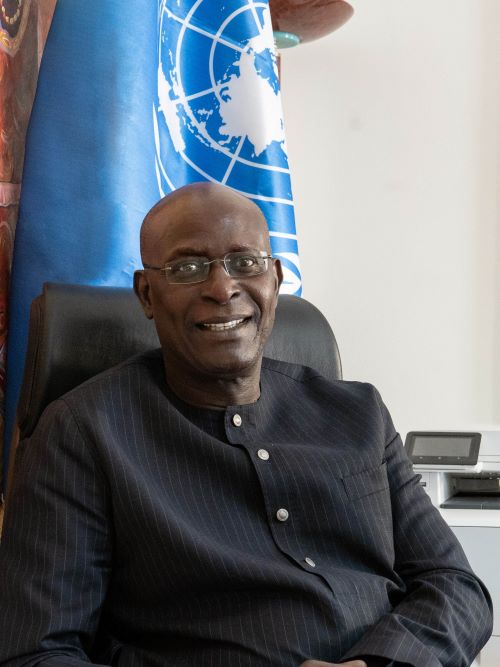


Mohamed M. M. Fall
UN Resident and Humanitarian Co-ordinator in Nigeria
Mohamed Malick Fall is the United Nations Resident and Humanitarian Coordinator in Nigeria. In this exclusive interview, he speaks on the need for a collective response to humanitarian crises in Nigeria, obstacles to humanitarian interventions, and the work of the United Nations, among others. UN OCHA Nigeria’s Head of Public Information, Ann Weru, and Public Information Officer, Dr. Chike Walter Duru, were there.
Excerpts:
Types of Humanitarian Issues in Nigeria
Different types of crises exist in Nigeria; some are linked to conflict and insecurity; there are those that are triggered by insurgency in the north-east, some are linked to intercommunal violence, herders/farmers clashes, abductions, kidnapping, banditry, prevalent in many parts of the country.
In addition, Nigeria has a certain level of climate vulnerability. Sometimes, drought; sometimes, floods; sometimes heat wave, that impact the wellbeing of people and sometimes trigger the movement of people, loss of property or loss of livelihood and they exacerbate the hardship that the people are facing.
How the UN is Responding to the Challenges
The UN has a two-fold response. One is the humanitarian response, which, to me, is guided by the principle of saving lives and reducing vulnerabilities; helping people, not only to get back on their feet, but also to have hope that they can have a better future.
The second component is the one that tackles the root causes of these crises. Most of those root causes are linked to deficits of development, lack of basic services, lack of livelihoods, lack of skills for young people and lack of access to employment. Those require much deeper action, which is building, not only on UN humanitarian intervention, but also on development-related activities, which will be looking at short, mid and long-term projects for the development of those people.
Obstacles to Humanitarian Interventions in Nigeria
We have several of them.
The biggest one is access, and sometimes, access is hampered by insecurity. There are many parts of the country without free and safe access because of the high level of insecurity that is still prevailing. This is valid for the north-east, where, despite all the efforts to push against the insurgency, you still see attacks like the recent ones in Konduga and Gwoza, which are sad reminders that it is not yet over. You have also insecurity prevailing in many other parts of the country.
Sometimes, Access to the People in Need is also Difficult
Funding gaps are also an issue, because, as you know, the world is overstretched by humanitarian challenges. For instance, we have gone past half of the year, but this year’s Nigerian Humanitarian Response Plan is funded below 50 per cent. We launched in May 2024, a Lean Season Plan, which targeted to address the most urgent needs of people affected by food insecurity and malnutrition, but we are in the peak of the lean season, and we have not even reached 30 per cent of the funding we need. If you look at humanitarian funding year by year, you will see that it is declining. The level of response from the donor community is getting lower because of the competing developments across the world. The wars in Gaza, Sudan, and other regions have completely changed the funding landscape for humanitarian response.
The Challenge of Funding
There is a cost of doing nothing. People always look at things from the point of the cost of doing something. Let me take one example. In the Lean Season Plan, we are looking at addressing severe food insecurity and malnutrition. Today, look at the number of children that are malnourished. The survival of hundreds of thousands of severely acutely malnourished children and those at risk depends on urgent interventions.
In the Lean Season Plan, there is a projection of 230,000 children at risk of severe acute malnutrition during the lean season in Borno, Adamawa and Yobe states, alone. Their survival depends on the steps taken against the challenge.
The cost of inaction is that life is on the line. Children that survive acute malnutrition, from the fragile health conditions they have, may also face growth and development challenges throughout their lives. The cost of inaction is very expensive.
Way Forward
I see several solutions around these challenges.
For funding, more innovative funding solutions are required. We must no longer rely on western countries as traditional donors.
A country like Nigeria is not poor. It is among the three biggest economies in Africa. It is increasingly urgent for the Government to allocate its own resources to the humanitarian response.
We also need to be more creative and see how we can make our humanitarian operations more efficient and more effective. There are many directions that need to be explored.
International Laws
Wherever you see conflict and war, it means that there are parties that do not believe in dialogue and in peaceful settlement of disputes.
For instance, the insurgents believe in extreme violence and terrorist actions. This is not peculiar to Nigeria. In the world, there are many wars taking place. Ukraine, Sudan, Gaza, and these are coming on top of previous crises. You have Somalia and Syria. The notion that any difference should be settled through arms and through guns amounts to pushing back on the principles of international laws. Many of the parties to conflict do not respect nor respond to the call of international humanitarian law.
How the UN is Supporting Displaced People and the Most Vulnerable
Whenever you see a crisis, those that pay the highest prices are the most vulnerable – the women, children, older persons, people living with disabilities, and that is why we prioritise them in our interventions. There are provisions in our interventions that prioritise the protection of children. There are also provisions that specially protect women from grave violations of their rights and from sexual violence. The rights of people living with disabilities are also protected.
For me, the humanitarian space is one of the few spaces where humanity has its expression. It is a place where you see actors daily, risking their lives to go and save lives, reduce vulnerability, protect and help people get back on their feet. It is also a space where you see host communities that are lacking in everything sharing the little, they have with people who are suffering or displaced. It is a place where you see Government and non-state actors getting together, to reduce vulnerability and save the lives of people. The work of humanitarians saving lives etc. has just one name – humanity prevailing.
Message for Stakeholders
What we need to reduce the humanitarian needs in the world is for the people to go back to the principle of humanity.
If we act on preventing conflict, stopping conflicts, we will take away a huge number of people in humanitarian need.
At the same time, humanitarian needs are not only triggered by conflict; unfortunately, the way we treat our planet; the way we treat our ecosystems, the way we respond to the climate crisis that we are facing are also important issues.
We also have increased poverty and deeper inequalities. All of these are among the factors that trigger human suffering.
We need to address conflict, increased poverty, the climate crisis, and inequalities. If world leaders continue to push to address these issues and more, we will see a better world.
Members of the public should support humanitarian action. They should understand that it is not about humanitarian organisations and workers alone. It is about the entire society. The call here is the expression of humanity. It is a call to every human being. It takes mobilization, commitment, awareness for every one of us to be part of that humanity.
















