


Harrison Ford: ‘Climate Change is Greatest Moral Crisis of Our Time’

Actor and conservationist, Harrison Ford said climate change presents humanity in the 21st century with its most urgent moral crisis in an impassioned speech at the seventh World Government Summit (WGS 2019) in Dubai yesterday.

Ford said global cities including Dubai, London, Los Angeles and Hong Kong are under threat from rising sea levels caused by warming oceans.

“75 per cent of the largest cities are on the coastline. As oceans warm, sea levels rise – endangering populations, threatening economies and their existence. All of us –rich or poor, powerful or powerless – will suffer the effects of climate change,” the Conservation International Vice Chair, 76, said in front of a packed out plenary hall at Madinat Jumeriah, Dubai.

He arguedwhen it comes to protecting oceans – the world has proved woefully inadequate, stating. “The earth and seas are the legacy we leave our children. In 10 years it may be too late.”

The UAE is the world’s first nation to have a Ministry of Climate Change and Environment, and Minister Dr. Thani Al Zeyoudi introduced Ford.

Ford warned delegates at the event: “We are facing what I believe is the greatest moral crisis of our time. We need to ask governments, businesses and communities to act, to invest in their environment and in our future. If nature is not kept healthy, humans will not survive – it’s as simple as that.”
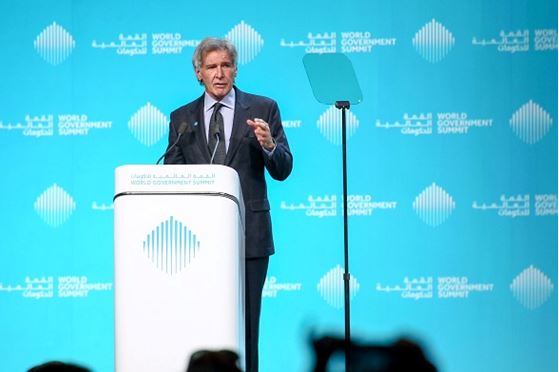
Harrison Ford
Harrison Ford

“If we are to survive on this planet – for our climate, for our security for our future – we need nature now more than ever. Because nature doesn’t need people – people need nature.

“So let’s work together, let’s roll up our sleeves. Let’s get this thing done,” he concluded.

The three-day World Government Summit 2019 runs until February 12 at Madinat Jumeirah in Dubai. The landmark event has convened more than 4,000 participants from 140 countries, including heads of state and governments, as well as top-tier representatives of 30 international organisations.


Hot this week

emPLE, Ecobank Reward Families, Promotes Financial Literacy with ‘Protecting Little Dreams’ Initiative

emPLE Nigeria, in partnership with Ecobank Nigeria, has reinforced...

IPMAN Kicks Against Issuing Licences for Petroleum Products Import

The Independent Petroleum Marketers Association of Nigeria (IPMAN) has...

Stanbic IBTC Empowers MSMEs with Business Growth Insights at Nigeria Business Summit Regional Tour in Ibadan

Micro, Small, and Medium Enterprises (MSMEs) across Oyo State...

NGX Chair: Insurance Sector Needs More Marketing, Digitalisation to Increase Penetration, Contribution to GDP

Remarks by Dr. Umaru Kwairanga, Chairman, Nigerian Exchange Group...

NAICOM Boss Charges CIIN on Professionalism, Ethics, Innovation as Jide Orimolade Emerges 53rd President

The Commissioner for Insurance/CEO, National Insurance Commission (NAICOM), Mr....

Topics

FOR THE RECORD – CONSUMER: King or Servant in Insurance Business

By Chief Yemi Soladoye Technical Adviser, Insurance Consumers Association of...

RE: NPA, BIDDERS AT WAR OVER CARGO SURVEY

The Management of the Nigerian Ports Authority (NPA) renounces...

Sovereign Trust Insurance Reports N10bn Gross Premium in 2018

Despite the challenging economic environment that characterized operations of...

China Southern Airline Orders 787 Dreamliners for $3.2B

Boeing and Guangzhou-based China Southern Airlines signed a purchase...

Local Bourse Sustains Positive Momentum… ASI up 1.1%

Yesterday, the local bourse maintained its positive performance as...

Nigeria Must Rethink Forex Policy to Spur Investment

There is need for Nigeria to seriously rethink her Forex policy to spur investment and quicker economic recovery. At the same time, the country recorded growth of only 3.96% y/y in Q1, 2015, down from 5.9% in Q4-2014, according to Razia Khan, Economist at Standard Chartered Bank, London. She said Nigeria’s oil sector contracted by 8% y/y in Q1, following growth of 1% in the previous quarter. “Decelerating growth was seen across most sectors in Q1, with the exception of crop production. Q2 growth may be slower still, reflecting a slowdown in activity around the elections, and the transition to a new government.”






