






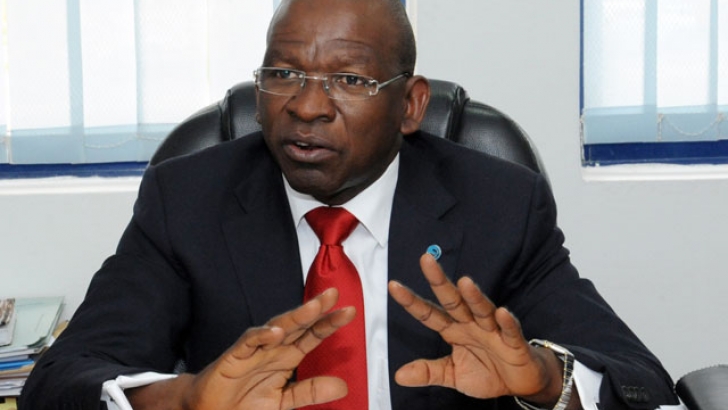


By Roberts Orya, MD/CEO Nigerian Export-Import Bank (NEXIM)
The Central Bank of Nigeria (CBN) has prognosticated a possible economic recession in 2016.
This possible worst outcome of the present slump is something I am sure President Muhammadu Buhari would do everything to prevent. No president wants to be known in history as a ‘Recession President.’ However, this undesirable economic situation can sometimes become a reality, even inspite of the best efforts of a well-meaning leadership.
Exploring the worst case scenario, the following are the factors that, if they conspire together, a recession might become a reality. Of course, this discussion is meant to inspire concerted efforts, including, perhaps prayers, so that we avoid the likely ugly prospect.
The most crucial factor is oil price. If the price of oil falls below $40 a barrel for a stretch of time in the coming months, we would have a very serious economic crisis. Some might say why should this be the case, if the economy is as diversified as the rebased Gross Domestic Product (GDP) showed in 2013; and if oil constitutes just about 15% of the GDP? Therein lies the unfinished work of the diversification of the Nigerian economy.
The diversification we have achieved so far is from the standpoint of a wider base of production, with some new sectors admitted into the GDP calculus for the first time in 2013. From the standpoint of government revenue, however, oil still accounts for 70 per cent of total receipts and over 90 per cent of external earnings.
As a result, the price of oil still wields an outsized influence on overall economic fortunes of the country. At this stage of Nigeria’s economic development, low oil price will definitely depress asset values, non-oil sectors’ performance and overall production. A sharp decline in oil price will generally sap business confidence in Nigeria.
The subsisting dependency, under our worst case scenario, would also erode liquidity and consumption. In fact, these are not just conjectures; they have been at play in recent months of lower oil prices.
The second determining factor is located in the fact that the current weak price outlook of oil is in a loop involving weaker growth in China and weaknesses in economic data from the matured markets. Given that before the current slowdown, the global economy was only at a slow pace of recovery from the last financial crisis, a sharp upward inflection in the global economy is very unlikely in the next two years. Thus, the protraction of a slowdown would have adverse effects in developing economies, including Nigeria. It will take a miracle for this not to happen; but miracles do happen.
The third factor is that President Buhari is fighting an insurgency. The insurgency may have all along been underrated because of its unconventional tactics and the need to project national security.
Therefore, the value in the resolve of Mr. President to end this ugly, growth-sapping insurgency as quickly as possible is well-considered. So, defence will continue to receive a sizeable chunk of the budget until Boko Haram is thoroughly degraded.
Until we achieve this success, some growth-spurring infrastructure would be alternatives forgone with high defence budgets. A facet to this argument is on-going in the United States as well as other big defence spenders of the world.
For Nigeria, defence spending will cease to be zero-sum for growth only as victory is attained against Boko Haram and post-insurgency reconstruction kicks in, or if the budget is spent on military hardware manufactured in the country.
The sum of these is that, with ill-luck, Nigeria can indeed slip into a recession, even if briefly. While leadership may not be able to prevent it, leadership can definitely inspire an economic turnaround that will lift growth above the pre-recession level.
Former U.S. President John F. Kennedy responded to a brief period of recession and high unemployment rate by expanding social security, unemployment benefits and cut taxes to bring the economy back on the growth track. Because Nigeria faces different economic dynamics, our strategies would be different. In the instance of tax cuts, our strategies need to be diametrically the opposite of the early 1960s U.S. reforms.
So where should we start and what is the latitude we have in reversing the current negative trend of economic fortunes?
Where we have to start is where President Buhari has started and maintained focus. We have to raise the level of efficiency in the system. We have to plug revenue leakages. And, of course, we have to rein in corruption.
President Buhari’s holy indignation against corruption cannot but be applauded, and it has been widely acknowledged. These are critical measures that will help economic performance, especially if we assimilate the culture of high efficiency and integrity. But these measures require complementary strategies.
One of the strategic accompaniments is provision of depth for the nascent sectors of Nigeria’s economic diversification.
For Nigerian Export – Import Bank (NEXIM Bank), these sectors are Manufacturing, Agro-processing, Solid minerals and Services. If we disaggregate what NEXIM Bank has in the past five years promoted as the MASS Agenda, we see the strengthening of both manufacturing and agro-processing. The services sector has literally exploded, while the solid minerals sector is the weakest of these four sectors that can help create jobs and non-oil export revenue.
The multi-billion dollar question is where are we to source the financing for the various programmes? But equally important is how to channel the financing. I believe Development Finance Institutions (DFIs) have the aces in providing workable answers to both the “where” and “how” questions.
Over the next 15 years, global resources would be mobilised in funding the Sustainable Development Goals (SDGs). The SDGs will provide the focal points of global financial interventions. A total $500 billion of innovative financing will be needed every year to finance the SDGs between now and 2030. This effectively means we now have a new paradigm for development co-operation.
Under SDGs framework, we will see more emphasis on governments’ collaboration with global and regional DFIs on one hand. On the other hand, DFIs are expected to ramp up co-operation with the private sector.
This would be the pattern for mobilising resources to finance projects whose value would increasingly be seen in terms of poverty eradication, promoting inequality, mitigating environmental risks and supporting inclusive societies. This places DFIs at the forefront of finance in the years to come.
Nigeria is in a unique position to tap into the emerging global finance that would increasingly promote sustainable development. Nigerians now lead the two frontline Pan African Development Finance Institutions. Erstwhile Nigerian Minister of Agriculture and Rural Development, Dr. Akinwumi Adesina assumed the leadership of African Development Bank (AfDB) on September 1. Later that month, another Nigerian, Dr. Benedict Oramah, became President of Africa Export – Import Bank (Afreximbank).
These Nigerians were appointed to work for the entire continent. But their nationality provides Nigeria an opportunity for closer affinity with these institutions beyond being the biggest financial contributor to them. There are important values these institutions offer.
The AfDB and Afreximbank – compared to their global or foreign cousins – are better placed to understand the local context to our development and support country-owned initiatives. This point is validated by Adesina’s pledge to focus the interventions of the AfDB on supporting power reform, agriculture, SMEs and youth empowerment in Africa. This is missile-accurate.
Adesina, like his predecessor, Donald Kaberuka, is poised to making the AfDB catalytic for African growth and for solving Africa’s development challenges, based on deep knowledge of the local context. His work in reforming Nigeria’s agriculture tells how much help he can lend from his new vantage position.
Another area of benefit is expansion of Nigeria’s network within the global community of Development Finance Institutions. I have seen first-hand the importance of this point since my ascension to the presidency of the Global Network of Exim Banks and Development Finance Institutions (G-NEXID) earlier this year. Nigeria needs to network better with the global development community.
The AfDB and Afreximbank are important institutions in expanding capacity for the country’s national DFIs. This would naturally cover sharing project knowledge, joint project development and transfer of funding capacities by the regional DFIs to the national DFIs through establishment of lines of credit.
This will help in channelling interventions more sharply to the areas of need and impact, as national DFIs even understand the local needs better.
Afreximbank has a suite of products and services to help Nigeria facilitate international trade. Nigerian banks and corporates can benefit from the trade support facilities of the Bank. NEXIM Bank has been in collaboration with Afreximbank to unlock more resources in the critical area of growing Nigeria’s non-oil exports. A number of Nigerian export manufacturers have benefitted from this co-operation.
Both the AfDB and Afreximbank are banks of not only the present but also of the future. Afreximbank grew its total assets by 25% in 2014 to $5.45 billion. A much-bigger bank, the AfDB has $100 billion capitalisation.
Both institutions are able to leverage their balance sheets to evolve into much bigger institutions. The AfDB just raised nearly $1 billion in additional resources through its new Africa50 Fund, which has been set up to mobilise long-term savings within and outside Africa to finance infrastructure projects across the continent.
In concluding, one of the greatest economic challenges Nigeria faces is how to economically empower the youth. The answer to this is support for entrepreneurship. Nigerian youths have been actively engaged in business creation. They control the entertainment industry and are expressing themselves in the technology sector.
If we managed to unlock funding for these and other sectors, the doldrums that a recession symbolises would become a possibility farfetched for Nigeria.
The good news is that the DFIs are well-focused and increasingly resourced to support the commercially viable enterprises of our vibrant youths to complement national efforts.
Roberts Orya is Managing Director / Chief Executive Officer, Nigerian Export – Import Bank. He is also honorary President, Global Network of Exim Banks and Development Finance Institutions.














