


Ecobank Deepens Financial Inclusion with EcobankPay Zone

The Managing Director, Ecobank Nigeria, Patrick Akinwuntan, has launched EcobankPay zone at Alaba International Market, Lagos, and expressed the bank’s commitment to continue innovating more payment and financial solutions to best serve traders across the country.

According to Akinwuntan, the bank has designated Alaba market as an EcobankPay zone, meaning that patrons of the market, Ecobank and non-Ecobank account holders, have more easy, secure and convenient ways to pay when they visit the market. He added that  EcobankPay’s unique offering is that anyone from any bank in Nigeria can pay with MasterPass, mVISA and mCASH with any phone by scanning QR code or using USSD.

Traders, he said, can now enjoy more possibilities to grow their business as they can also sell to customers with EcobankPay in 32 countries in Africa. He added that “EcobankPay is free to set up as the shop owner only needs his/her QR code and phone for notifications to start receiving quick and easy payments.
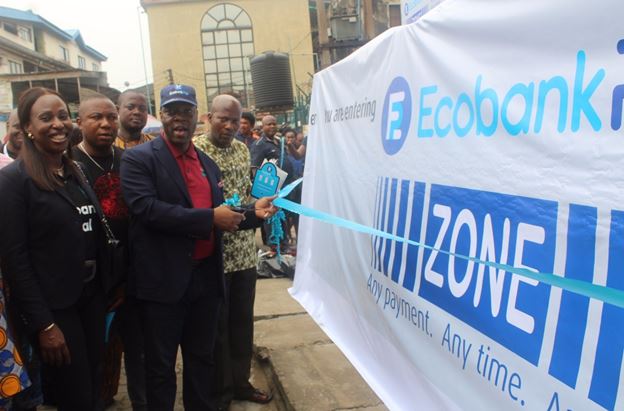
Left: Carol Oyedeji, Executive Director, Commercial Banking, Ecobank Nigeria; Ben Okolie, General Secretary, Alaba International Market Association (Electronics); Patrick Akinwuntan, Managing Director, Ecobank Nigeria; Okwelogu Romanus, Managing Director, Ajuoye Dynamic Concept, (customer of Ecobank) and Jude Esedebe, Managing Director, J-Clax International (customer of Ecobank) at the launch of EcobankPay zone at Alaba International Market by Ecobank in Lagos on Friday.

EcobankPay, a special merchant QR Code product of the Pan African Bank, enables customers make seamless payment for goods and services across the three major payment platforms without the use of plastic cards. The uniqueness of the digital product according to the bank is that it has MasterPass, MVisa and Mcash embedded in the merchant identity QR Code. If the person that wishes to buy goods is coming from a bank that has MVisa and wishes to pay, the same QR Code would accept MVisa payment and vice versa. That creates interoperability and convenience for the merchants. The QR Code is much cheaper than having a point of sale (PoS).

For the merchants, the beauty of EcobankPay is in the cost of setting up, as the shop owner simply prints the QR Code on a paper and can stick it anywhere and do not run any risks. It is convenient and the mobile app is ubiquitous, allowing you 24/7 access and affordabl for every Nigerian.

As a merchant on EcobankPay, you automatically have a QR Code that accepts all the three payment platforms – MasterPass, MVisa and Mcash. Shoppers who used the EcobankPay QR Code are right now treated to special discount transactions at selected shops in Lagos, Abuja, Port Harcourt and Aba.


Hot this week

Sovereign Trust Insurance Receives Recapitalisation Certificate from NAICOM

Sovereign Trust Insurance Plc (STI), one of Nigeria’s leading...

SanlamAllianz Nigeria Launches Proud Moments 2.0, Celebrates Achievements Worth Protecting

Riding on the resounding success of its foundational debut,...

Insurance Meets Tech 5.0 Now Holds on November 20, 2026

Insurance Meets Tech (IMT), Nigeria’s leading platform for conversations...

Sanwo-Olu, Lai Mohammed, Gbenga Daniel to Discuss 2027 Elections, Insecurity at 7th Freedom Online Lecture

Challenges facing the economy and insecurity, especially associated with...

AXA Mansard Intensifies Hepatitis Awareness with Free Community Screening

As part of efforts to promote preventive healthcare and...

Topics

NCDMB, NLNG, Shell, Others for 11th Practical Nigerian Content Forum Dec 5

  Deepening Nigerian Content Opportunities in the Decade of...

NLNG, Petroleum Ministry Inspect Train 7 Project Site in Bonny

From left are Dagogo Buowari, Manager, Nigerian Content Development,...

PwC Report: Real Estate Contribution to GDP Target N2.7tr by 2016

PricewaterCoopers (PwC) has projected the contribution of real estate to the country’s Gross Domestic Product (GDP) to grow by almost N3 trillion in 2016. The accounting firm however said this is dependent on the right environment, which include adherence to global best practices in the sector, transparency and timely delivery on project execution, among others. The sector currently contributes about N1.8 trillion to the GDP. “Going by PWC revelation and the quest to meet the vision 2020 target, a lot needs to be done towards improved public infrastructure to drive the required positive change in the real estate and facilities management industry, in addition to improving the living condition of the average Nigerian.

Businesses Saw Significant Rise in Fraud, Risk in 2016

Fraud, cyber, and security incidents are now the “new...

African Free Trade Body Laments Low Regional Integration

The African Continental Free Trade Area (AfCFTA) marks a...

NAICOM, Stakeholders Applaud Daily Economy, Author at Insurance Book Launch

L-R: General Manager, Production, Punch Nigeria Limited, Mr Olayinka...

NSE Wins Outstanding Invaluable Company Award for CSR

The Nigerian Stock Exchange (NSE) is pleased to announce...






